
A Girl Is a Girl Is a Girl
Female Bodies Between Play and Display
Across different programmes of the 19th Vilnius Short Film Festival, Panagiota Stoltidou encounters films that probe the iconography of female adolescence.
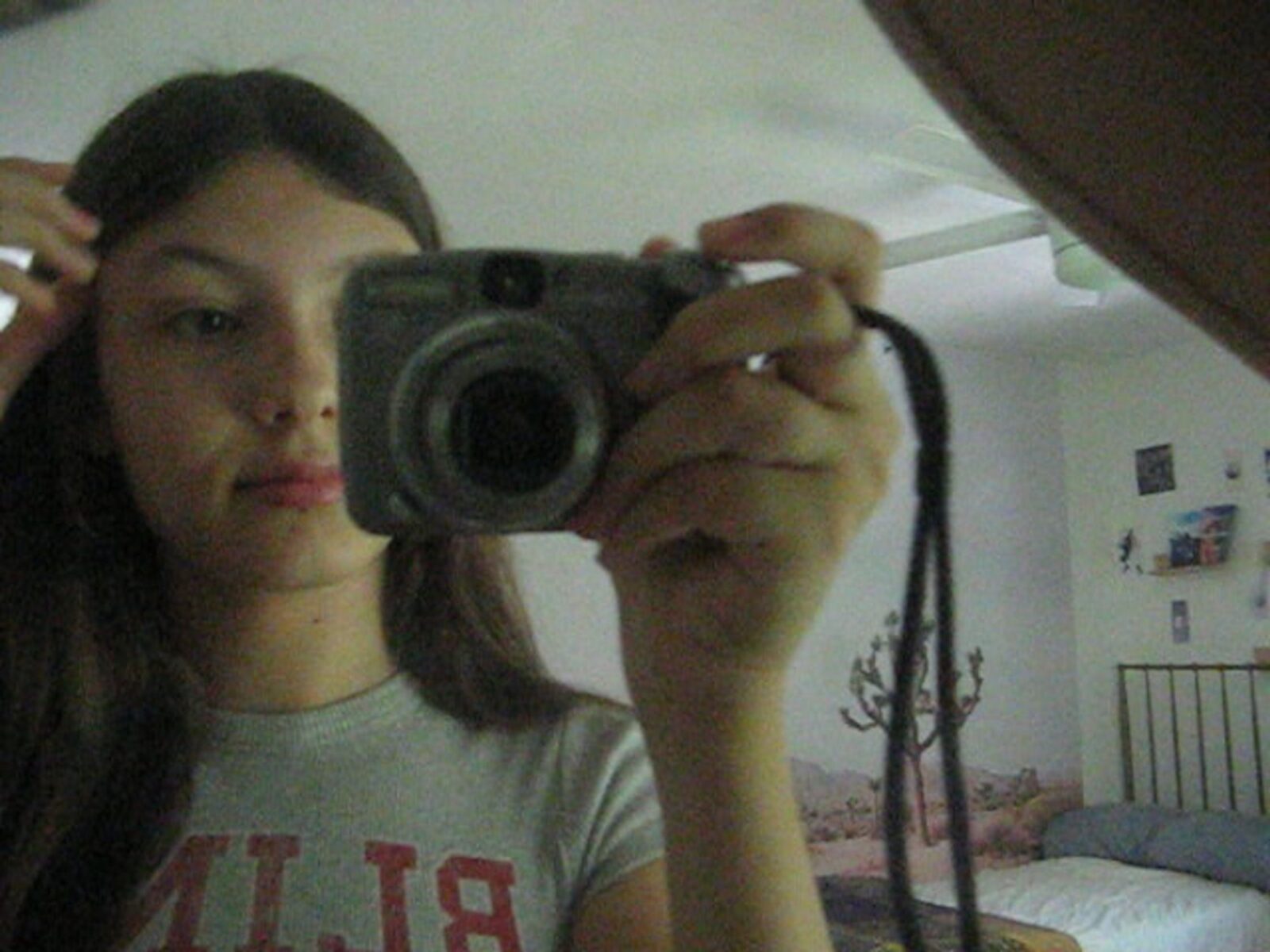
It was my thirteenth summer when I first noticed I was being perceived differently. I had recently bought myself a navy-blue bikini that I thought looked good on me. My theater troupe was organising a one-week excursion to the countryside, where we would spend half of our time practicing for an upcoming performance. The other half we would spend at the beach. Someone had brought along a shabby digicam, and I’d asked our light technician to take pictures of us swimming. When I looked at the photos later, I was surprised by what—who—I saw. It wasn’t me, not who I knew myself to be. The photographs accentuated my chest; half of my face was off-frame. I tried to convince myself that the light technician was an unskilled photographer, or that he simply liked the blue bikini. Why else would he frame me so? I deleted his pictures. Yet they had carved out for me a new way of looking at my body, and I was curious.
How would girls relate to their changing bodies if they were not so obsessively, unceasingly scrutinised? It’s a question woven throughout the international competition of the 19th Vilnius Short Film Festival. Across different programmes of this year’s edition, I’ve encountered girls and young women who were similarly contending with alienating images of themselves. One girl’s experience hit particularly close to home. In Skin Despair (2025), the festival’s Grand Prix winner, Catalan director Mireia Vilapuig recalls a thirteenth summer much like my own, when a digital camera would come to shatter her perception of self. The debut short starts as a series of homemade video vignettes that capture a boisterous teenager’s delight in recording the mundane wonders of daily life, from solitary walks on the beach and city strolls with friends to a dinner of crackers, cheese, and what looks like a whole jar of olives. Yet that’s only half the truth. This filming talent, we soon learn from the voiceover, is not Vilapuig herself but a stand-in, employed to help the director remember. Of her own thirteenth summer, there’s barely any footage left; she’s deleted it all. “I wonder whether I wanted to hide something or simply forget everything.”
At first, we might be inclined to brush off the erasure as a mere symptom of teenage angst. There is, after all, a distinct kind of self-aversion that accompanies puberty, and one that Vilapuig sketches eloquently. She recounts all-too-familiar memories of discomfort from that first stretch of adolescence, a sensation of hurt on her skin and feeling like something inside her was about to explode. The physical changes may come about so suddenly, so brutally, that one is caught in a paradoxical state of being—at once almost unbearably embodied, one’s selfhood reduced to a raging mess of hormones and bodily sensations, and not embodied at all, unable to reconcile one’s memory of their body with the body that now ambushes them everywhere, staring back at them from behind the looking glass.
As is often the case, there is a deep attraction to be found on the other side of repulsion. Like a never-before-seen insect, the changing body attracts as much as it repels, a fact that is implicit in the very premise of Skin Despair. It’s true, Vilapuig once felt a strong impulse to destroy any and all evidence of who she was becoming. But why was that evidence there to begin with? Time and again, the fragments of half-remembered experience that the director attempts to recreate with her stand-in see the latter zooming in on the features of her face, or on her reflection in the bedroom mirror, while she gets ready for an outing with friends. As tends to happen in the lives of most girls, this mirror quickly becomes contested territory, and Vilapuig’s voiceover matter-of-factly relates the inherent contradiction of the mirror-self as object of both wonder and terror. There she was a moment ago, kissing her reflection, “with tongue also,” lips pressed against the cold surface. Here she is now, observing her oily, imperfect skin up close. She’d spend hours in front of the mirror, taking turns admiring and policing her image. Though different in feeling, these attitudes would ultimately boil down to one and the same source: “Looking at myself and not being able to recognise me.”
Yet it wasn’t only mirrors that confronted Vilapuig with a barely recognisable self. Men’s gaze held just as strong an evidence of her changing body. (I think back to the zoomed-in shots of my blue bikini.) It is, of course, no coincidence that the summer the filmmaker ended up deleting her discs was the summer she first became a blatant object of desire for classmates and strangers alike. Everywhere she looked, she was already being looked at. Now, older men would come up to her on the street and offer her candy and compliments. For much of the short, the imagery is paired with details from these first encounters with men, whether in the form of oral recollections or as found text messages overlaid on the screen.
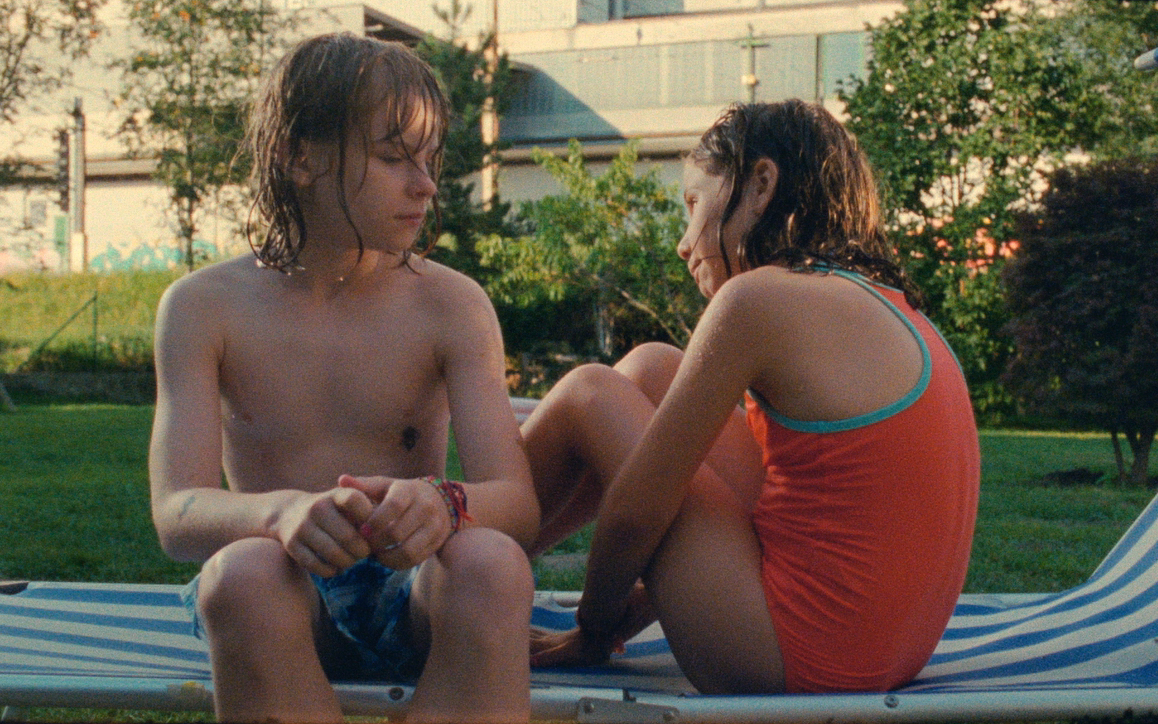
The Swimsuit (Amina Krami, 2025)
Perhaps it’s not so much the sheer, biological fact of an altering physique but these novel gazes that most effectively baptise a girl. And sometimes, this gaze—the label—is given long before girlhood has made itself physiologically legible. In Amina Krami’s The Swimsuit (2025), another international competition entry in Vilnius, we follow prepubescent Noa over the span of a summer afternoon, running around with friends and splashing about in an inflatable swimming pool on the premises of an expansive garden. No older than ten, Noa is a textbook tomboy. From her boys’ swim trunks, rascal energy, and unkempt hair, all the way down to her unisex name, the first half of the film is primarily concerned with weaving an iconography for Noa’s rejection of feminine codes, or better: for the genderless freedom of her childhood. Yet the fun won’t last long. Noa is soon lured into the house with promises of a present, only to find herself blindsided by a red girls’ swimsuit, Miami logo and all. “You are a big girl now. You can’t walk around outside like that anymore,” her mother instructs her. In the time it takes for the eager anticipation on Noa’s face to give way to disappointment, she’s effectively become a girl. The Swimsuit construes coming-of-age as a coming-into-gender, exposing girlhood for what it is: a socially enforced limitation placed upon the movements of one’s body (or, quite literally: a garment to wear).
This is no grand revelation, of course. Since Simone de Beauvoir’s The Second Sex (1949), the understanding of womanhood as but one social interpretation of having a female sex has cemented itself in the cultural imaginary. Being a girl is not a matter of being born but of becoming one, or being made to become one by force. It’s a truth that Krami and Vilapuig understand all too well. But do their films, fluent though they might be in tracing the ritualised hurt inherent in growing up a girl, attempt to disrupt the dominant modes of self-perception that have been made available to us? Or do they merely describe them? In Krami’s film, Noa’s final act of disobedience—implicit in the closeup of her new girls’ swimsuit laying discarded on some corner of the garden—is brief and contained, unlikely to create ripples big enough in the story to convince us of a better fate for its heroine. In other words, this is not an actual escape but the director’s fantasy of one at best, and as such, an indispensable part of the system that it seeks to rebel against.
If these stories of female adolescence are to have subversive potential, and I believe they do, then that must be sought elsewhere. Maybe the way out they offer lies not so much in what they tell, but in how they tell it. Consider Bonita Rajpurohit’s iykyk (if you know you know) (2024). On the surface, this reads like yet another narrative about the everyday tragedies of girlhood, albeit one that is importantly complicated by the realities of trans girlhood. Across six short chapters, we bear witness as the young and ever-hopeful Kusum, played by Rajpurohit herself, goes on a series of dates with men she meets online, each of whom has his own unique way of offending her, sometimes more, sometimes less advertently. From how Felix diminishes her experience of gender transition by comparing it to his own “brave” practice of cross-dressing to how Yashwardhan makes no conversation that extends beyond Kusum’s trans identity, only to then have her perform oral sex on him without her express consent, iykyk is committed to unpacking the casual aggressions that one is subject to when dating men as a trans woman.
Soon enough, these aggressions add up to crucially affect one’s sense of self. “There is a void within myself that can only be filled with this fucking male validation,” Kusum laments to her best friend in one of the film’s most heartrending scenes, but does nothing to reverse the pattern she acknowledges; when we last see her, she’s living in a new flat with a man who barely registers her presence, much less appreciates it. Seen alongside Krami’s concern for the preteen girl and Vilapuig’s focus on the adolescent one, Rajpurohit’s close attention to the trans young woman paints the final brushstrokes on the coming-of-age portrait of a subjectivity that has long been reductively confined to its physical coordinates.
Yet the format of Rajpurohit’s short needs only to be read carefully enough, and then it’s free to tell an altogether different story. Indeed, there is something compelling, intriguing even, about the director’s choice to cast herself in the lead. Her physical presence inside the narrative crafts an indisputable link to reality, the echo of a world beyond the one unfolding on screen. So do a number of other formal devices; for much of the film’s running time, and despite the highly stylised title card, I was convinced that I was watching a straightforward documentary. Whether it’s the true-to-life, improvised performances and the understated script or the naturalistic colour grading and handheld shots, iykyk gives the overall impression of a story plucked directly from everyday life.
It all adds up to a capacious blend of fiction and reality. Rajpurohit’s clear formal gesture towards a life beyond the film—her very own on-screen body yet another conduit for reality—helps sharpen Kusum’s real-world, lived-in edge. In a story in which one is systematically made to feel empty, isolated, or unreal, this matters greatly. Kusum might feel alone in navigating the constraints that men place on her identity, but the film’s docufictional approach is a loud, constant reminder that her story is of this world. In playfully exaggerating a core faculty of all fiction, that is, its intrinsic allegiance to the outside world, iykyk crystallises a cogent blueprint for a more sustainable girlhood: one that is no longer built within the limits of one’s individual perception, but instead feeds from a larger, interpersonal network of shared experience.
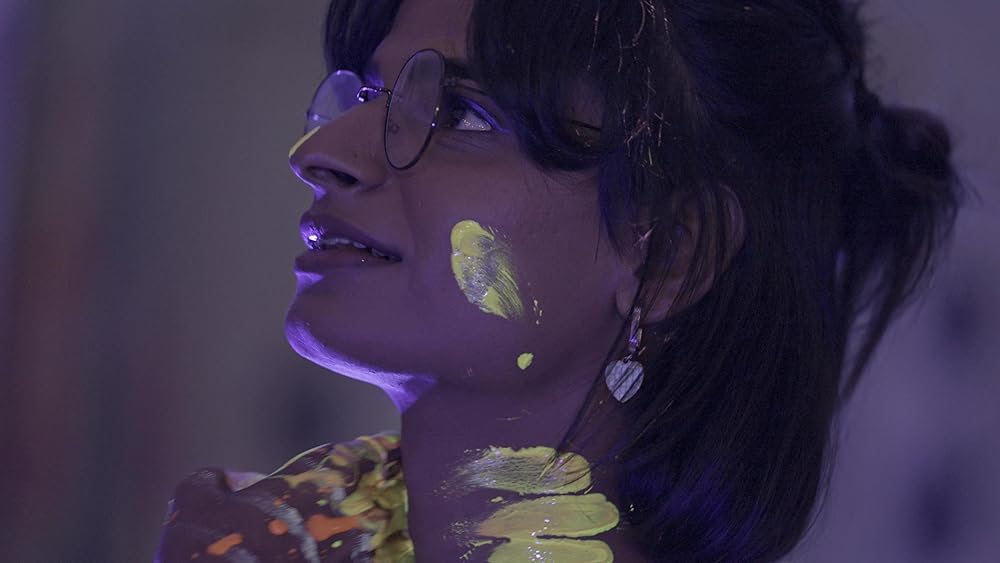
iykyk (if you know you know) (Bonita Rajpurohit, 2024)
Skin Despair also pursues an escape route from girlhood as isolated performance to girlhood as community through the trappings of its format. Intriguingly labeled a documentary, the film has a much more fluid relationship to reality than its tag would suggest. Indeed, while the work does document truthfully, what it documents is not true. At least not in the sense that it actually happened. The film’s reality is, at its core, a fabricated one, insofar as it comprises a collage of two similar yet ultimately separate archives of experience. It’s true, Vilapuig did employ an actor to reconstruct the very specific scene of her own past. But the teenage stand-in doesn’t directly enact Vilapuig’s memories. The director’s voice may be overlaid on footage of her alter ego, yet oftentimes the visual narration rebels, creating distance from the voiceover or eschewing it entirely. In one scene, Vilapuig recounts a breakup conversation with a former classmate, intercut with footage of the actor walking on the beach at dusk. In another, she recalls giving out a fake number to a stranger against the static shot of a scoop of ice cream melting away on the hot cement floor.
Though these unconventional image-sound collations are also, and undeniably, Vilapuig’s doing, there’s an overwhelming sense that her stand-in was at the helm of the visual narration for most of the production. There are two girls at play here, two stories. Within the short’s reality-making mechanism, the filmmaker reveals herself to be less of a domineering ventriloquist than an artful collaborator, looking on as her replacement performs gestures or movements that she knows all too well from her own adolescence yet are also, indisputably, someone else’s. More radically still than iykyk, Skin Despair concocts a female selfhood that is not only fundamentally plural—straddling the aural testimony of one girl and the visual testimony of another—but one that also understands this plurality to be essential to girls’ survival. It is, after all, only through this reaching out, this active distribution of the self into a wider sphere of experience, that Vilapuig seems to be able to reclaim the same identity that, not so long ago, she condemned to silence.
I’ve also chosen silence before. I never told a soul about those pictures from the theater trip, nor did I ever touch the blue bikini in the years since; I felt a shame that only grew larger the more I became aware of its irrationality. Part of why we keep the pains of girlhood a secret is that we feel responsible for them. Communities are crucial to remaking ourselves precisely because they allow us to see our grievances for what they really are: systemic, imposed, and thus detachable. Neither a misstep nor a choice, but a skin to shed. As we pull back the layers of that shame we once thought unique to ourselves, we might catch a glimpse of all the other things that make us girls. I can’t claim to know exactly what those would be. But I get a feeling they would explode girlhood, open it up to as many varied and surprising manifestations as there are girls. World-affirming and self-expansive, these genre-bending films at VSFF make for a luminous companion on the long and arduous descent from the strictures of Girl to the pleasures of girls.
This text was developed during the European Workshop for Film Criticism #8—a tandem workshop set during Kortfilmfestival Leuven and Vilnius Short Film Festival—and edited by tutor Michaël Van Remoortere.
The European Workshop for Film Criticism is a collaboration of the European Network for Film Discourse (The END) and Talking Shorts, with the support of the Creative Europe MEDIA programme.