Animating the Naïve
Maida Srabović on Fačuk
In a God-fearing village lying between two rivers, giving birth to a fačuk—an illegitimate child—is a mortal sin. Everyone in the village recoils from the young pregnant woman who is about to give birth at any moment. The animated Fačuk won the New Critics & New Audiences Award 2026.

A rooster pierces an egg with its beak, spilling yolk across the ground. A spider subdues a butterfly caught in its web. An apple rots on the ground as wasps and ants swarm to devour what’s left of its sweetness. This is the world of Maida Srabović’s animated short film Fačuk, where the unsettling remnants of Croatian naïve art come to life. “I was always horrified by those paintings as a child,” the director tells me over Zoom, describing the naïve art of her grandmother’s village. “The strange proportions, the aggressive colour schemes, the people and animals that looked like tortured zombies. I was genuinely afraid of [them].”
This formative memory has haunted Srabović for decades. The art she refers to is rooted in a movement that arose in the early 1930s in Hlebine, a village in the Podravina region of Croatia, where self-taught artists depicted rural life with an untrained hand and an unflinching eye. These painters adopted unconventional perspectives, used bold colours, and frequently worked with oil on glass, creating what became known as the Hlebine School of Croatian naïve art.
While attending her grandmother’s funeral, Srabović got the idea to make an animated film inspired by these works. “It was November, I was in this small, muddy village; everything was dark and cold. Suddenly, I had this flashback to those paintings”. She assumed someone must have already made a movie in this style, given its importance to Croatian culture, but quickly discovered there weren’t any. As she researched the painters from this region, one figure stood apart. “Most of these artists depicted the same things: rural life, farm work, folklore,” she tells us. “But then I discovered Mijo Kovačić. There was a darker side to his art; it was almost horror-like.” One of the last masters of the Hlebine School of naïve art, Kovačić’s paintings would become the visual blueprint for her short film, Fačuk. His work The Pit, in which three hands reach out in desperation from an underwater chasm, features prominently in Srabovic’s film. “When I saw this painting, it completely captivated me. It evokes the exact feeling I want audiences to have when they watch my film.”
The animation follows a young woman returning to her village, pregnant with a child out of wedlock. The moment she crosses the social threshold, a familiar sensation overcomes her: seeing eyes everywhere, the weight of religious fervour and communal judgement pressing down on her. The nameless village is a place where a woman’s body is never entirely her own. The story is inspired by Srabović’s family, the title borrowed from a word often whispered about her grandfather: “fačuk” is a pejorative term for an illegitimate child. “In Croatia, it’s mainly used as an insult. It’s something you’d never say to someone’s face, but behind their back. “My grandfather didn’t have a father, so I grew up hearing that word a lot,” the director explains. Because of that localism, she struggled to convince her distributor to leave the title untranslated. “They were worried about it being too difficult for [international] audiences to pronounce. But I’d rather the title be misspelled than lose its meaning. It sounds harsh, almost spiky, like the thorns of a shrub. It fits the film perfectly: ugly and rough.”
Developed over a five-year period in which Poland criminalised abortion and the US Supreme Court overturned Roe v. Wade, Fačuk emerged into a world where women’s reproductive rights are being rolled back globally. The film’s story of a woman judged for choices she never truly had resonates beyond its historical setting. “That’s why I wanted the film to evoke empathy,” Srabović says, “to understand how society judges women harshly for decisions they’re often forced into.” Within this context, it’s even more fitting that she channels this critique through the very aesthetic that first terrified her as a child.
If you read a description of what Croatian naïve art typically depicts—lush harvests and bright fields, contrasting hardscrabble rural life with abundance—you have to make an effort to see the troubling effect it may have on a child. It’s art that acknowledges hardship while celebrating the redemptive power of the land. Srabović’s film initially feels like it is subverting this approach. The violence inhabiting Fačuk’s first half is menacing, gestural, but not yet fully realised: we observe as a villager drowns a bag full of kittens in the river while another force-feeds a goose handfuls of grain to fatten it up for market. These aren’t gratuitous moments but glimpses into a society’s relationship with the living world around them; a casual cruelty that extends to the vulnerable woman at the film’s center. “In Kovačić’s work, nature is always threatening,” Srabović tells us. “He lived near the Drava River, where flooding was constant. He both feared and respected nature. I wanted to reflect that.” As we learn more about the village and its people [in the film], the landscape darkens alongside that revelation, becoming desolate, almost apocalyptic.
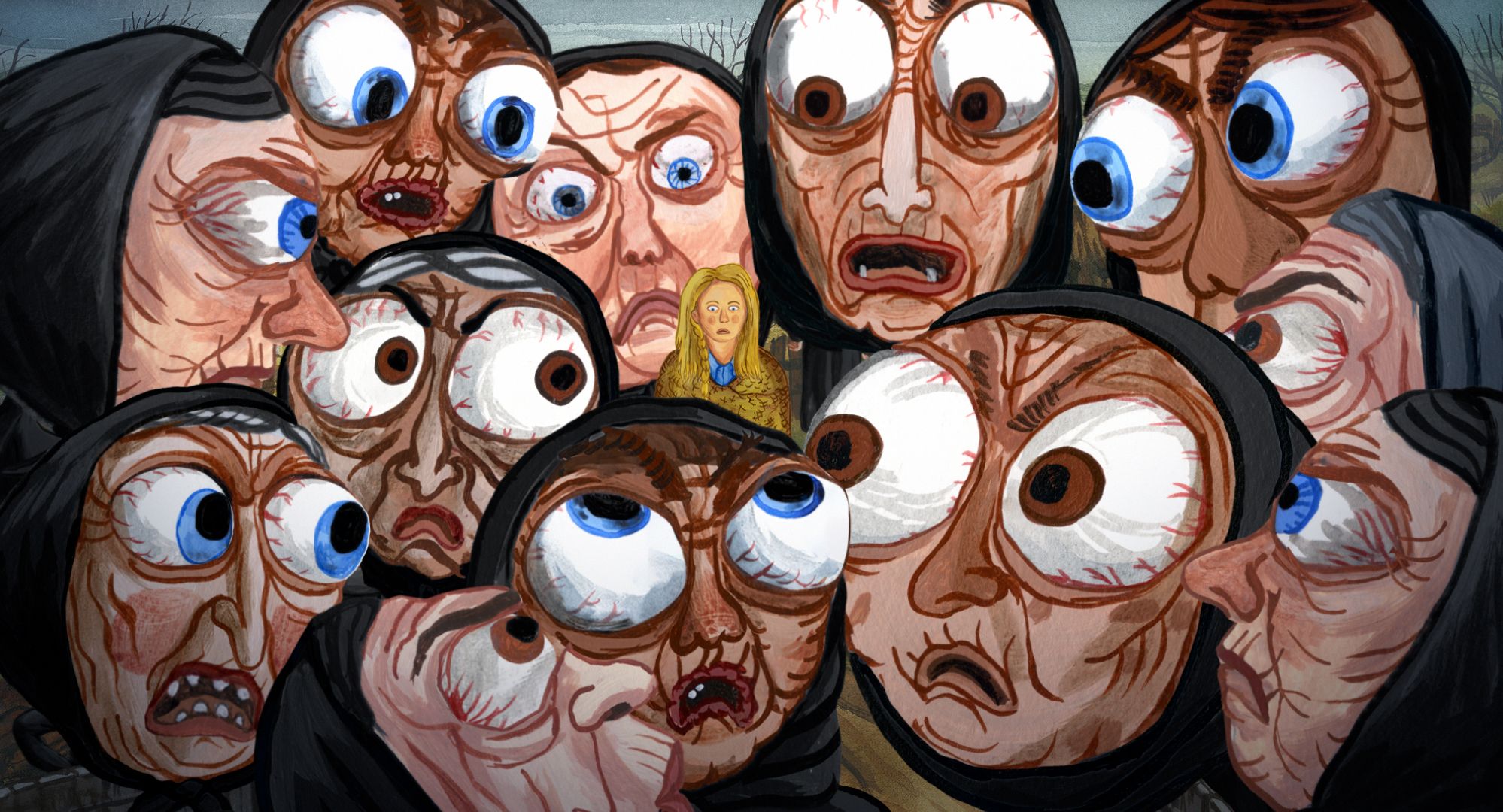
Fačuk (Maida Srabović, 2025)
The concept of illegitimacy, central to its title, runs through Fačuk on multiple levels. Naïve art, celebrated for its authenticity but dismissed for its lack of formal training, has long been treated as the illegitimate child of the art world: too sophisticated to be classed as folk art, too untutored to be taken seriously by critics. Srabović relates to that position. “I don’t come from an animation or art background. My background is in film editing. This was my first time directing, so I struggled with imposter syndrome.” Early feedback only reinforced that feeling. “When I pitched the film, one producer said to me: ‘Why would you make a film in this old naïve style when we have so many renowned contemporary artists?’”
Such a dismissive reaction would only strengthen her resolve. Together with art director Stipan Tadić, a Croatian painter now based in New York whose own work combines the flat perspectives of naïve art with the melancholic realism of Edward Hopper, Srabović developed an approach that embraced this roughness as a virtue. Tadić drew every background and figure by hand on paper; the team scanned his work and used digital cut-out techniques in After Effects. “The concept was: for this primitive painting and primitive mindset, we go with a primitive style,” Srabović explains. The result is unsettling, with figures moving in awkward, jerky motions, as if resisting their own animation. Srabović’s choice of medium could also be seen as a provocation: animation carries its own illegitimacy, too often dismissed as being immature or unserious. Srabović laughs, recalling the Croatian premiere. “I had friends who tried to bring their children! I had to tell them, no! Please don’t! This film isn’t for kids!”
Another reason Fačuk isn’t suitable for younger viewers, in addition to its display of casual violence, is that it doesn’t shy away from the visceral reality of childbirth. In one of the film’s most intense sequences, the pregnant woman’s body literally rips open during labour, an image drawn from old Bosnian folklore. “There are local beliefs that women giving birth ‘fall apart’ internally,” Srabović tells me. Her grandmother used to tell her stories about a dragon that would impregnate women working in the fields. “They would tell the other villagers that they fell asleep with their cows and sheep, and woke up naked, watching the dragon fly away.” The women would then give birth to a shapeless mass of flesh. “They said you had to beat it with a broom and bury it under a tree or in piles of compost, because otherwise the dragon’s baby would come back at night to drink your family’s blood.” These folk beliefs, she notes, reflected how illegitimacy was actually treated. “Women were ostracised, made to feel that what they carried inside them was monstrous. I wanted the main character to have this fear: is what I’m carrying so bad that everyone is against me?”
The film climaxes with a biblical flood that engulfs the village moments after the protagonist gives birth. It’s an act of purifying destruction, but one that could also be viewed as a powerful metaphor for the psychological turmoil that can follow childbirth, something Srabović only fully realised after completing the film. “I experienced this kind of deep depression when we finished the project. My therapist told me I was experiencing post-partum depression because I had just delivered a film.” But the flood wasn’t chosen for its psychological resonance. Water has always been symbolic to her, representing duality: “It gives life, but it can also take it. It’s soothing yet destructive.” In the short, the flood washes away not only the people’s sins, but also the village itself. There’s no redemption here, no quick fixes, only the possibility of beginning again. Srabović’s great-grandmother never got that chance.
“She gave up her baby, my grandfather, because she met another man who didn’t want to raise a fačuk.” For years, Srabović was angry at her great-grandmother for giving up her baby. But over time, she came to question what pressures and circumstances might have led to such an impossible decision. Fačuk, similarly, refuses easy answers. We’re implicated in this village, in its seeing eyes and whispered judgments. But even its most grotesque images pulse with compassion for all things deemed unworthy: the illegitimate children, the untrained artists, and the women who refuse to disappear quietly.
Fačuk was nominated for the New Critics & New Audiences Award 2026 at FeKK – Ljubljana Short Film Festival by Alex Petrescu, Elena del Olmo Andrade, Emily Jisoo Bowles, Hana Kreševič, Hava Masaeva, and José Emilio González Calvillo, the participants of the European Workshop for Film Criticism #7.
The European Workshop for New Curators, and the New Critics & New Audiences Award are projects co-produced by the European Network for Film Discourse (The END) and Talking Shorts, with the support of the Creative Europe MEDIA programme, and in collaboration with This Is Short.