
Archiving as Activism
Interview with Anna Linder
Swedish Archive for Queer Moving Images (SAQMI) director Anna Linder elaborates on the “Imagine Sápmi – Sámi Queer Moving Images” programme they curated for the 2026 Uppsala Kortfilmfestival and the activism rooted in upholding an archive.
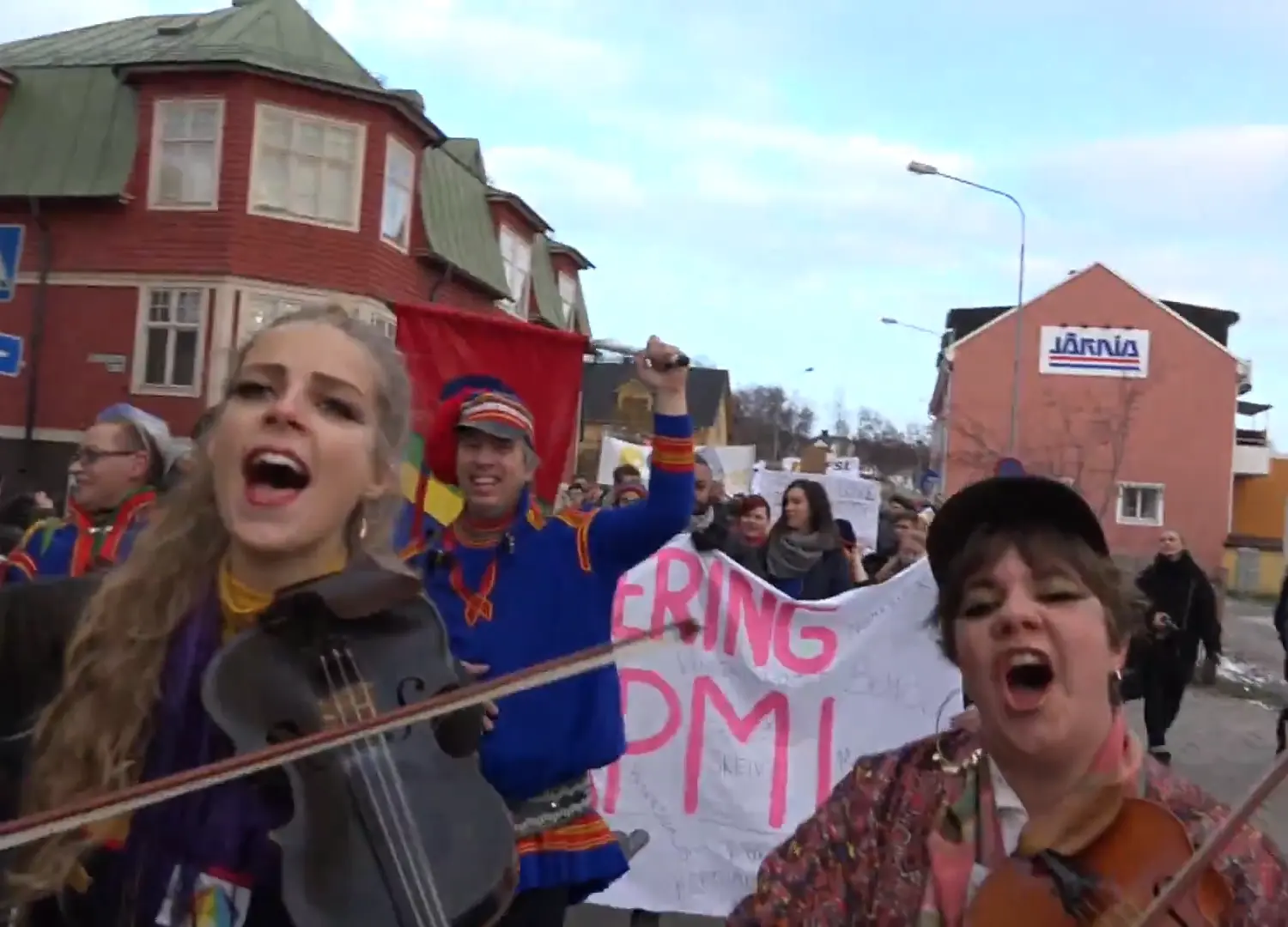
“We’re going to move mountains!” exclaims a marcher in the first Sápmi Pride of 2014, in an interview for the short documentary Sápmi Pride, Gironis (2014). Held in Kiruna (Giron in the Sámi language), Sweden’s northernmost city, the parade assembled 300 people to celebrate LGBTQ+ Sámi identity. Marchers play fiddles and sing at the top of their lungs in this jubilant procession, with some dressed in gákti, the traditional Sámi coat sporting vibrant blues and reds.
An indigenous people with a population of around 100,000 in Northern Scandinavia, the Sámi have long battled discrimination and forced assimilation at the hands of the state. The film depicts LGBTQ+ visibility as inseparable from their fight for self-determination and the preservation of nature. “Diversity is normal in forests, so it should be normal in society,” remarks a participant, dispelling any notion that queerness is unnatural, or incompatible with Sámi culture.
Sápmi Pride, Gironis screened as part of the “Imagine Sápmi – Sámi Queer Moving Images” programme curated by Anna Linder for the 2026 Uppsala Kortfilmfestival, held in the Swedish city from 19 to 25 October. Ranging from amateur documentaries to an extract from a TV series, the five short films map a constellation of Sámi queer image-making and grassroots activism over the past quarter century. In an interview over Zoom a few days after the festival, Linder speaks about their approach to programming the selection and what they find most important: “to work with an intersectional perspective, and connect historical works with contemporary ones.”
Linder is the director of The Swedish Archive for Queer Moving Images (SAQMI), which they founded in 2017. “I was researching experimental feminist queer moving images at the University of Gothenburg and was surprised to find that no dedicated collection for queer moving images existed in the world at the time.” Linder continues: “Starting SAQMI stemmed from my longing to see more queer films from Sweden, and to make them accessible to others.”
Over the past decade, they have engaged in meticulous detective work to track down and catalogue queer films not held in the national archives, the earliest of which include documentation of Gay Liberation Week in Stockholm in 1979. In lieu of existing infrastructure, they have built their own network of filmmakers, historians, and volunteers from the ground up, all of whom contribute to sourcing and preserving these works. The archive expands as old and new films alike are added to the collection, one that is continuously activated through screenings with local pride events, film festivals, and institutions such as Anthology Film Archives in New York.
Within SAQMI sits Imagine Sápmi, itself a living archive, with a focus on Sámi queer films. “The name is a play on words,” Linder explains. “Sápmi is the cultural region inhabited by the Sámi people, but it sounds similar to SAQMI. The title is also inspired by the indigenous film festival ImagineNative in Toronto. Linder has a Sámi background, and had dreamt of creating this dedicated section since the early days of SAQMI. Initially, they presented three Sámi film programmes at the Sámi Week in Umeå in 2012 and later that year at The Modern Museum in Stockholm for Tempo Documentary Festival, but struggled to find a home for them afterwards.
“I had done all this research and had all this material, but no one wanted it, not even the Sámi Film Institute (known as Sámi Film Centrum at the time).” That’s when they started their own initiative. “Sweden isn’t great when it comes to queer or Sámi-related issues, so it was difficult to get any funding.” Unfazed by the systemic barriers, Linder gathered an advisory group* of scholars, filmmakers, and activists to collectively develop the Imagine Sápmi archive, a plurality of voices that is reflected in the films themselves.
The Imagine Sápmi programme at Uppsala Kortfilmfestival opens with Queering Sápmi (2013), a short film made by the eponymous landmark project that ran from 2011 to 2015. Testimonies by Sámi queer individuals recounting their experiences of isolation and first love are layered over images of icy tundras and snow-topped villages. The voiceover format preserves the anonymity of the participants, but it also hints at what queer stories might be cloaked in the thick Sápmi snow. “We have always existed and will always exist.”
Rather than a chronological order, the films slip fluidly between timelines, spotlighting queer Sámi joys and struggles on both an individual and a collective level. While the first two films, Queering Sápmi and Sápmi Pride, Gironis provide context on local initiatives, the middle two, Okto Alene (2010) and Lesbisk i Kautokeino (2001), hone in on specific Sámi lives and communities.
Okto Alene unfolds like an episode of TV news, taking the story of Lemet, an 18-year-old bullied for being gay, as the point of departure to investigate homophobia in a rural Sámi village. The documentary traces the backlash through the domestic sphere to the political arena; from Lemet’s sister lamenting how she was bullied by association, to the leader of the Network for Gay and Lesbian Sámi discussing their lack of funding, a scene that cuts to a representative of the Sámi parliament calling the network “unserious”. Through its weaving of interviews, the film attempts to understand diverging points of view, envisioning a future where denizens might coexist even in discord.
At the heart of the programme sits Lesbisk i Kautokeino, the first film Linder selected for the screening and its longest at 26 minutes. The documentary follows Marit, a Sámi lesbian, as she returns to her hometown Kautokeino, having moved to the city with her girlfriend after facing death threats. On the journey up North, she makes a pit stop to visit Berit Sara, a lesbian reindeer herder who has just come out of the ‘fridge’. Flirting ensues, and Sara flexes her skills by throwing a lasso around Marit’s friend to mischievously reel her in. Despite the dearth of potential love interests on the tundra, Sara has no desire to leave, seeing no contradiction between her queerness and indigenous way of life.
“We knew this film was on a VHS tape, but we couldn’t find it anywhere. It was listed in a catalogue for a library in Norway, but the copy wasn’t there. It took a year for the filmmaker to reply to me, but once he did, he was happy for us to screen it.” Linder elaborates: “You have to know that a film exists in order to find it. Most of the time, it screens a few times and gets shelved, then everyone forgets about it.” Thanks to the tireless archiving of Imagine Sápmi’s advisory board, this vital fragment of Sámi queer history continues to circulate today.
Linder likens the process of assembling these fragments to DJing: “I try to mix genres when programming around a specific theme. It can be boring to watch the same type of short film five times in a row, especially when the topic is so heavy. I love music videos, so I often include them in my curation to wake the audience up.” In a similar move, they end the film programme on an upbeat note with a brief extract from Oro Jaska (which means ‘shut up’ in the Northern Sámi language), an Emmy-nominated fiction TV show released in 2024, and the first Sámi series to address queer identity.
The clip opens on Issát, a queer Sámi teenager, revving up a snowmobile for a race that could win him a ticket to America. After a nail-bitingly tense chase, he emerges victorious from the flurry and kisses his boyfriend in front of the crowd. “Fuck the USA!”, he exclaims, “I don’t need to go anywhere to show people who I am.” Issát’s defiance echoes that of Berit Sara, a thread of queer Sámi solidarity that unspools across a generation. “By including something more recent, I wanted to show how the situation has improved for queer Sámi people,” explains Linder. “That’s also reflected in the form: now we have TV shows, not just grassroots documentaries.”
Screenings like “Imagine Sápmi” are crucial sites for encountering underseen perspectives and cultivating exchange between filmmakers, curators, and audiences. Yet Linder reminds us of the unglamorous labour undergirding them. “There’s so much admin and logistics like print traffic and subtitling to sort out, and I end up doing a lot of it myself.” They go on: “I would love for SAQMI to have paid positions for a dedicated archivist, a technician, and a communications officer, but we don’t get any funding for that. We’re not seen as a real archive.” The rise of right-wing parties in Sweden has made it increasingly challenging to receive grants for queer and Sámi projects. “I’ve been working at 100% capacity at SAQMI for 10 years,” they sigh, “we submit so many funding applications, but I don’t know how we will survive in the future. But I don’t want to give it up. We get so many positive comments and people who want to partake. It’s a lot of fun; I just love it.”
Linder is looking ahead undeterred. A complete timeline of Sámi queer films in the SAQMI catalogue is currently under construction, to be completed in 2027 in time for the archive’s tenth anniversary. The curator also sees this initiative as “a great way to get people involved; they can volunteer to upload the data online, or submit a film. We don’t even need the film file; even a single film still is proof enough of its existence.” SAQMI’s next film project will be a collaboration with QRAB – The Archives and Library of the Queer Movement, shining a light on Sweden’s queer punk scene: “They don’t believe in doing anything commercial, so most of the documentation is done by the community itself.” This punk spirit also illuminates the “Imagine Sápmi” programme: a testament to the queer community’s ability to build grassroots infrastructure and document it on their own terms.
* The advisory group for the Imagine Sápmi project included Levi Karvonen, Kata Kyrölä, Sara Lindquist, Timimie Märak, Stina Nilss, and Liselotte Wajstedt.