
Baby Crack
The Joy of Being
A one-year-old discovers the world: with a curious, carefree gaze, everyday moments become a poetic journey of discovery. But the idea of constructing a narrative that encapsulates the things the filmmaker most admires from childhood gets in the way of genuine exploration.
A Onesie-clad, rosy-cheeked toddler is eyeing himself in a full-length mirror. Crowning his seventy or so centimetres is a comfortably cushioned GoPro rig, its lens bulbously swelling and slinking as the toddler moves his head to and fro his reflection, reaching to fondle the camera before being gently intercepted by a parental hand telling him to just leave it be.
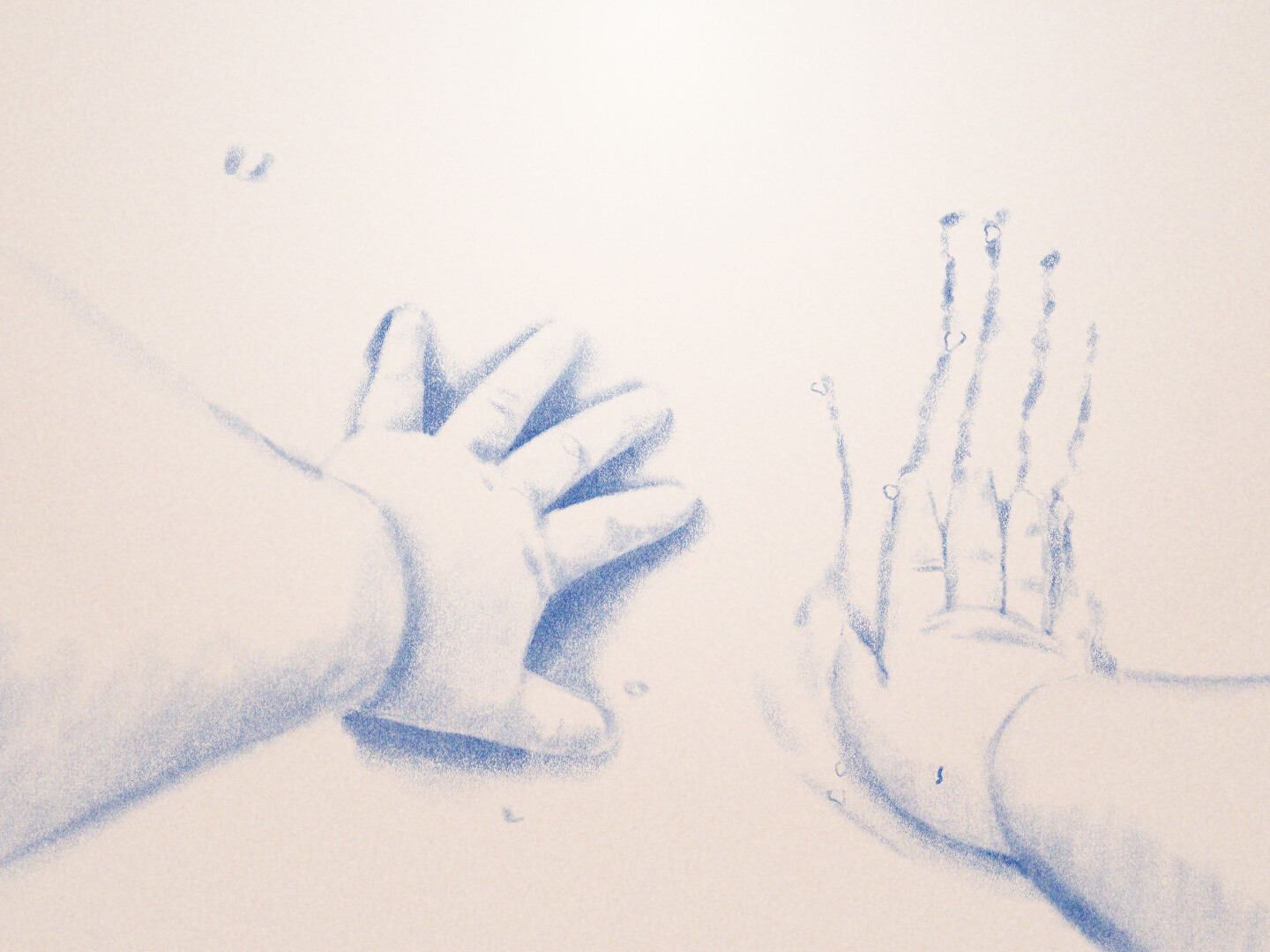
In her graduation project The Joy of Being (2025), Danish filmmaker Emma Bruun Ruus sets out to offer a glimpse through the curious, carefree and magical eyes of her one-year-old Balder: to capture his point of view by mounting a camera on his head, fulfilling the widespread wish to return to a more playful interaction with one’s surroundings, the unbothered child as a mediator between time, things, and audience.
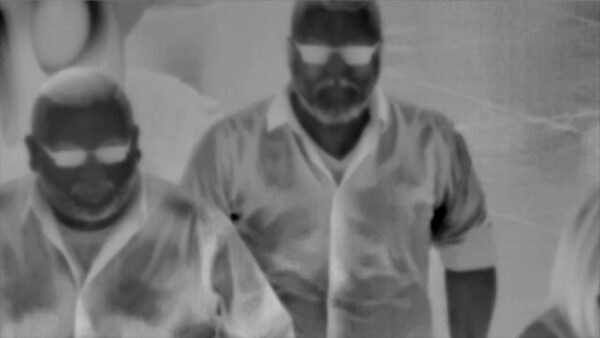
The Balder-cam footage is not shown in its raw form. Instead, the framerate is curtailed to a nostalgically undercranked jitter, the remaining images painstakingly rotoscoped and abstracted until there’s little left but off-white highlights and cyan shadows contouring the many things Balder stumbles across. With the whole world folding in on itself, bliss becomes abundant: daisies on invisible stems, swaying in a gentle coastal breeze, eager bees landing on their pistils, pigeons rummaging for food scraps on the uniformly creme plane of a town square. The softly cooing baby takes it all in: through him, objects and encounters are stripped of any meaning or association that extends beyond the word that describes them and any immediate emotion they might evoke: dog, yay.
To be engulfed, to dive headfirst and be completely and utterly captivated with whatever is at hand, this is peaceful, thus Balder’s life is peaceful. “Through Balder’s gaze, everyday life is transformed into a poetic journey of discovery, where every sound, shadow, and touch is met with wonder,” the film’s synopsis on the website of The Danish Film Institute reads. This feeling of wonder is portrayed as being the result of the toddler’s limited engagement with what surrounds him; his delightful inability to contextualise spatially, temporally, or emotionally. The all-too-familiar amalgam of regret of the past and fear for the future dissolves once transported into a mind that’s gloriously unoccupied with either; tethered to the here and now by its sheer lack of awareness of an alternative. Balder’s humble affairs are so uncompromisingly rooted in the tactile that whatever isn’t in reach of his stubby little hands literally disappears into irrelevance, taking the form of flat-out absence.
At any given time, The Joy of Being shows nothing that does not pertain urgently to the experience of the child, or that he cannot yet make sense of; the depiction is a world entirely devoted to him, and, considering where he is developmentally, rightly so. Only one scene momentarily breaks the pleasant homogeneity: having lost track of his parents, Balder finds himself surrounded by blotchy blue silhouettes striding past him, detailless in their otherness, hostile in their not belonging. Briefly, Balder’s unfamiliarity with what he sees does not spark joy or curiosity, but instead instills fear and a primal sense of danger. The transformation of shape through emotion hints at layers that are otherwise left unexplored: the ineffable mechanisms of a child’s imagination, and their often terrifying inability to make sense of the world they’re a part of.
Despite the beautifully crafted and undeniably touching experience, there’s a sobering realisation that Balder’s point of view might not capture anything more profound than his approximate eyeline. What’s being presented as a child’s uninhibited gaze on—for lack of a better term—everything, is in reality, an adult filmmaker’s testimonial of what they expect or hope this perspective to look like, conducted and art directed to the absolute bone. There’s a reverence for the child’s perceived innocence that is communicated throughout The Joy of Being, the title alone is forthright enough, with the aim to allow grown-ups to revel in this serenity that they feel they’ve outgrown, yet perhaps this bliss solely exists because of the adult frame of reference.
Because to conjure up this desired child-like state means to mold it, to curate the moments, angles, and reactions that are in accord with the ideal of the pure, wondrous child. The idea of constructing a narrative that precisely encapsulates the things the artist admires in childhood gets in the way of genuine exploration. Seemingly unwilling to deviate from the preconceived path, the work becomes priggish. It’s a question of either governing the artwork from above or approaching it from equal grounds: in the former, does Balder really have all that much to do with what is shown? Is this a film about Balder’s experience or a means to indulge in nostalgia that’s dependent on a highly optimistic and exceedingly selective idea of a child’s consciousness? When push comes to shove, is the babies’ purpose anything other than a supposed certificate of authenticity of Bruun Ruus’ own artistic vision? That the filmmakers are also Balder’s parents—Dad Louis Emil Ramm Seeberg edited the film—adds a layer of syntheticity that is hard to see past; not only do the makers control the narrative after the fact by collaging the shot material to their liking, but they were also even at the helm of the shooting itself. Call it cynical, but it’s hard to shake the image of the parents hoisting Balder up on one shoulder, pointing him at subjects of interest in order to get the shots they have in mind.
Regardless, the film remains capable of real emotional impact. Even if this is not to the credit of Balder’s consciousness, but the clarity and craftsmanship of Bruun Ruus. To distill the coveted qualities of childlike innocence and transpose them to the screen in a way that so accurately conveys what the mature heart oh so yearns for. It’s a remarkable cold splash in the face, often paired with witnessing something sublime or horrific; the lifting of a veil of sorrows that’s suddenly so pedestrian and fleeting it’s downright embarrassing that it was there to begin with. Though the question remains: Do I really need a baby to see a bee, in order to… see a bee?
This text was developed during the European Workshop for Film Criticism #8—a tandem workshop set during Kortfilmfestival Leuven and Vilnius Short Film Festival—and edited by tutor Michaël Van Remoortere.
The European Workshop for Film Criticism is a collaboration of the European Network for Film Discourse (The END) and Talking Shorts, with the support of the Creative Europe MEDIA programme.



There are no comments yet, be the first!