
Bedside Terrors
happiness
In this desktop documentary, Fırat Yücel chronicles the activism fatigue of a group of activists, eyes fixed on screens as they follow the news from Palestine and across the region. happiness was nominated for the New Critics & New Audiences Award 2026.

The archetypal figure of the modern age was the nonchalant flâneur, drifting through crowds in an intoxicated state, as per Charles Baudelaire and Walter Benjamin. Our internet-driven, techno-capitalist present, governed by the logic of postmodern warfare, might be best embodied by the doom-scrolling insomniac—alone, restless, and overstimulated by the crushing flux of images and sounds. Anchored in the aesthetic and technical devices of the desktop essay format, filmmaker and video artist Fırat Yücel’s happiness (2025) introduces us to this particular character. The experimental short incorporates a multitude of websites, platforms, and applications to mirror the spiraling psyche of this screen-bound individual.
About the individual in question, we don’t learn much—other than they live in Amsterdam like Yücel himself, have trouble sleeping, and are actively following the political struggles around the world on their social media feed—so much we glean from recordings of computer and phone screens that make up most of the film. Through a diaristic narrative spanning roughly a year and composed of sparse textual entries being typed out on a black backdrop, happiness conveys both the intimate perspective of a first-person voice and a shared, collective experience—that of the frustration arising from the limited scope of political action available to a distant observer.
It is a condition which Yücel himself arguably identifies with, yet one he portrays in a slightly critical manner through the suggestive use of narration, fictional or auto-fictional. To what extent his narrator plays a self-referential role, however, remains unclear. In any case, the concerned cyber-activist from the Western world emerges as an ambivalent political force—a force that, when confronted with their inner frustrations, reasonably compels us to ask: why would anyone care about the sleeping difficulties of a person living in Amsterdam while the entire Palestinian population is threatened by a live-broadcast genocide? And what is staying awake, if not a minimal concession, when millions outside of Europe are struggling on a daily basis to stay alive? However, Yücel tactfully avoids charging the narrative voice with self-obsessive distractions, such as guilt-tripping themselves, and by extension, the viewer, in a way that would have obscured or minimised the suffering of oppressed communities. Instead, by means of an unadorned and laconic prose, he makes room to reflect on the moral and political limitations of expressing solidarity with them from afar.
While the film’s sleep-deprived narrator desperately seeks solace for their wakeful nights within the confines of screens—playing games, listening to white noise, adjusting the screen’s light—their social media feeds keep getting flooded with troubling, violent images from Palestine, the Democratic Republic of Congo, and Lebanon. The compulsion to refresh the page, to see more, to learn more, and, with the best of intentions, to share more, responds directly to a banalised and perpetual state of war—one in which there never seems to be enough violence to exhaust our attention.
Desktop essays transform the two-dimensional screen into a multilayered canvas, where meanings, emotions, and sensations emerge in a liberating fashion, defying not only the boundaries of the frame as a visual component but also the horizontal logic of montage. In happiness, however, the digital screen closes in on the viewer; it besieges them from every corner. The hypertextual approach applied to the narrator’s quest for sleep and some peace of mind consistently leads to the exposure of hidden, insidious forms of oppression. If one dares to look, the remnants of colonialism and techno-capitalism reveal themselves as omnipresent, even in the molecules meant to offer relief.
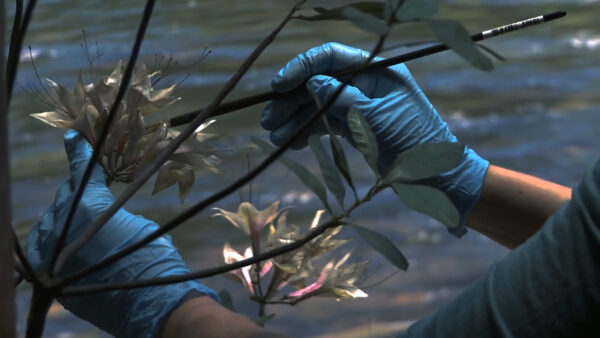
In one of their entries, the narrator mentions being advised by a friend to take 5-HTP—an amino acid that contributes to serotonin production in the body—to treat their insomnia, only to learn that supplements rich in this molecule are extracted from a plant called griffonia, native to West Africa. As if its resources had not been exploited enough already, the natural flora of the African continent is now used to soothe the white guilt of former colonial powers. Yücel and his narrator may not push their inquiry further, but the chain of oppression does not stop there. The very platform used in the film to raise awareness of the Palestinian cause is owned by a white supremacist billionaire; the very computer on which this text was written is composed of minerals illegally extracted from the Democratic Republic of Congo.
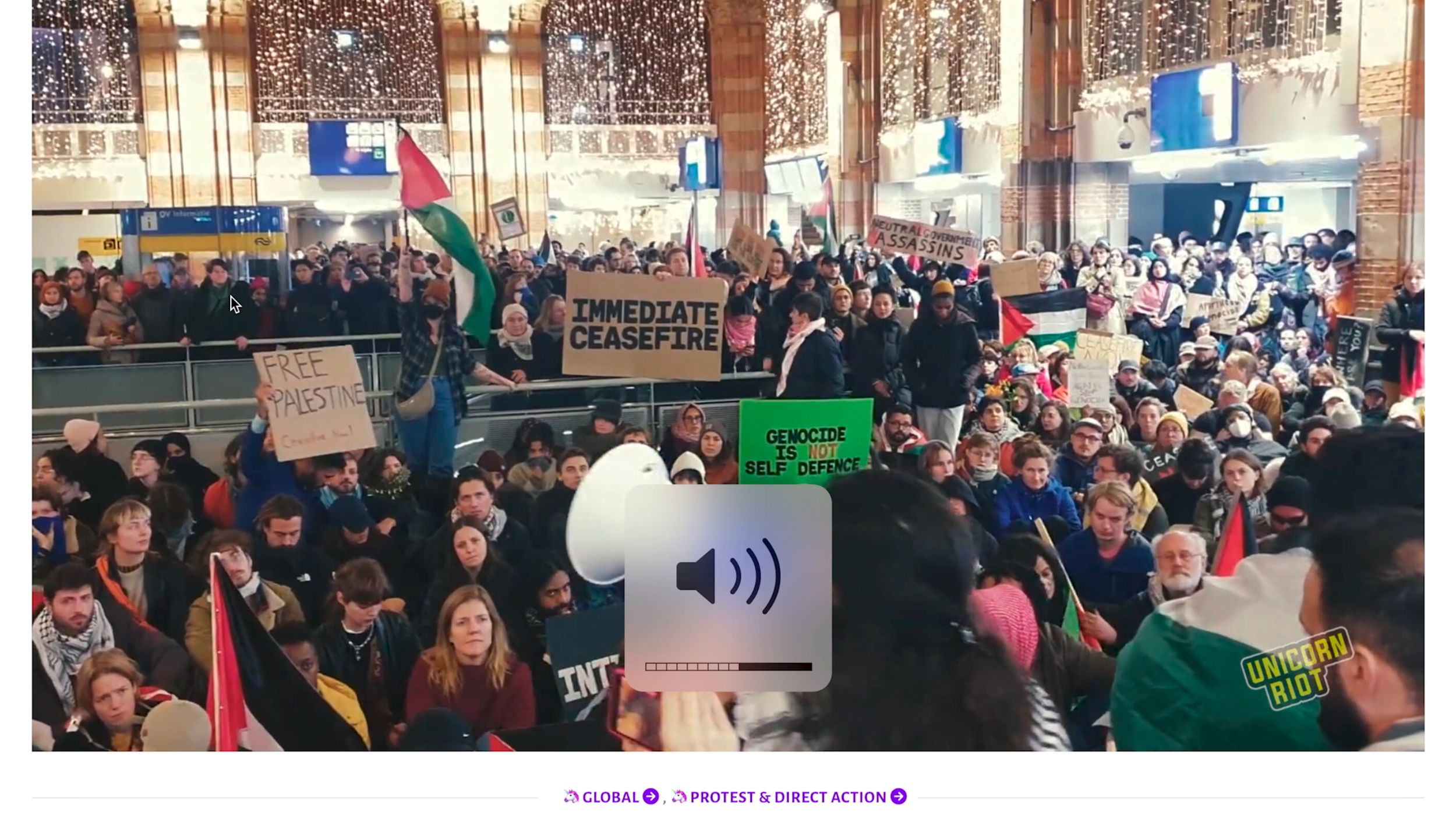
happiness (Firat Yücel, 2025)
Entrapped and inadvertently complicit in neocolonial exchanges of power, information, and money, which direction is left for the individual to seek a way out? In the narrator’s case, browsing images of the streets at first appears to provide a sense of purpose, with collective action offering the possibility of transcending one’s isolated anger. Throughout the film, their disoriented cyber-wanderings are interwoven with videos shot during pro-Palestinian protests in Amsterdam. However, Yücel’s assessment of the political capacities of public spaces feels guarded, insofar as he refrains from depicting them as a utopian alternative to the internet. Rather than opposing the two, Yücel frames the internet as a site of counter-surveillance within public spaces, made visible through the images of extreme police brutality that appear in screen recordings. He aptly observes how the democratic ideals attributed to European culture—and to the West in general—must be considered alongside their internal tensions, tensions that, without the presence of digital devices and their modes of circulation, would have gone unnoticed and unaccounted for.
Another key point that happiness does not fail to notice is the digitalisation of public spaces, especially the way phone screens have become indispensable to assure the posterity of these communal gatherings. As an extension of the phone camera, it becomes a necessary evil that carries the punctum of this distant form of solidarity into the digital realm. Beyond acting as the virtual bearer of the masses’ revolts, its shadow also haunts the streets themselves. During one of the demonstrations, we witness the camera being drawn to screens like a moth to a flame. Zooming in at one point on an Instagram comment about Gaza, printed and used as a banner, and, in another, following a protester’s screen as he films the crowd, the camera captures their unavoidable presence in physical spaces. Either they appear merely as a simulacrum—like the Instagram comment—or as recording devices, happiness can’t help but concede their ubiquity.
To all the moral deadlocks deployed through the narrator’s daily musings, there does not seem to be any satisfactory solution from a political perspective—not that Yücel actually tries to propose one. From beginning to end, the dark playfulness of his approach hints that we, as viewers, already know how it feels to be inundated with images of suffering, unable to stop them, and yet still compelled to go on with our day. Despite the linear, chronological order the narrative follows, the film condenses into an eternal present moment, stranding the viewer within this hyper-mediated yet dissociative infosphere. Yücel is aware that, for many people, it is always easier to turn one’s head away from the world and submerge oneself into a state of ignorant bliss. Fundamentally, happiness challenges the viewer to do the opposite—not to self-destructively and counterproductively lament the impossibility of making an impact on globalised systems of oppression and violence, but to maintain an active awareness while living within them.
happiness was nominated for the New Critics & New Audiences Award 2026 at Vilnius Short Film Festival by Boet Meijers, Elif Türkan Erisik, Nilay Cornaud, Oliver Dixon, Panagiota Stoltidou, and Sabrina Rose, the participants of the European Workshop for Film Criticism #8.
The European Workshop for New Curators and the New Critics & New Audiences Award are projects co-produced by the European Network for Film Discourse (The END) and Talking Shorts, with the support of the Creative Europe MEDIA programme, and in collaboration with This Is Short.






There are no comments yet, be the first!