
Dèyè mòn, gen mòn*
Interview with Miryam Charles
In her new short film, Haitian-Canadian filmmaker Miryam Charles circles back to obsessions that have always driven her work: her heritage, family scars, and a sense of belonging.
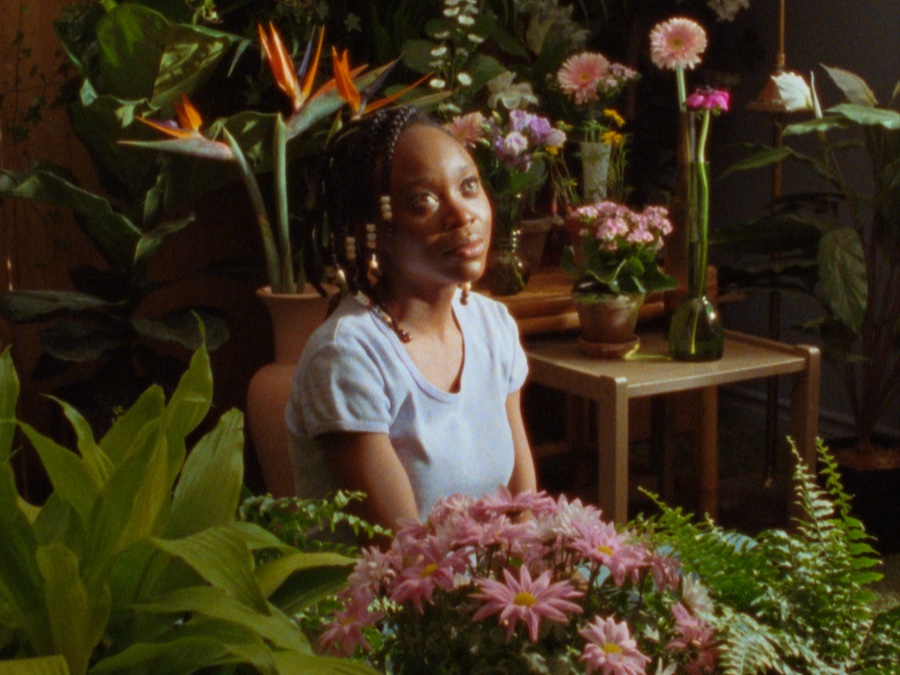
* Creole for: Beyond the mountains, more mountains
The work of Haitian-Canadian filmmaker Miryam Charles has always had an atemporal quality to it. Like poetry, the sounds and images she crafts so prolifically seem to float free. In our conversation, she often spoke of ghosts, but the word that kept coming to my mind was “wanderers”. Most of her previous films are more akin to personal diaries translated into films than anything else. Charles’ signature is made of characters lost in hazy-looking landscapes captured on 16mm film, woven with intimate voiceovers narrating personal diaries of sorts, leading us into worlds that feel familiar yet very distant. Watching her earlier films, like Drei Atlas (2018), Second Generation (2019) or Song for the New World (2021), I always feel like I’m meeting wanderers, just passing through, as I get to hear the fragmented thoughts and desires of grieving men and women. Are they from a distant land or from around the corner? You can’t quite tell.
In her first feature, This House (2022), a raw and intensely personal film, Charles confronts the gaping hole the death of her teenage cousin left in her family. It was a film so hard to make, she acknowledged it transformed her; and her latest short Treasure Island (2026), which played in competition at Festival du nouveau cinéma, may offer a glimpse of what creative areas she might want to explore next. The wanderers I was used to encountering are back, but they’ve changed. This time, both of their feet are well anchored into our world. They speak louder, they are confident and sharp, and they swear a lot. They take the form of a merry band of five preteens who lose track of time in a park, somewhere in Quebec, fleeing their houses with the hopes of finding a home of their own, armed with nothing but faith and sheer will.
Twelve-year-old Marthe talks her brother and cousins into running away, but the mood quickly sours. Through their infighting, doubts and dilemmas, Charles circles back to the obsessions that have always driven her work (Haitian heritage, family scars, and a sense of belonging), but she now strikes a different tone. Leaning more on narrative conventions than on her usual experimental approach, she specifically speaks to a younger audience, and in doing so, it’s a joy to watch her take on a genre we’re not used to seeing from her: comedy.
While preparing for this interview, I took the opportunity to dive back into your filmography, and it so happened that I was also fighting a really bad case of jet lag. My brain was in a constant haze; I was uprooted and exhausted, and I realised that state of mind was particularly well suited to rediscovering your cinema. What’s your relationship to jet lag?
Pretty much the same as yours. I don’t adapt to time differences very well. I always feel caught in a kind of in-between, as though I’m trying to stay anchored to Montreal time, even though I know that makes no sense. I tell myself it’ll make coming home easier, but the truth is my body simply refuses to adjust. So I’ve learned to accept that I’ll be completely out of sync wherever I go, and that I’ll feel better once I’m back.
I’m asking you this because, rewatching your films, I noticed that they are never closed in on themselves. Your works are nomadic, in a sense. The essence of Haiti is always palpable—even if I couldn’t tell you exactly what that essence is—but the gaze is outward, as if Haiti is always seen through the lens of its relationship with the world. Is this dialogue with the world a deliberate part of your approach?
I think it’s central to my work. I often say that I make films about ghosts, and for me, Haiti is a kind of ghost. I’m haunted by Haiti—in a good way.
When my parents immigrated to Quebec, the plan was to stay in Canada for a few years and then go back to Haiti. It was never meant to be for the rest of our lives. The political situation there was complicated, so my parents left, but in their minds it was temporary. As kids, we genuinely believed we’d spend a few years in Canada and then return. But it never happened.
That nostalgia for a return that never came is at the heart of what I do. I have gone back to Haiti to visit family, of course, but when I talk about returning, I mean really going back for good, not just visiting. And in a way, I try to re-enact that return in every film I make. My parents are getting older now, and I’m aware that, for them, it won’t happen. I’m getting older too. If I were wealthy, I suppose I could move back to Haiti and live in a secure neighbourhood, but I don’t have those means either. Still, it’s really important to me to keep that longing alive, and I do it through my films. I like to think that younger people of Haitian descent who see my work might carry that desire with them, and that maybe one day, for them, it will come true.
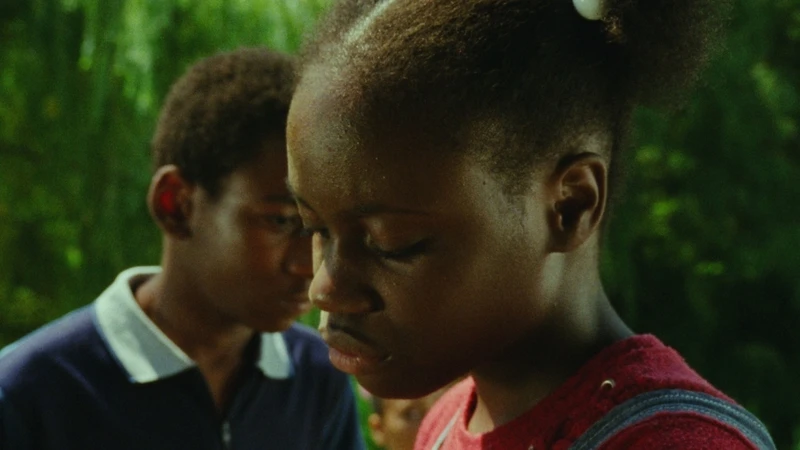
Treasure Island (Miryam Charles, 2026)
This brings me to Treasure Island. It is being labelled as a comedy, but I see it very much as a children’s film. Had you been wanting to reach young audiences for a long time, or did it come about as an opportunity?
I feel like I’m always making the same film, just in different variations, but this one was mostly a reaction to [my first feature film] This House. I loved making this film, but it was also emotionally very hard. Once it was finished, I travelled a great deal with the film, and so many people came up to me after screenings to tell me about their own trauma—that a member of their family had been murdered, for example. I often found myself consoling people, sometimes without knowing how to respond. I think I accumulated a certain sadness over the whole tour.
So I wanted to move toward something gentler. The subjects are essentially the same—I’m always dealing with the same themes [of displacement, identity, uprooting]—but I wanted to approach them through something softer, connected to childhood and to hope.
Maybe it’s my very Québécois perspective, but I saw it as a homage to the Contes pour tous 11 In Quebec, the Contes pour tous series is the benchmark for children’s cinema. These family films are hugely popular and deeply woven into the province’s culture, and classics like La guerre des tuques (1984) helped shape a strong francophone identity. They are still celebrated as cultural landmarks, but they offered a narrow picture of what it meant to be Québécois: on screen, that mostly meant being white, working class and French-speaking. ↩︎ films. I recognised all the quirks of that series. Was that a conscious reference?
Yes, absolutely. I grew up with the Contes pour tous series. I watched them over and over on VHS, so they were definitely a reference. But I also remember that as a child, as much as I loved them, I had questions about representation. So I decided to write this children’s fable that I would have loved to see when I was a kid. That’s partly where it came from.
The film is set in 1993, so just before the 1995 Quebec referendum for independence, and you also touch on that referendum in This House. Can you tell me about that period of your life?
It’s closely tied to my identity and to my sense of belonging. That was when I started to realise that the time we were supposed to spend in Quebec might turn out to be more than just a few years.
You already sensed it?
Yes, and in the ‘90s, part of the popular conversation was: how can immigrants integrate into Quebec society? Even in my family, we had discussions about how to behave in order to be accepted and welcomed. My parents made a choice—one I think they regretted later—not to speak Creole with us, so we would integrate well. At home, it was French, to make sure we spoke good French and could fit in.
For me, the whole Quebec–Canada referendum question played into that: what do we identify with? My parents had come to Canada, and the referendum was suddenly a rejection of this new national identity they were trying to hang onto. Those who remember will know there was a kind of narrative going around. Many people from immigrant communities were convinced that if Quebec separated, they would be kicked out. I’ve talked about it with several friends; our parents were convinced they would no longer be welcome and would have to go elsewhere in Canada or to the United States. The referendum was followed very closely in our communities, because people had left an unstable situation in Haiti, and in their minds, the referendum was going to create a new kind of instability. I think I’m still marked by that anxiety.
With the recent return to power of the Parti Québécois [the political party advocating for Quebec’s independence], have you moved past that, or is it still with you?
I’ve moved past it, because I took the time to learn. I learned why there was this desire for independence. The anxiety is gone, but it’s still a defining moment in my life and in my family’s history. I think that’s why it keeps coming back in my projects.
For your early films, you’ve often said you edited the sound first and structured the film around it. Do you approach your fiction films in a similar way?
I do exactly the same thing. For me, everything starts with sound. I have an archive full of recordings that I’ve built up over the years. I love just wandering around capturing really mundane sounds of all kinds of things. Before I even write a script—any script—I go back to that library and create a kind of sound map based on emotional connections, let’s say. I do a first edit, I listen to it again and again, and then I start writing the script. It helps me figure out where I am and where I’m going.
What did the sound map for Treasure Island sound like?
There were a lot of birdsongs from Haiti. Since the film was a reaction to This House, it was also another form of tribute to my cousin. I used a lot of birdsong because she loved birds, so I included the sounds of her favourite ones. There are many wind sounds, including from Haiti, from the village where she lived. I also used sounds I’d recorded at my sister’s place—we shot there too; the house in the film is hers. So there are lots of family sounds hidden here and there, which mean something to me but not necessarily to the people watching.
In previous interviews, you’ve said you didn’t necessarily see yourself becoming a filmmaker. You also said you wouldn’t be a filmmaker forever, and that you’d become a teacher. So how do you see your career? What’s your relationship to being a filmmaker right now?
I love working with people, but I’m also extremely introverted, so I’m always a little surprised that I have a career at all. [laughs] If I listened more to myself, I’d stay home drinking tea and rarely go out.
I always thought I would do this for a set period of time—around fifteen years. I’ve been making films for almost ten years now. My two current projects are financed; I have one more to make after that, and then I’m going to retire. Completely. As much as I love it—and this isn’t ingratitude—being a filmmaker demands a lot. You have to talk to a lot of people, and my social battery is always at minus 1,000.
So I’ll retire and keep creating just for myself: writing poems, making sound collages of all sorts of things. I’ll tell myself, “I had a good career,” and then I’ll go teach elementary school, with the kids. The truth is, I’ve come to the end of making the same film—of exploring everything I had to say about my ghost, which is Haiti. And after that, I’ll go do something else. That’ll be it.