Encampment Cinema
Hagiography or critique? Oliver Dixon explores tensions and divisions found in pro-Palestinian cinema, from recent so-called “encampment shorts” to Jean-Luc Godard and Anne-Marie Miéville’s essay films.
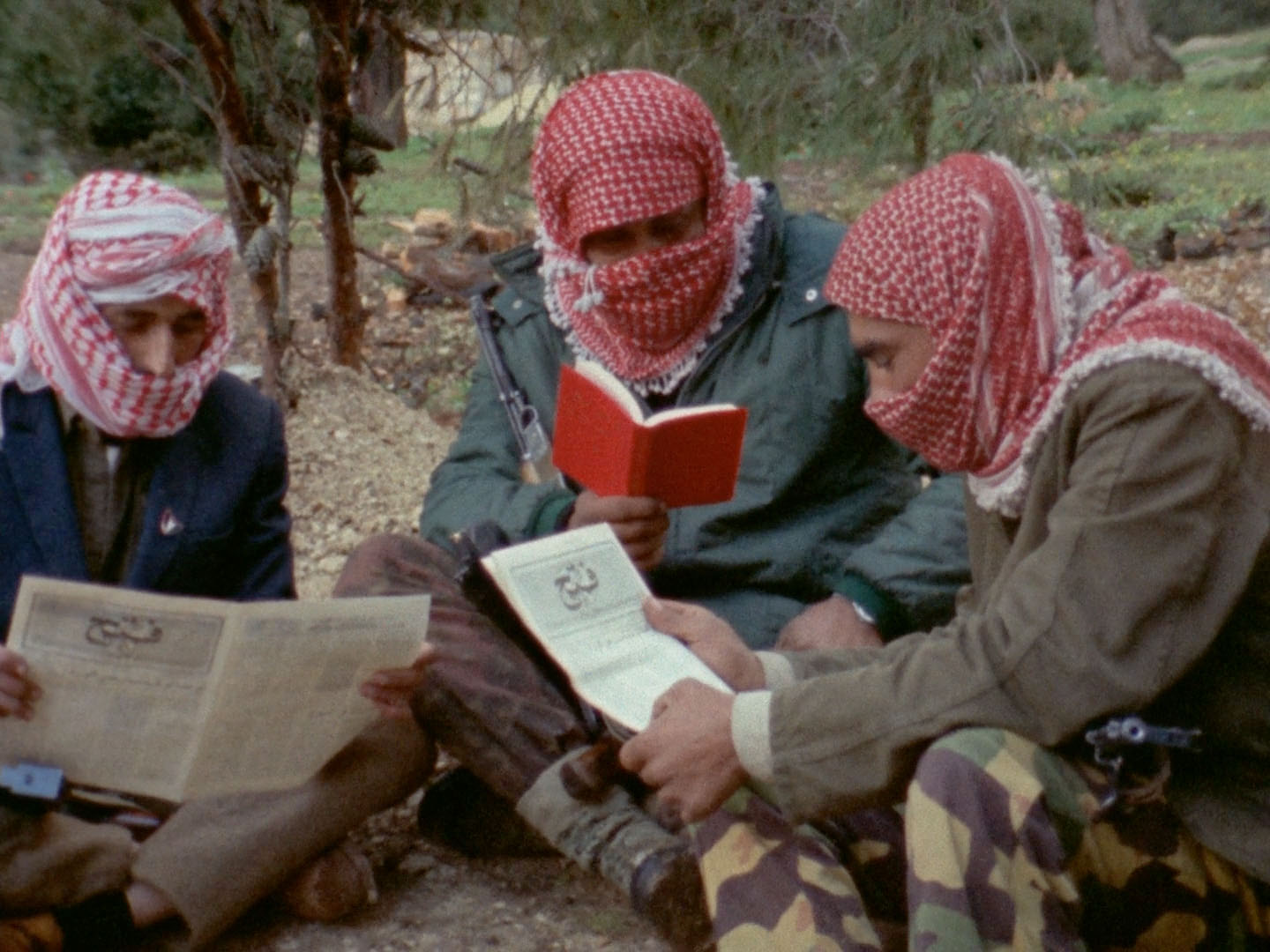
In the spring of 2024, students at Columbia University, New York, established an encampment on the university’s South Lawn. Students demanded their university divest from the Israeli war machine and civil institutions. Columbia set the precedent, and soon the encampments spread. Not just in the USA, but in Canada, Australia, the UK, France, the Netherlands, Belgium, and Germany, the demands were clear: financial disclosure and arms divestment. At my own university, our encampment ran for over a hundred days, providing not just a potential site for disrupting university functioning but also a site of insurgent social reproduction, education, food distribution, intra-city solidarity among many community and activist groups, and, conversely, intensive infighting and dissensus. The summer months passed, and many encampments began to wind down (though the encampment at SOAS, University of London, would continue until the following summer).
While the tactic was not without successes in furthering both local and global divestment agendas, and has been repeated more recently, its failures, blockages, and present crisis of replicability have since become clearer. Many universities brutally repressed or sought legal routes to prevent the tactic, while mainstream media painted students as antisemites and campuses as unsafe. Moreover, it is difficult to assess the extent to which encampments entailed substantial material disruptions to day-to-day university functioning; where repression was avoided, negotiations with administrators often stalled. Many managers viewed encampments as minor nuisances or even attempted to co-opt the radicality attached to them to advance their own images as liberalising world leaders.
With their global spread as one of the major mass Palestine solidarity movements, the encampments risked becoming a symbol of ‘resistance’ and ‘hope’ par excellence in the Western world. The 2025 documentary The Encampments did much to consolidate this image. While operating within a welcome, sympathetic-committed mode, its typical dénouement invoked inevitable victory atop an emotive, swelling string drone. Indeed, many of the same liberal publications that attacked the encampments along lines of antisemitism or undemocratic campus environments praised the film for its hopeful urgency and intelligence.
There is an inherent tension in the rush to memorialise the encampments. In the face of accelerated repression, it feels necessary to recollect the possibilities for collective action. Yet, the risk of hagiography threatens to undermine both our understanding of the tactic itself—How did encampments operate? Were they sites of material disruption or insurgent social reproduction? Did these two tendencies undermine one another? How might this tension connect the tactic to similar historical strategies, such as those of the Occupy movement? What worked? What didn’t?—and the institutional and administrative shifts that have taken place since 2024 that compromise the viability of such routes for university-centred struggles. How then have some recent short films about the encampments approached or evaded hagiography, and what might their cinematic lineage reveal?
In the winter of 2024, I joined a project set up by academics at the University of Warwick to produce a series of short films about the UK encampments. Alongside my comrades and other scholars and activists, the group produced four shorts and a series of interviews with organisers that were eventually collected as Far From Gaza: Films from the Encampments, 2025. Made at a temporal removal from the spring-summer of action, and as the anthology’s title suggests, the final shorts evoked not hagiography but distances: distance from the locale of the encampments and the struggle as one filmmaker had moved back to their native Egypt after finishing their degree (A September Song, Noureldin Ahmed); the distance from Palestine and the contradictions of making images of a single encampment whose history is so entangled with elsewhere and other times (The Dividing Line, Oliver Dixon and Katie Wrench); the distance and closeness from filmmakers’ Jewish heritage surrounding the encampments’ media furore (untitled, anonymous director); the distance from a moment of explosive activism now waned (Looking Back, Augustin); and across several short interviews, the distances of the tactic, often revolving as it did around organising political teach-ins, community food banks or religious ceremony, from its goal of divestment. Watching these films, one is reticent, I hope, to make simplistic or reactionary short-circuits between the encampments and victory, solidarity struggles, and the Palestinian struggle or Judaism and Zionism.
Such distances were doubled at the level of form. The Far From Gaza shorts deployed a range of distancing devices. Looking Back focused self-reflexively on a single image of the Cambridge encampment, showing only close-up segments to build and destabilise its own narrative before revealing the complete image at the end. A September Song projected images of the now-far-away encampment on a Cairo brick wall, their contemporary flatness in the face of the struggle’s distance foregrounded; another deconstructed media images and discourses proliferated at the time of the encampments. The Dividing Line deployed repeated mirrors to reflect our phone-camera imagery back into the frame and fractured voice-overs to interrupt a complete, holistic analysis of events.
These strategies reflected our urges to convey the encampments in the past tense, superseded in effectivity, as well as to critique the all-too-easy construction of hopeful images of resistance. Yet, the shorts did not shy away from the specificity of sensual, affective or pedagogical experiences within the Cambridge encampment: the role of media spokespeople, the miraculous appearance of the aurora borealis above the encampment one night, the role of religious rituals, the repeated chants, or our self-conscious, in media res attempts to understand the history of our strategy and student movements.
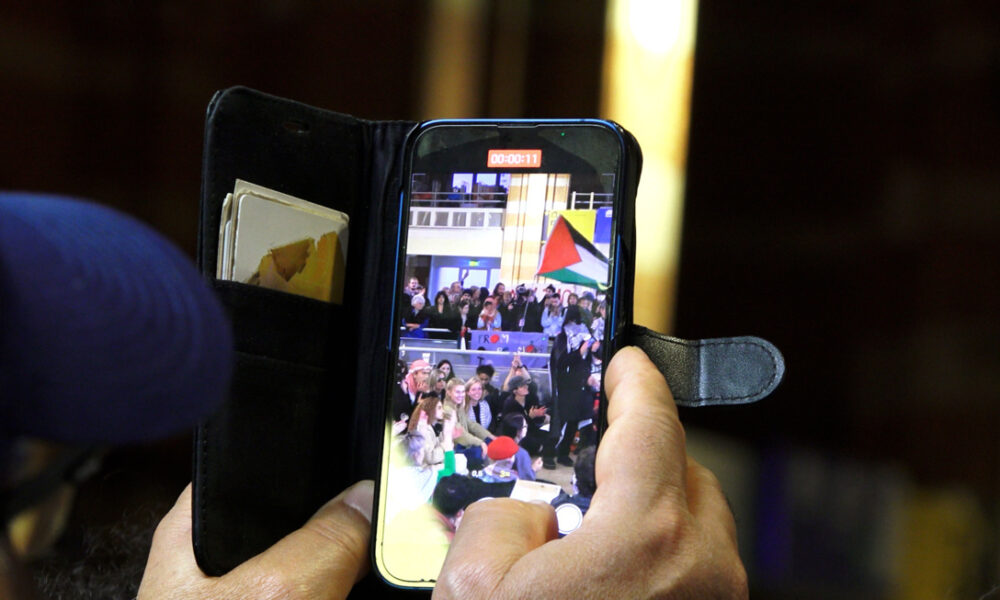
happiness (Firat Yücel, 2025)
In the winter of 2026 at Vilnius Short Film Festival, nearly two years after the first Columbia encampment, I encountered another short film reflecting on the student encampments. Firat Yücel’s happiness (2025) is a first-person, desktop film composed mainly of a montage of social media imagery (from the banal: a Twitter/X post from ‘Depressed Bergman’, over Béla Tarr films, to the horrific: phone footage of the IDF bombing Gaza). Through typed messages, an unnamed narrator recounts their difficulties with insomnia emerging from their obsessive screen time and endless encounters with images of genocide. The narrator only finds respite at the Amsterdam train station occupations and the University of Amsterdam student encampment.
Once again, this film is composed through distance. happiness mediates images of the Amsterdam encampment, or rather of police brutalising the encampment, almost entirely through screen recordings. What we encounter is less images of the struggle itself, in its ostensible immediacy, than the fragmented, dislocated manners with which we come to digitally perceive political organising. Social media flow heightens moments of intense violence and feeling over and above the mundanity of discussion, debate, care, planning, downtime, cleaning, and spreadsheets that marked the majority of time in encampments.
happiness also operates in an ironic mode, doubling the narrator’s digital distance with spectatorial detachment from the narrator. In the face of the destruction in Gaza and the political imperatives it generates, the narrator’s insomniac plight rings as self-centred. The obsessive montage reflects the nonsensical navigation of history in the digital sphere, and the narrator’s commentary conveys the fraying, self-centred subjectivity this engenders. This combination underlines both that this entanglement is real and difficult and that its narcissism is a problem.
The Amsterdam encampment serves as both example and outside here, as that which can be relayed as a digital fragment or that which can drag one away from one’s screen. While this approach underscores the allure of political organising, with respect to the encampment form itself and specificities of Amsterdam students’ struggle, it is, at best, minimally enlightening. At worst, this replicates a stultifying image of the encampment as a site of ‘resistance’ conceived not simply against Western arms investment but also against the more nebulous, reified sphere of the Digital.
In European cinema, it was Jean-Luc Godard and Anne-Marie Miéville who offered a prime exemplar of a distancing mode vis-à-vis the Palestinian struggle, with their essay-film Ici et Ailleurs (Here and Elsewhere, 1976). Ici et Ailleurs thus offers both a key touchstone for the encampment shorts already discussed and serves as a useful comparison to elucidate the latter’s specificity. Ici et Ailleurs’ initial object of critique is a film Godard and Jean-Pierre Gorin intended to make in 1970 on the armed Palestinian resistance group Al Fatah, tellingly titled Jusqu’à la victoire (Until Victory). Yet after Jordanian forces massacred the fedayeen and Palestinian civilians, the film’s hopeful projections rang false. In Jusqu’à la victoire, cinema was a formula: “the people’s will” + “armed struggle” + “political work” + “extended war” = victory. Like The Encampments, Jusqu’à la victoire’s proposed dénouement foreclosed the possibility of defeat and mystified the Palestinian struggle.
Reworking footage from the abandoned film into Ici et Ailleurs’ montage, Godard and Miéville began to question its simple militant additive construction. Ici et Ailleurs exposes this formulaic approach and complicates the geographical separation that underscored Godard and Gorin’s inability to project beyond victory. In one famous sequence, French actors move in front of the camera one by one, holding still images from Jusqu’à la victoire and declaring each as an individual node in the militant sum, “the people’s will”, “armed struggle”, etc. By arresting these images from their flow, highlighting the process of construction from the French lens, and separating out the militant voice-over, Godard and Miéville underline the absence (of Palestinian death, of defeat, of Godard and Gorin’s simple return to safety) that Jusqu’à la victoire’s militant construction might have painted over. As Godard’s voice-over puts it, “a flow of images and sounds that mask silence. A silence that becomes deadly because it’s prevented from breaking out”. It is this foundational gesture, of foregrounding imagistic construction and reception to reveal the structuring absences that underpins the militant, hagiographic, or committed modes, that the encampment shorts build upon.
Yet, unlike the Western solidarity struggles of the encampments, Ici et Ailleurs concerns the Palestinian struggle itself and, principally, the separation of French filmmakers from that struggle. A key image that proliferates across Ici et Ailleurs is of a French family sitting watching the television, which shows adverts between images of dead bodies and the fedayeen. Returning again and again, this detached, comfortable sphere is juxtaposed continually with the puncturing image of a dead Palestinian. This is not simply a contrasted division of here/elsewhere, safety/danger, or spectator/object. Rather, it is the conjunction, et/and, that binds these terms and that Godard and Miéville ultimately emphasise. Here AND elsewhere. As the philosopher Gilles Deleuze famously put it: “AND is neither one thing nor the other, it’s always in between, between two things; it’s the borderline, there’s always a border, a line of flight or flow, only we don’t see it, because it’s the least perceptible of things” (from an interview “Three Questions About Six fois deux”).
In other words, Godard and Miéville set out not only to investigate the formative process by which images and sounds enforce and develop a border, or the political-economic unevenness that sustains that division, but also the possibility of traversing those divisions. Neither here nor elsewhere, but in-between. How does the distinction and security of images and sounds divide the here from the elsewhere, mystifying the false unities of either? How might the multiplicity of the AND undo the mystification of militant equations? What relations between here and elsewhere might we envision in the conjunctional interstices?
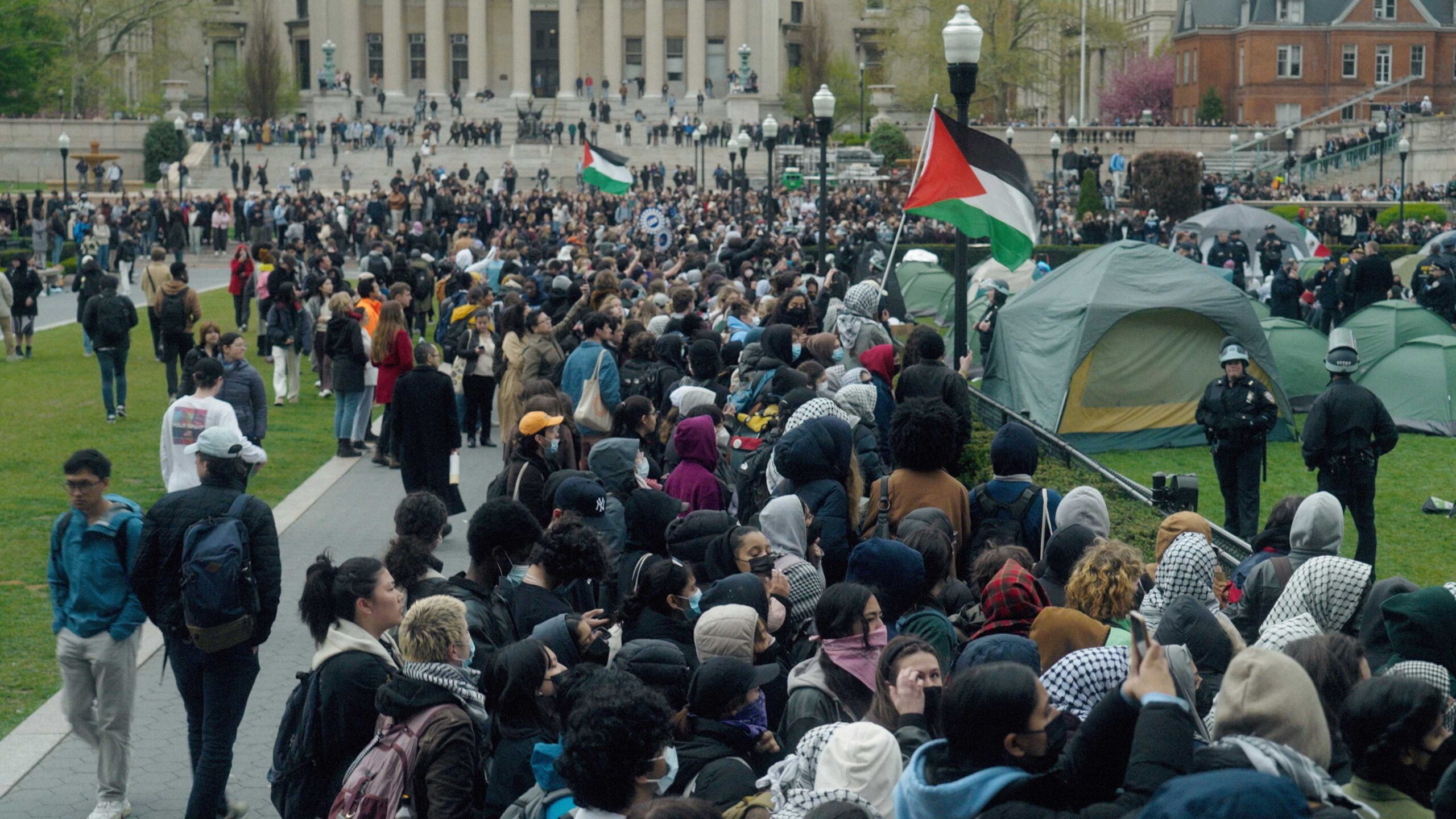
The Encampments (Michael T Workman & Kei Pritsker, 2025)
By contrast, the encampment shorts were all made by direct participants in solidarity struggles, rather than mere observers. These films and the encampment struggles themselves thus recalibrate the border space identified and occupied by Godard and Miéville. Instead of in-betweenness, the shorts emphasised spatial, political, and economic entanglement and coalescence. In The Dividing Line, we attempted to find a representation adequate to the financial, industrial and political system that bound the here to the elsewhere; repeating an image of the empty lawn where the Cambridge encampment lay, and fracturing our image’s line of sight with mirrors reflecting beyond the lawn, we suggested, “what is here cannot be seen”, while also demanding, “what is here can be seen”. The titular dividing line then is a political line, us/them, Palestine/Israel, that divides across space, rather than dividing space itself.
In A September Song, the Cambridge encampment is bound to Cairo via projection of footage from the former onto the latter (notably, in a location near Tahrir Square where symbols of Palestinian resistance proliferated. In a blurb describing the film, Noureldin Ahmed recalls a friend asking him about the Cambridge encampment: “Doesn’t this remind you of Tahrir?”). Both are further glued together by captions of the poem Ghwenwa Septemberiyya (A September Song) written by Egyptian poet Salah Jaheen and recorded in London by Soad Hosni before her death. England, Egypt, and Palestine are all effectively tied through both personal biography and an aesthetic archive. For Ahmed, it is not the borders between them but their political entanglement that marks these as shared spaces for liberation. In happiness, digital mediation collapses spatial division, and only through political activity can the narrator resist the pacification of this collapse, turning it instead into a catalyst. A divided digital un-division from elsewhere makes new urgent political demands of the here.
If there is a slipperiness in these examples, of effacing unevenness in favour of too-simple unities, one that Godard and Miéville seek to avoid, this doubles those other tensions of the encampment form and its cinema: Affirmative alternative political space or purely negatory material disruption? Hagiography or critique? Political unity across spatial coalescence or uneven struggles in spatial divides? The encampment films cannot resolve these tensions. They must be worked out on the terrain of concrete struggle. But they do at least allow us to glimpse that such tensions exist and that the real texture of struggles demands we oscillate between and across them. When do we require celebratory memorialisation to invigorate further struggle? When do we require a careful critique of our actions? How might building alternative political spaces engender or hinder more abolitionary attempts to struggle against our ties with the arms industry? When might symbolic unity across differential struggles bolster our strength, and when might it mystify?
I regularly walk past the site of the original Cambridge encampment at King’s College’s front lawns. The grass has now long since grown over. Its neatness and pruned perfection mark the washing away of a space of real, if strained and painful, beauty. Despite their varying modes and differential approaches, the encampment films discussed all cling to this beauty. This small cinematic archive of but one chapter in the global solidarity struggle with Palestine reminds me that a few patches of trimmed grass will not suffice to erase the memory of those fleeting spring months and the complicated desires for liberation they expressed.
This text was developed during the European Workshop for Film Criticism #8—a tandem workshop set during Kortfilmfestival Leuven and Vilnius Short Film Festival—and edited by tutor Michaël Van Remoortere.
The European Workshop for Film Criticism is a collaboration of the European Network for Film Discourse (The END) and Talking Shorts, with the support of the Creative Europe MEDIA programme.