
Love as an Open Question
Maya Sfakianaki on How Many Lovers Can You Fit Inside a House
Convinced she could love all her partners equally, Maya Sfakianaki set out to make a film about polyamory. As one relationship intensified, the very principles she set out to explore started to clash with reality.
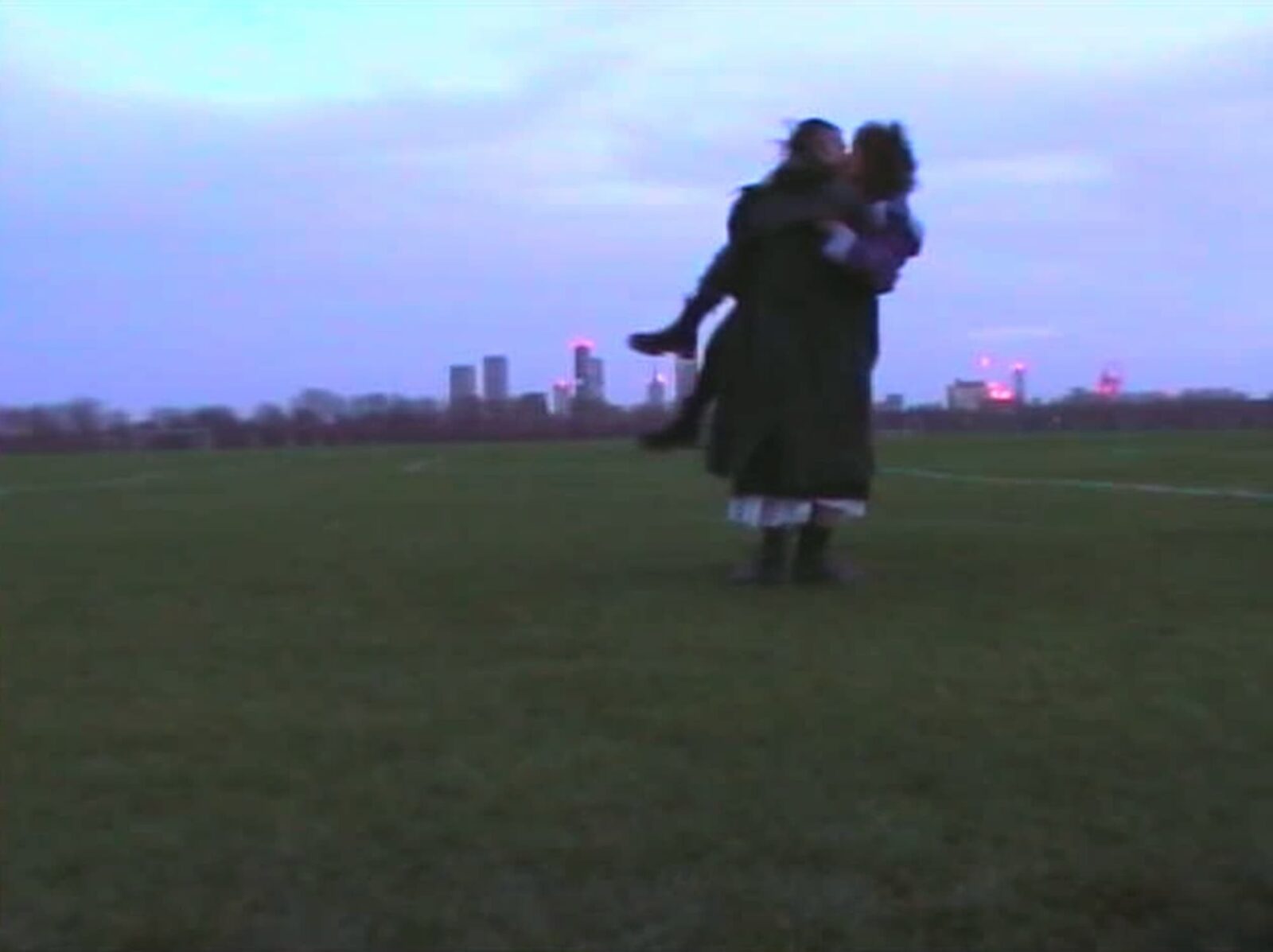
How Many Lovers Can You Fit Inside a House is a deeply intimate, introspective 20-minute documentary. Director Maya Sfakianaki moves through layers of vulnerability—setting out to explore polyamorous life, discovering a desire for commitment, and having her heart broken along the way.
Shot with a home-video aesthetic, the camera feels almost like a security blanket. At first, Sfakianaki holds it, filming her lovers from behind the lens. Gradually, she steps into the frame. Sam, one of her lovers, starts filming her; she lets him in and lets herself be seen. The camera becomes a dialogue, facilitating a relationship mediated through a lens, and the film shifts from her individual experience towards connection.
At the end of the day, the visual language remains unmistakably Sfakianaki’s. Her musical work, including her EP Honestly Stuffed released in November last year, shapes her way of perceiving the world and the film’s rhythm; her background in poetry echoes through the film’s title; her perspective determines the editing and her cinematic influences surface in the filmic language. It’s resolutely her film and her set of questions, and we move with her through the uncertainties and fears of loving.
Meeting Sfakianaki makes it immediately clear that she is exactly like her film: open. She moved from Greece to the UK at 17, studied Film Studies at the University of Kent, and now works as a filmmaker and curator with a focus on short-form work. Being part of the Balkan diaspora, I was curious about how she experiences and perceives love, so I wanted to start the interview by matching the vulnerable tone of her film, in which she speaks exclusively in English.
Do you feel that you perceive love and learn how to love romantically in English?
I wouldn’t say I perceive love in words. I think love is a bit more universal than language.
Film can also be understood as something similar to love, as a translucent force. When did you realise you wanted to make a film about your relationships and the ways you relate to other people?
I always wanted to make art, and I want to make art I can be completely honest about. I’m just talking about what I know and what I experience. I spent a good part of my teenage years and my 20s feeling blocked. Coming from quite an artistic family, I felt I was not good enough to be an artist, even though I had a lot of creative urges. Then, I guess you get older, life gets shorter, and you realise you can’t spend all your time thinking about what other people will think. So, I started making art. I made this film when I was 27 or 28, and then I did my two albums. It was a time when polyamory was really speaking to me, and I was very intrigued by it. But the film took a different direction because I decided to stay true to what was actually going on rather than my theoretical outlook on the whole thing. I’d always wanted to make a film, and I’m so glad I did. Now I want to make another one, hopefully.
I feel that your film captures the fluidity between polyamory and monogamy very well. How did you choose your cinematic language? To what extent was it a conscious choice?
Initially, the whole film was going to look like it did at the beginning. But then it stopped feeling true to me. I started out thinking I was going to make a soft, poetic, slightly ambiguous film that would be more theoretical about polyamory—how beautiful it is and how possible it is. Then I was faced with the struggles of a very deep romantic connection that felt really intimate, and that shook my idea that polyamory could be so effortless. The film then shifts into much rawer footage, footage that loses that theoretical, aesthetic focus and becomes more like pieces of everyday life and the experiences we were having. That felt more intimate to me, so there is a big shift in the middle of the film. I just tried to stay true to the feeling that I had. I didn’t do what I had intended to do; I just did what the footage told me to do.
As the camera becomes a toy between you and Sam, the thematic focus and the perspective begin to shift. The more vulnerable you become, the more of yourself you’re revealing. It then becomes palpable that your vulnerability is the driving force of the film. When did you realise the film was becoming more introspective?
I didn’t really want to make a film about myself, but when you make a film about what you have around you and about intimacy, you cannot really capture that if you are not in it. You can’t just show up and film two people being intimate, which I tried. I’ve filmed tons of people, different couples, being intimate. I did some interviews, but I didn’t use any of that footage because it just didn’t feel real; it felt staged.
The only moments that felt authentic were the ones in which I was deeply involved. I think this film is about me and Sam, our love, and the intimacy that developed between us. That was such a beautiful thing, and something you rarely encounter. I haven’t often been that intimate with anyone else. That’s what I wanted to show, rather than myself.
Still, your imprint is unmistakable, and you give a great deal of yourself to this project, as its editor as well. In the film, you and Sam are literally and figuratively laid bare: from confessing your feelings to each other, to having sex, to speaking openly about the breakup. Ethically speaking, did you give your partners a veto in the editing process? Did you give yourself one?
I feel like my work has a punk quality—not just an aesthetic, but an ethic. Punk can be quite insulting and subversive, and I really want to be more insolent and subversive. That can be tricky when you’re talking about relationships, nudity, and such intimate moments. But the most vulnerable person in the film is me. I always expose myself first. I feel other people can trust me if they see how open I can be.
But if I had a veto? Not really. I didn’t want one. There was nothing worse I could put in there than that scene in which I’m having an orgasm; there was nothing more embarrassing. It’s a good, challenging feeling, and sometimes we have to put things out there that make us feel very uncomfortable, so that other people can feel more comfortable doing the same. That is how images become more normalised. It comes back to the camera as a toy, as something between me and the other people, because I didn’t want to just be the author holding the camera. In the editing room, obviously, you cannot let everybody come in because ultimately it’s your film. Sam wasn’t extremely happy with the film, but of course, I didn’t release it without showing it to him. I feel it’s very important to show the people involved the material before releasing something like that.
I’d like to know more about the way you depict nudity and your urge to normalise it in order for those who come after you to feel freer to do the same. Given your background in Film Studies, programming, and curating, what were your cinematic influences?
There are women throughout film history who have really tried to talk about sensuality. Barbara Hammer did it very well in Dyketactics, the short film she made about women making love in a beautiful rural environment. I was also very inspired by Maya Deren, whose experimental cinema and use of self-portrayal make herself the subject of her art. And Jeanne Dielman by Chantal Akerman—I’ve watched all her short films. Her early work and the way she simply filmed herself in her bedroom, basically waking up in the morning and doing acts of the everyday, really inspired me.
You can see that this has been happening over the last 80 years, and things still haven’t changed that much. There are a lot of people, especially men on Letterboxd, who feel shocked by the content of my film. When we have access to porn websites, to so many images of the body, I don’t see how it could be challenging to have real sex in a short film. I don’t think the images themselves are scandalous. It’s more the act of placing them within the narrative of the film that seems to shock people. Especially from my perspective: it’s my body and my orgasm, and I’m filming it. I have my orgasm on camera. Great, you know? I’m 30 years old now, and I’ve lived through my 20s and built the self-confidence to be able to do that. People are going to see this in many different ways, and you just have to stand by it.
That confidence in vulnerability also seems to shape the way you title your work. Both How Many Lovers Can You Fit Inside a House and Honestly Stuffed, your previous short, have a distinctly poetic quality. How do you go about naming your works?
I’ve been writing poetry since I was 15. I write all the lyrics to my music, so I found a good way to create an avenue. I’m interested in words, meanings, and associations. Honestly Stuffed came from a song, basically a poem I wrote when I came back to London after doing my master’s in Spain. I honestly felt stuffed, tired, and exhausted. It was raining; I was at Tate Modern. I remember being surrounded by all these people and thinking, “I just can’t really feel like I belong anywhere at the moment.” Much of the art I’m making is about the environment I’m in and the alienation of big cities, being far away from nature and from true connections.
The title, How Many Lovers Can You Fit Inside a House, comes from the idea of a house as a place where a family lives—a nuclear family: two parents and a kid. I wanted to subvert that idea and talk about polyamory in the title itself, kind of deconstructing that system, its meaning, and the associations attached to what “house” is supposed to mean.
Did you have the title when you were still thinking about making a film primarily about polyamory, or did it come to you later, once the film had changed direction?
It came to me quite late in the edit. I hadn’t really thought about it. That was the only title that felt like it worked. I talked with my best friend, Stavros Markoulakis, who’s also a filmmaker. He watched the film, and he loves long titles as well, so he said, “That’s it.” Then people tried to shorten it, but nothing sounded as full. It has a rhythm: how many lovers you can fit inside a house; how you build your relationship; how many people you feel comfortable being connected to. It’s a question that I think everybody thinks about when they meet another person, especially in modern relationships.
People are challenging the monogamous construct more and more, and they don’t necessarily feel comfortable doing it. Polyamory can be quite challenging to our sense of self and our insecurities. You have to be very strong-willed and powerful, because it’s an ideal. In an ideal world, for me as well, we could love so many different people, and we could be open with our love and share it. How can we reach that ideal in this individualistic world, where we are not loved, where if you’re not rich, you have to prove yourself all the time? I don’t know.
But I feel it’s worth fighting for. I think it’s something we should be able to achieve. Monogamy is a social norm, one that is kind of imposed upon us and that sometimes works wonderfully. But it is not the only possibility, and it is important to stay open to questions and keep questioning the norm. My film isn’t an answer; it’s about staying curious.
This text was developed during the European Workshop for Film Criticism #10—a tandem workshop set during FeKK – Ljubljana Short Film Festival and Bucharest International Experimental Film Festival (BIEFF)—and edited by tutor Yun-hua Chen.
The European Workshop for Film Criticism is a collaboration of the European Network for Film Discourse (The END) and Talking Shorts, with the support of the Creative Europe MEDIA programme.