
Love in the Slaughterhouse
Skin on Skin
Simon Schneckenburger’s graduation film cracks open a blood-soaked world that is coolly violent yet surprisingly tender.
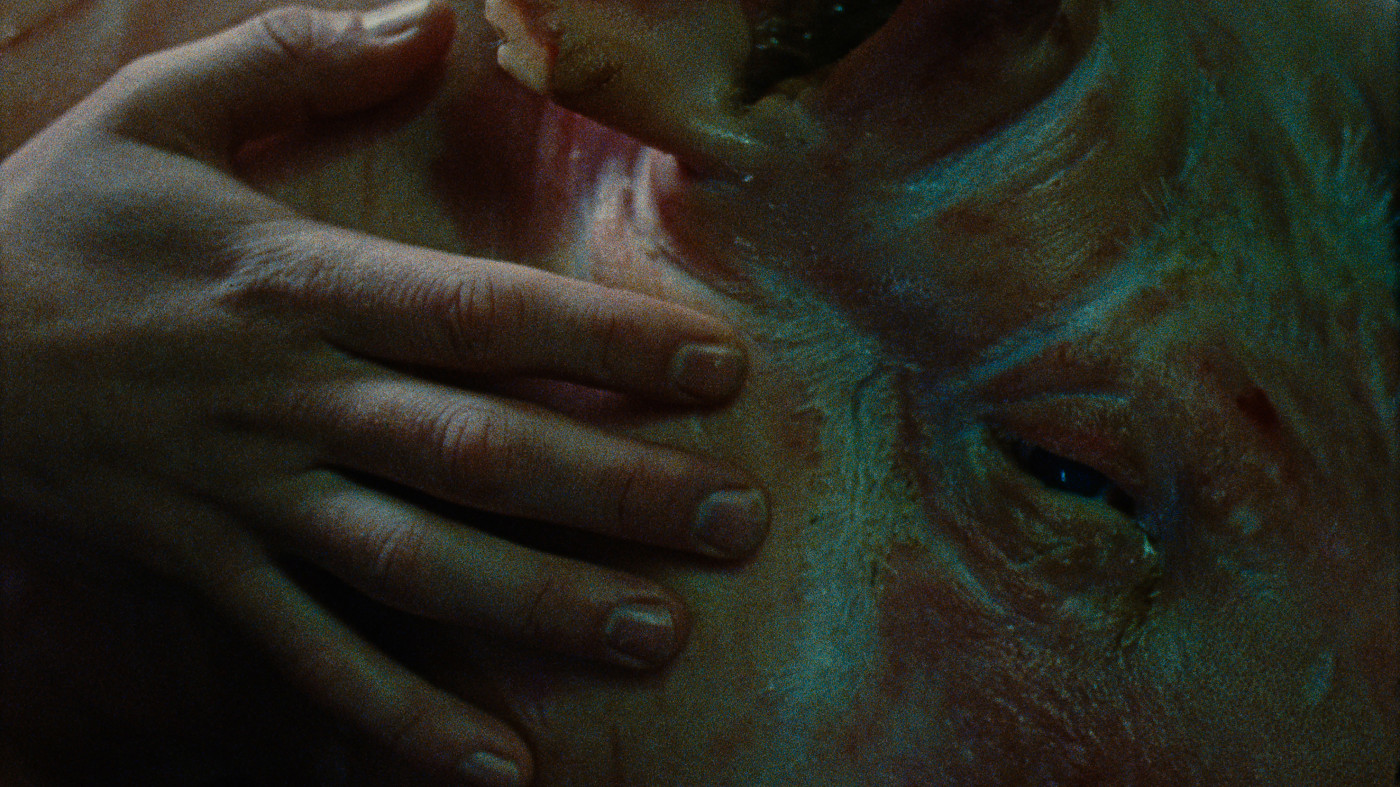
Is a hand still capable of affection in a place wherein touch has been rendered brutal? This is the compelling question at the heart of Skin on Skin (2025), writer-director Simon Schneckenburger’s graduation project at Filmakademie Baden-Württemberg and the winner of the European Competition Peer Award at the 31st Kortfilmfestival Leuven. Set in an industrial slaughterhouse in present-day Germany, the narrative is punctuated by a detached, banal cruelty: from the Eastern European immigrant workers who kill and skin pigs on the daily to the security guards patting down the workers before each night shift, bodies meet with mechanical aggression.
That is, all bodies except two. Bosnian worker Boris and German security guard Jakob seem to have found an unlikely alliance amidst this landscape of automated death and xenophobic hostility. The film opens onto a closeup of the two having sex in the backseat of a car, the features of their faces softened by the warm orange light of the afternoon. Yet the respite cannot last long. When they return to their nocturnal posts, Jakob and Boris barely exchange any words; their once intimate glances are now furtive and abrupt; close bodily contact, though not strictly impossible, hinges on the condition that it be made legible as routine procedure—the security check. Over the long hours spent working in each other’s vicinity, the men’s physical relationship subscribes to the same social structures that govern the slaughterhouse: Boris kills and eviscerates animals for little to no money; Jakob is paid to inspect Boris at work.
Disturbingly, these work hierarchies can often blur the line between a loving gaze and a controlling one. “Stop watching me,” Boris cheekily admonishes Jakob after another one of their car meetings, eyes still closed but keenly aware of the admiring glance searching his face. “It’s my job,” Jakob retorts, and by the time the two men find themselves alone again, we’ve seen enough to understand that this is no straightforward statement. In the damp confines of the slaughterhouse, Jakob’s scrutiny of Boris’s physique is equal parts labour of love and tool of domination. Nowhere is this more palpable than in the security room. After Boris turns him down during a common shift, Jakob locks himself away to masturbate to zoomed-in footage of a pixelated Boris, dehairing dead pigs with a blow torch. In stark opposition to the car scene, here Boris is unaware of the eyes that meticulously map out his every movement. To be sure, Jakob’s voyerism still has something of the obsessive reverence of a lover, and yet its contingency upon a digital instrument of surveillance lays bare the sinister power dynamics into which his very desire is inevitably absorbed.
Schneckenburger shows a deep understanding for how human connection is shaped by the place in which it unspools. Crucially, his sense of place is not only derived from modern technologies of ubiquitous surveillance. Talking to Cineuropa ahead of the film’s premiere at Karlovy Vary earlier this year, the director addressed the atmospheric force of his latest setting. The art department spent months building the set design inside a former slaughterhouse in Tauber-Bischofsheim, which had to close in 2018 following an animal welfare scandal. Even though most of the set pieces were new, the space itself retained, in Schneckenburger’s words, “a strong presence, a heaviness, a lingering sense of death that you simply couldn’t ignore.” During the shoot, the discomfort was less indebted to mental evocations of the factory’s history of violence than it was a product of the repeated physical exposure to the oppressive scents that had etched themselves into the enclosing walls.
The film filters this sensorial unease powerfully. No sooner have we begun to take in the full beauty of that initial naked embrace in the car than the scene cuts to digital footage of disemboweled pigs suspended lifelessly in the air, their hind legs attached to an overhead conveyor. Time and again, Skin on Skin collapses images of sensual touch—Jakob’s hand quietly coming to rest on Boris’s arm—onto closeups of a more clinical sort of bodily contact, as when Boris dehairs the pigs, or Jakob spreads his fingers over the wet surface of a carcass left out in the rain. Such parallels have a sobering effect: challenged by the slaughterhouse’s pervasive iconography of physical violence, the vision of the two men’s tangled limbs does not so much evoke emotional closeness as it emphasises the unrelenting brutality that it momentarily replaces. In a sensorial economy ruled by the sight, smells and textures of decay, can one living body ever enter into meaningful contact with another?
Perhaps it can, but only briefly so. If Jakob and Boris wish to escape the dehumanising pull of their surroundings, they have no choice but to physically flee. Soon enough, Jakob hashes out a plan: it will only take a moment to turn off the security camera in the admin office and retrieve Boris’s confiscated passport under cover of darkness, and then they can finally be off to Bosnia, to make a fresh start. Yet Boris, whose express longing to return to his home country punctuates the men’s brief encounters like a sad refrain, is reluctant to take his lover along. Amidst the escalating emotional tension that attends this revelation, Jakob must decide between a selfish instinct to keep Boris close and a responsibility, felt equally deeply, to keep him safe.
And so Boris leaves alone. When Jakob lays eyes on him for the last time, he’s but a tiny black spot on the CCTV screen, retreating ever further into the wide expanse of a sunlit field. It’s a heartbreaking moment of definitive loss, and yet there is something defiant about Boris’s newfound freedom, and about Jakob’s tears that fall so abundantly, in so cruel a place.
This text was developed during the European Workshop for Film Criticism #8—a tandem workshop set during Kortfilmfestival Leuven and Vilnius Short Film Festival—and edited by tutor Michaël Van Remoortere.
The European Workshop for Film Criticism is a collaboration of the European Network for Film Discourse (The END) and Talking Shorts, with the support of the Creative Europe MEDIA programme.





There are no comments yet, be the first!