
Making Light Work
In a short film programme curated by artist-filmmaker Randa Maroufi, our perception of global workers and labour—the main theme of this year’s FILMFEST DRESDEN—is questioned and, potentially, restored.
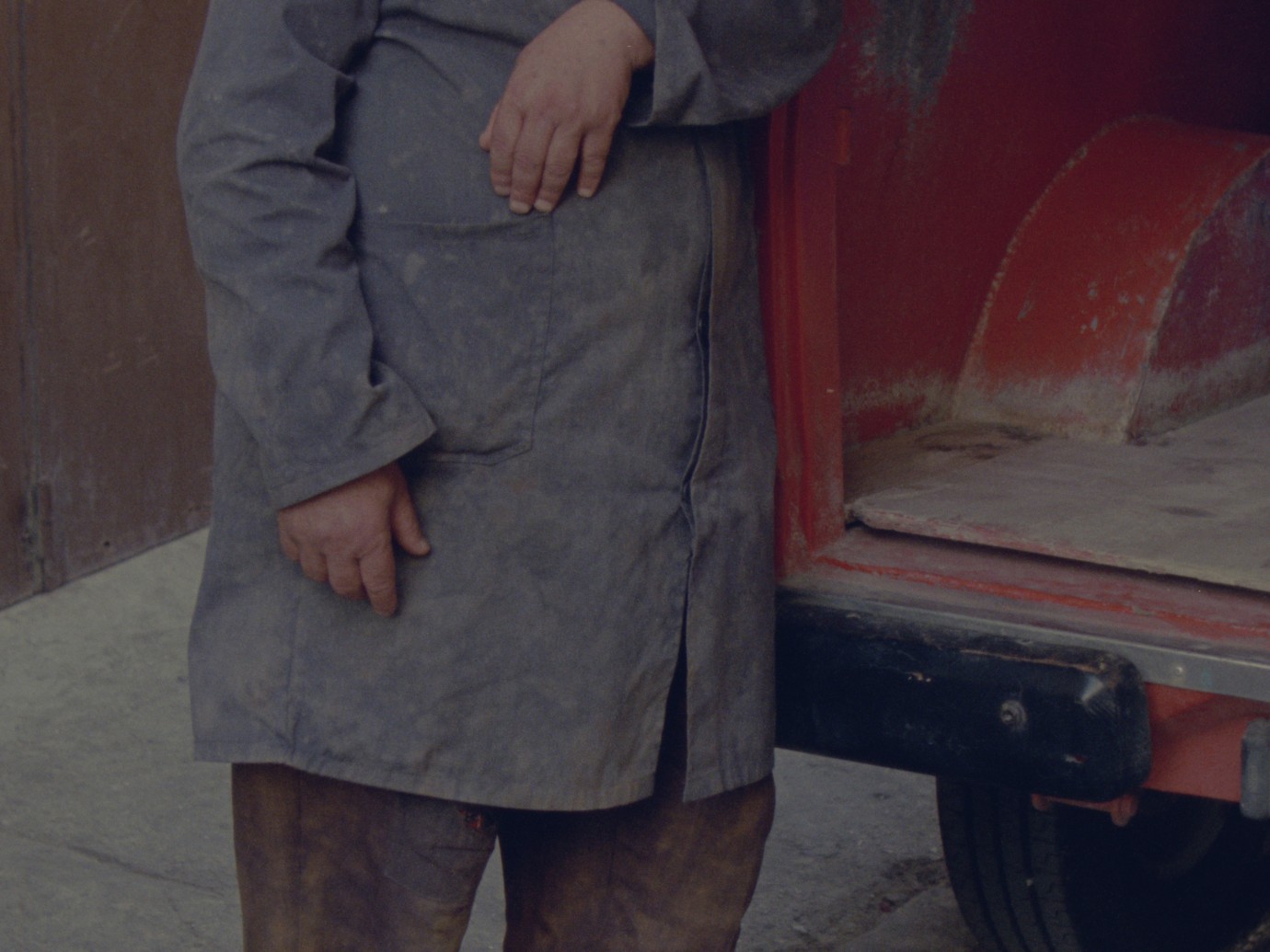
In March 2026, the betting company Polymarket announced it would open a bar in Washington, DC, called The Situation Room. Its announcement stated that the bar would feature over 80 Wi-Fi-connected screens, each plugged into various live data feeds, including flight trackers, newswires, stock tickers, and X accounts. Over a cocktail, the promise was that patrons, many of whom were political lobbyists and Congressional staffers according to Esquire, would be ideally placed to “monitor the situation” and, one would presume, be encouraged to bet on the outcome of said situation.
This Bloomberg-Terminal-as-entertainment is perhaps the most extreme and most grotesque example of hypercapitalist visual culture, but its features are visible far beyond a single Washington bar. Philosopher and media theorist Marshall McLuhan’s “global village”, where a Tunisian bleach-seller, a Chinese stoneworker, and a Serbian labourer can all be instantaneously connected to one another through technology, has come to pass, and the dominant images it produces are both immediate and immaterial.
Through Flightradar24, it is possible to follow a flight from the UAE to India in real-time. Yet the flight will bear the same simple yellow graphic, regardless of whether it is a low-cost airline taking migrant workers back home or a chartered jet carrying a transnational corporation’s executive. News of a ‘liberalisation’ in employment regulations in Argentina will reach London, Frankfurt, and Tokyo, and trigger flurries of trades before a teacher in Buenos Aires has even got out of class. Being globally connected, the great promise that the post-Cold-War internet age held, has been realised, and the images produced by this connection are generated ever more instantaneously and perversely, ever more disconnected from the material conditions they were created in.
This is the context for “What Remains of Gestures”, a programme curated by artist-filmmaker Randa Maroufi and presented at this year’s FILMFEST DRESDEN. The six short films in the programme jam up global capital’s systems of representing labour, in a way that filmmaking is especially well-placed to do, with its ability to set the pace at which we view its sound and images. They slow things down and reintroduce the labourer as a sensory body, not a far-off variable in a networked dataset. They ask us to take the time to feel what these acts of labour do to those involved and, in doing so, restore, if not agency, then at least dignity to our perception of these global workers.
All of the films’ subjects are situated in the geographical margins for a viewer in Dresden, or indeed anywhere in Western Europe or North America. It can be easy, therefore, to only think of their labour through the consumption of the products that they ship to us when our lives, their labour; their lives and our labour are all interconnected. Jonathan Brunner’s From Ecuador With Love (2025) makes this case through one of the most potent symbols of decadence: a bouquet of roses. To a recipient of these flowers, somewhere in the global supply chain, they would (hopefully) be taken as a gesture of love, their lack of utility a sign that the giver has spent their money purely as an expression of emotion.
None of that romance is present in Brunner’s journey of the industrial flower production line in Ecuador. An initial, almost two-minute shot of the still-uncut flowers is vibrant and still. As a trolley trundles through, snipping the stems that are ready, industry begins. The roses seem marginal against the machinery in which they are passed through, their main features being not emotional appeal but their delicateness, their thorniness, their fight to stay fresh. In short, all the things that make them a challenge to handle for the anonymous labourers operating under the hum of climate controls.
Row upon row of workers, some heavily masked to face the haze of pesticides, others gloved to shield their fingers from the stems they are tasked with handling, toil within a mechanised system where each rose is not yet a heartfelt message, but a thorn to be trimmed, a flower to be measured and sorted by size and tightly packed in secure wrapping. Nobody speaks; every movement is synchronised, controlled, and endlessly rehearsed. This system, which creates such cold rationality out of nature, From Ecuador With Love argues, does so both to its products and to its workers. Alienation and the global processes of supply chains operate very much in sync.
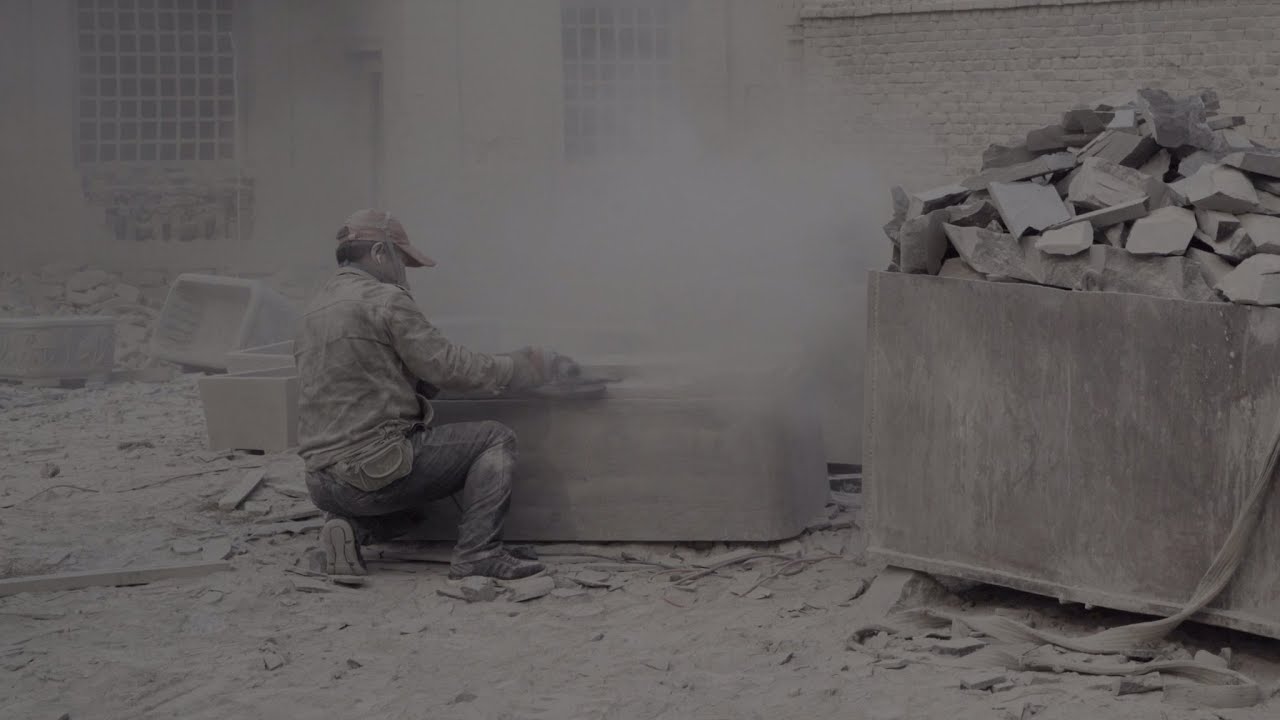
All Movements Should Kill the Wind (Yuyan Wang, 2019)
Capital would have us—particularly those of us in the global North—view labour in the abstract, something that happens “over there”, out of sight and out of earshot, with the resulting product arriving at our door in sterile packaging and a cardboard box with a dimpled smile printed on it. Like Brunner’s film, Yuyan Wang’s All Movements Should Kill the Wind (2019) is a reminder that labour is anything but sterile.
This study of a group of workers in a remote Chinese masonry is visceral. A soundscape of dull, industrial drones is frequently interrupted by the screeches of struggling angle grinders and the thunks of a sledgehammer. At times, the dust created from this work fills the screen, leaving us to navigate just through sounds, before a worker emerges from the haze. When we do see the workers, it’s not a clear vision; their faces and clothes caked in a thick layer of dust. Shearling coats are the closest thing to PPE, and their lungs no doubt are also taking in the particles. Work does not just make a product; it makes noise, smell, and pollution.
Sounds of labour are also central to Hicham Gardaf’s In Praise of Slowness (2023) and the way it portrays the bleach-sellers of his hometown, Tangier. Gardaf holds space for the calls of the bleach-sellers and frames them as a key part of the cityscape’s threatened sonic fabric. Often heard in the background, drifting in and out of earshot through an open window as the sellers walk from one street to another, it is centred here, with shots framing the seller’s mouth in close-up as he lists his wares: l’ouqda, javel. The calls are not fleeting, and as they are repeated, each time as clear as the last, their resonances increase. In just over 15 minutes, Gardaf is able to distill a sense of the nostalgia that this soundscape evokes for him, something which has been built up over decades.
As the filmmaker narrates, over an intertitle, “the ears tell the eyes where to look. The feet follow.” We hear the bleach-sellers describe their supply chain and the role they play for so many of the city’s shops, cafes, and bars, and their chants are as much a part of that economic infrastructure as the 5-liter bottles they carry with them. Perhaps it is only when Tangier, once abuzz with these workers’ melodies, has fallen silent, that their role as a compass for its residents becomes clear. A change in their livelihoods is inextricably linked with the same forces that are overhauling the city in which they live. Work and daily life bleed into each other, whether we expect it or not.
Idriss Karim’s Marta (1969) follows the titular woman at work and at home over two days, the markers of one setting mirrored in the other. Parts of a loom clunk up and down a roll of fabric that is being woven in the mill in one sequence; in the next, the same movements are as mechanically carried out at home to butter a slice of bread to feed one of three hungry children. A hand wiping a plate dry with a tea towel is followed by a close-up of another part of the loom swinging round and round in much the same way. The film can be read as an implicit critique of Poland’s socialist authorities at the time and the emancipation they were promising for women through the workplace. Employment in the labour market has not been a source of emancipation for at least this woman; it has simply created another site for her to carry out the gestures of toil she also performs in the domestic sphere.
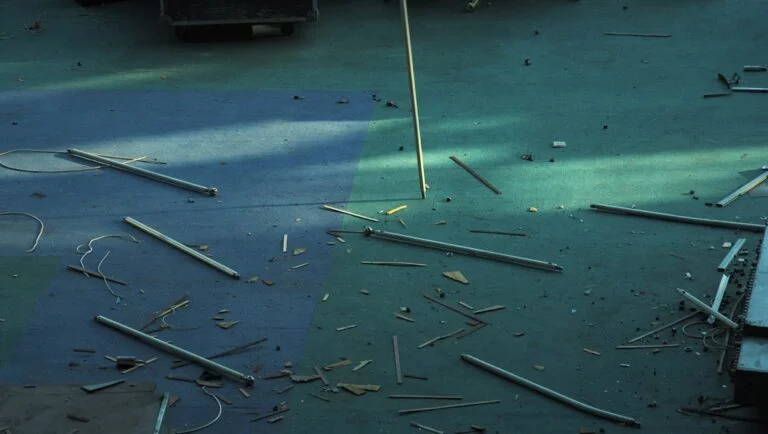
Inventory (Ivan Marković, 2025)
The entire programme challenges the notion of ‘free’ time. Even when not actively working, work is shaping each subject’s time. Marta’s leisure and labour share a gestural vocabulary; the moments of stillness in Ilir Hasanaj’s Workers’ Wings (2024) and All Movements Should Kill The Wind do not convey any peace or satiation, but instead an exhaustion so complete that the movements of labour can no longer be carried out. Work cannot be clocked out from when its temporal and physical demands are so extreme, it seeps into life as a whole.
In the case of Workers’ Wings, this seepage is irreversible. Hasanaj’s study of three Kosovar manual labourers, permanently injured whilst at work in unsafe, exploitative conditions, is a lasting testament to those whom the labour market has treated as expendable. The systems and individuals that have exploited their bodies are not spared indictment, but the focus here is on the workers themselves. Scars, X-rays, and other signs of hurt form part of a striking visual approach, with deep, pulsing washes of colour, inviting us to view these bodies and their injuries through a literal new light, giving them a presence where their employers tried to leave an absence. And yet, the three subjects of the film are not reduced to their injuries. They gather outdoors, ride a bike, and still do what work they can. Long, searching shots linger on their faces as they look out and their injuries become just one part in each of their ongoing, complex lives. Faced with a labour market that has dehumanised them, Hasanaj avoids a double exploitation of his subjects, allowing them to present their exploitation without being defined by it.
The films in this programme all share an attitude of dignity towards the workers, yes, but not for work itself. There is no Stakhanovite idealisation of the grit and pain of manual labour here. None of the films entertain the notion that work itself is rewarding. It is tough, time-consuming, and in the case of Workers’ Wings, life-altering. The dignity of their subjects stems from the endurance of labour, not as a result of it.
Ivan Marković’s Inventory (2025) is a clear illustration of this. Its setting, Belgrade’s Sava Centre, is loaded with grand promises and idealism now left empty. Built in the former Yugoslavia, its immense spans of glazing and concrete structures were meant to symbolise the height of the country’s modernity—a united fraternity of peoples open to both East and West, and where avant-garde cultural programming would take place. It has since been at points mooted for privatisation, left empty, and operated as a venue for the country’s cultural elite, far removed from the popular ideals it was designed to meet.
The workers we see are clearing out the remnants of the building’s interior. Sleek chairs are stacked up and pushed out two at a time. Flooring is pulled up, leaving dusty concrete. This is all in service of a renovation that is to come—perhaps—but the workers today are not doing any of that; they are simply dismantling a symbol of a more hopeful time. There is no glory in this work; it holds no promise of supporting a cause. It is hard, it is repetitive, but it is done. In calm silence, a generation of labourers who may never have frequented this building carry out work that holds little meaning to them. What is foregrounded is not the cause, but the effort, time, and skill that are present even when a task has no greater purpose. The effort expounded is worthy of acknowledgment in its own right.
“What Remains of Gestures” and its films do not set out to take control of the means of production, regardless of whether that is what may be desired of, or feasible for, a film to do. Rather, their role when viewed together as a programme is to, at the very least, take control of the images of production, reasserting that labour is a psychosomatic act. How work is carried out, where, and by whom has global implications. We are used to seeing some of these implications discussed endlessly—a delayed shipment, an increase in unit price. Randa Maroufi’s programme uses the lights and sound and time of filmmaking to make visible the other implications, that are lasting and embodied, those that cannot be speculated upon from a bar in DC.