Making Room
Interview with Kevin Walker and Irene Zahariadis
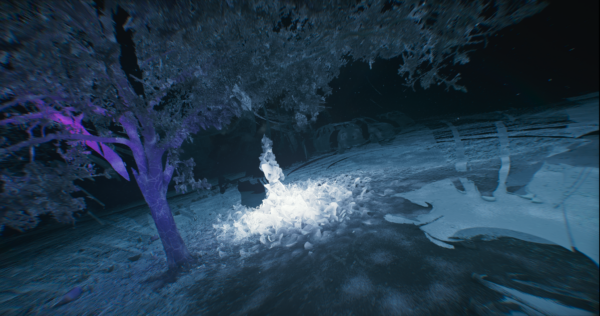
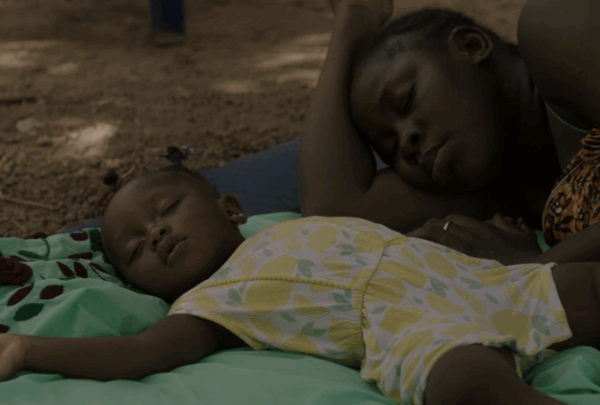
In Things Hidden Since the Foundation of the World, a group of elderly villagers must move the remains of their ancestors to a mausoleum at the peak of the mountain of Prophet Elias. The film was nominated for the New Critics & New Audiences Award 2026.

There is a reality of the Greek remote islands and villages that never makes it to the glossy postcards. In summer, they boom with the noise of tourism and the return of the diaspora, a temporary resurrection that, come winter, gives way to empty houses and silence. This side of a small volcanic island in the South Aegean Sea, named Nisyros, is the backdrop of Kevin Walker’s and Irene Zahariadis’ Things Hidden Since the Foundation of the World, a short film at the intersection of documentary and fiction. In it, the depopulating village of Nikia faces a lack of cemetery space, as a result of which the local priest urges the last remaining inhabitants to exhume their loved ones and make room for the newly deceased.
Growing up in the Greek provinces myself, the pragmatism of this proposition felt instantly familiar, almost habitual. As ominous as it may sound to a Western audience, it is a lived reality for many and, as I learn from interviewing the directors, for Irene’s father. When her grandmother passed away, thirteen years after being unexpectedly widowed, it was her father who was tasked with exhuming the remains to consolidate them in the family grave. “Personally, digging your parents’ remains, to me, sounded so alien,” admits Walker, highlighting the difference between his co-director’s cultural upbringing and his own. “In America, when a loved one dies, we sort of push it to the side and sweep it under the rug.” But in Nikia, there is no rug to sweep death under. Without a funeral home, the family needs to handle all arrangements on their own, the short film reminds us.
The story first came to Walker’s attention while he was visiting Nisyros with Zahariadis, hearing accounts from her family and other locals. To him, the material immediately carried a cinematic quality. For Irene, however, coming around to making a film about it was more complicated. “It was very difficult for me, both at the beginning and throughout the process,” she says. “There were moments when I struggled deeply, because I felt I was exposing something extremely intimate about their lives, knowing my dad would see it on screen. But in the end, it became healing for him as well. He was very moved by it and felt that his story had been told.”
Zahariadis’ parents are two of the (only) eleven permanent residents of Nikia, a few of whom also appear on screen. One of the most intimate and humorous scenes features Mr. Giorgos and Mr. Kostas, two old friends—the latter recently celebrated as the oldest person in Nisyros, at 101—who are caught chatting in the street. And what do they joke about? Death, of course.
Zahariadis’s role was crucial in bridging the language barrier. Having spent her early childhood in Nisyros and then a few years in Athens before moving abroad, she was tasked with guiding the non-actors and communicating what was needed for each scene. But in some cases, that wasn’t necessary. “A lot of them actually didn’t need much direction,” she says. They’re naturally charismatic and funny. Take these two friends, for example,” referring to Mr. Giorgos and Mr. Kostas, “We never told them the film was about death. They just started talking.”
This casual stoicism, or what Irene describes as a “healthy toughness”, raises a critical question about the perception of loss in the Greek provinces. Are these people used to death because they are also used to people leaving all the time? Like many island communities, Nisyros also experienced waves of emigration in the mid-20th century, with New York emerging as an extension of “home” for the Nisyrians. Over time, more and more people across Greece have left the villages and small islands for the promise of a better future in larger cities.
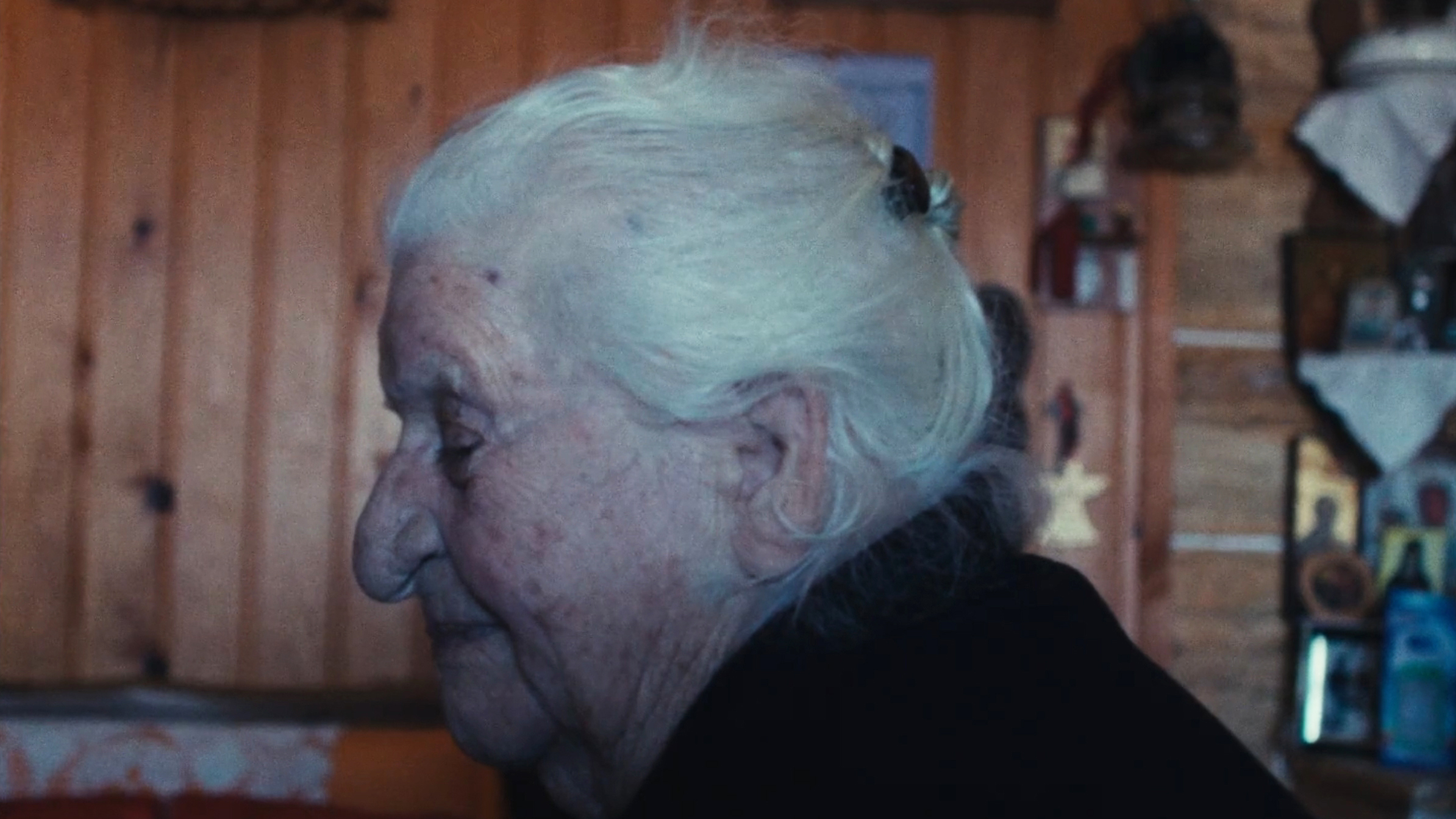
Things Hidden Since the Foundation of the World (Kevin Walker & Irene Zahariadis, 2025)
Today, Zahariadis’ father is the only one of four brothers who still lives there. The film’s visual landscape mirrors this: white and blue houses stand empty, waiting for owners who may never return. Even the famous cobblestone square of Nikia—considered by some one of the most beautiful in the Aegean—feels deserted in the film, with nothing but a single table and three empty chairs, echoing the emptiness of Greek islands during winter.
And yet, just as this emptiness threatens to dominate the frame, the village is brought back to life through the filmmakers’ playful interventions. Grainy Super 8mm recordings from decades past fill the screen with images of a communal life that once felt ordinary: people cooking, everyday gatherings, and children at play. Intimate and unrepeatable, the archival footage belongs to Irene’s father. “He loved taking videos of everything,” she says, admitting it “felt so special” to be able to include those parts in the short. One toddler on-screen, she adds, is her older brother. “You can’t write this kind of stuff. It’s so authentically captured in the moment.” The footage reveals Nikia in a different era, when families who had moved to New York would return with their children, and the village felt full again.
Alongside Mr. Zahariadis’ archives, the film finds another unexpected way to reanimate the village. As the camera moves through the small neighbourhoods and now-abandoned houses, voices and dialogues from classic Greek films (of the 1950s and 1960s—known as the Golden Age of Greek Cinema) fill the soundscape. These excerpts remain deliberately unsubtitled, unfamiliar and opaque to non-Greek speakers. As a native Greek speaker myself, I couldn’t help but ask about the decision to leave them untranslated. “I don’t think everything is meant for everyone to understand,” Zahariadis replies. “Subtitles would make people analyse them in a different way.” For example, the ambiance reminds her how lively Greek homes can be, and the importance of capturing a feeling, rather than intellectualising it. The task of finding those audio excerpts fell to Walker, who also edited the short, imbuing it with a different nuance. Approaching those films as a non-native Greek speaker himself, he treated them as pure sound that could carry emotion without explanation. While editing, he searched through Greek films from the 1950s, following what he describes as “a pull towards texture”, to highlight scenes that suggested a happy domestic life and an everyday liveliness beyond language. In capturing the “fullness” of the lives left behind, the film also honours the dead of Nikia, those who still sometimes visit their loved ones to sit at the same table, as the film so cleverly suggests in both visuals and atmosphere.
That attention to texture extends beyond sound and into the film’s visual language. Walker shares that he spent almost a year figuring out how to make the look of the film match, while working between digital and 16mm to emulate the Super 8 found-footage, but without shooting on 8mm themselves. In terms of the effect the co-directors aimed to achieve, he adds that they “wanted the image to feel dirtied up, degraded.” We spent a long time refining that, so that when we came out of it, everything felt visually seamless, like it had all been shot with the same camera,” he says.
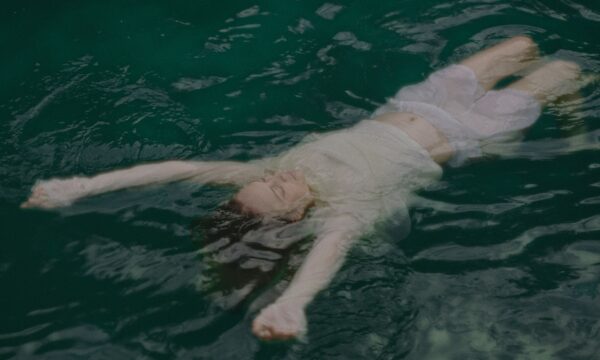
What began as an idea for a script, inspired by real events, gradually shifted once they arrived on the island. Zahariadis’ role became one of mediating presence and trust, allowing people to be spontaneous and improvise, while Walker focused on shaping the narrative structure. “The way I think about it,” he says, “is that I was making a fiction film, and Irene was making a documentary.” After all, Things Hidden Since the Foundation of the World could never be considered strictly a documentary; in a film where chairs sometimes move on their own, and the past is as present as it is on those village streets, the ghosts of Nikia have their own say.
But does the haunting presence extend into the screenings themselves? Walker recalls the first time they showed the film in Nikia last summer: a projector was set up against the wall of what used to be the school, and the whole village gathered to watch. “It was fascinating,” he says. “People were cracking jokes, dogs were barking, kids were running around. We’re used to watching it in festivals in Rotterdam or New York, in very quiet spaces. Watching it in Nisyros, I realised for the first time that you can have fun with [our] film.” Zahariadis remembers the joy on the villagers’ faces: “Kostas and Giorgos were so excited to see themselves. A lot of them had never been to a movie theater before. Seeing themselves up on the projector was a once-in-a-lifetime experience.”
Whether the film is fiction or documentary becomes irrelevant. It is perhaps best understood as a census. It counts the living, who are few, and the dead, who are many, and gives them one more chance to exist together—if not in Nikia, at least within the frame of the screen.
Things Hidden Since the Foundation of the World was nominated for the New Critics & New Audiences Award 2026 at Lago Film Fest by Alexandra Sirotenko, Cindy Chehab, Mai Nguyen, Najrin Islam, Raouf Moussa, and Tania Hernández González, the participants of the European Workshop for New Curators #2.
The European Workshop for New Curators and the New Critics & New Audiences Award are projects co-produced by the European Network for Film Discourse (The END) and Talking Shorts, with the support of the Creative Europe MEDIA programme, and in collaboration with This Is Short.