
Memory in Orbit
Forgotten Spaceman
Blending public and personal archives, Forgotten Spaceman explores the lost dreams of exile through the intertwined histories of a cosmonaut, a family, and a country.
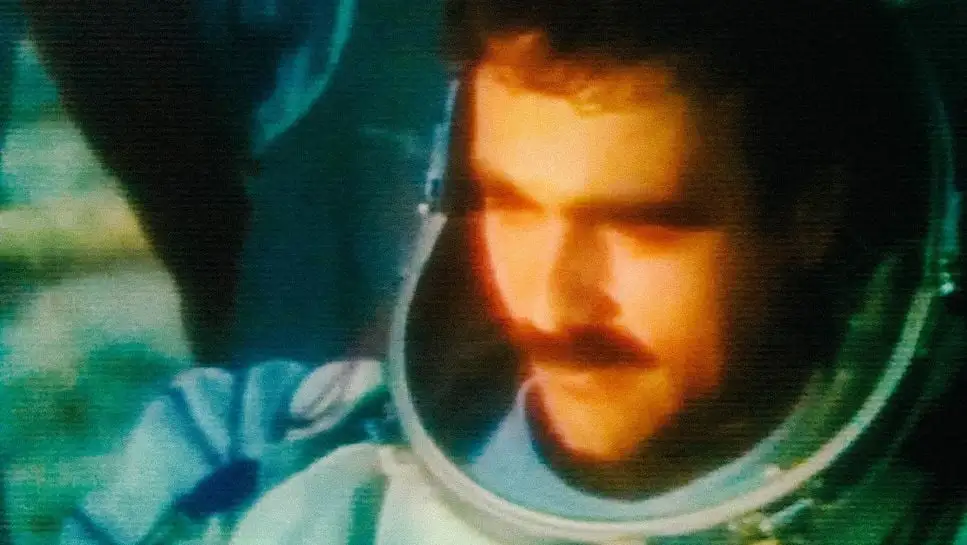
On July 6th 2026, the first and only Afghan cosmonaut, Abdul Ahad Momand, received a state funeral in Kabul. Living in Germany at the time of his death, his body returned to a country still marked by the political turmoil from which he had fled over three decades before. In such timing, Forgotten Spaceman arrives as an unintended obituary. This reflective documentary from Elham Ehsas blends public and private archives, connecting the director’s own family history to that of the cosmonaut, tracing both against the destiny of Afghanistan and its citizens from the end of the 20th century to the present day.
Forgotten Spaceman addresses the inherent challenge in making sense of Momand’s place in Afghan history. While on the one hand celebrated for making Pashto the fourth language broadcast from space, on the other his historic spacewalk was facilitated by the Interkosmos programme which was, during the Cold War, an important tool of Soviet soft power. As Ehsas identifies, this made the nature of Momand’s feat politically contested. As much as he signified the astronomical potential of the Afghan people to those rewarding his miraculous return with garlands of flowers, to others supporting insurgent groups it was tainted, proving that Afghanistan existed within the Russian sphere of influence—or in one bit of deadpan wordplay by Ehsas, “still in Russia’s orbit”.
One of the central inquiries of the film is how to discuss this achievement outside of a partisan discourse of Cold War fault lines, of Operation Cyclone versus Soviet air raids. Forgotten Spaceman claims the right to mourn a nation’s lost future for its own sake and not merely as a footnote in campist debate, grounding its argument on humanist foundations. Though this approach at times sands off the edges for a more tidy, universalist appeal, it is a strategy that makes the most sense in the context of the film’s subsequent focus on migration and displacement.
A single photograph provides a branch and a crossroads for the themes of the film, this being the opening image of a reporter conducting the first post-reentry interview with Momand. In the first instance, the shot introduces us to this famous public figure and his achievements. Returning to the same image halfway through the film, a newly revealed detail shifts the focus from public to personal archive as the journalist is identified as the director’s own father, someone with his own role on the stage of Afghan history. A further stream of photographs evidence this, with Ehsas searching for his father’s face within the frame—sometimes central, sometimes a background actor—interviewing “presidents, film stars and warlords.” What the two men share is not just a proximity to grand events but a vulnerability to them, both being forced to flee the country in different moments of violent transition: Momand in the wake of Soviet withdrawal and the fall of the Najibullah government, and Ehsas’s father with the rise of the Taliban. Ehsas’s narration makes explicit what is lost in this uprooting: Momand is displaced from his roles as deputy minister and cosmonaut into a life as an accountant, while his own father, once a storied recorder of national history, finds himself working in a crisp factory in London.
While a decade and very different political dynamics separate their respective exiles, where the experiences of these men overlap provides the thesis of the film. As its elements cohere, the story of Forgotten Spaceman becomes one of how the loss of one’s homeland squanders capacity for human flourishing, or as Ehsas articulates, how it “steals what you were meant to give the world”. This loss is presented not only as an individual injury but a collective one, for Afghans and for humanity. Ehsas speaks to Momand in the second person throughout, recounting his father’s story as well as the story of Afghanistan: “Dear Mr. Momand, while you were in the sky, chaos continued on the ground, chaos continued on the ground”. While this direct address heightens a feeling of intimacy and familiarity in the film, it also implies a distance wide enough to necessitate epistolary communication. It is an approach which well captures the painful condition of diasporic exile, separation marked by a longing to return and reconnect.
The way Forgotten Spaceman utilises some of the classic strategies of desktop documentary foregrounds that this is not just a film about the history behind images, but the history of their circulation and consumption. Surveying the dominant narratives about his country of origin, Ehsas comments, “they know about our wars and refugees but […] not about the Afghan who flew.” Performances by Afghan musicians are placed alongside images which have more regularly defined the country to the Western world—Mujahideen fighters, stinger missiles, tanks and aerial assault. In moments reminiscent of Adam Curtis, we move between these contrasting sets of images as if they were different realities, trying to find a path from one to the other.
The searching nature of the work is accentuated by its visual texture, in washed-out RGB with CRT scan lines flowing upwards throughout. At times the archival material is distorted through proximity, zoomed in so much that images blur and decay. The faces of figures riding on tanks lose their features entirely, and a bomber plane judders into view at a frame rate inadequate to the level of scrutiny it is under. Physically pressed up against the screen, we accompany Ehsas looking for clues, unable to make sense of history as presented.
This sense of hyperopia recurs most intensely towards the end, when Voyager 1’s famous photograph of a distant Earth is enlarged beyond all recognition, the entire planet represented by approximately eleven pixels. Invoking and paraphrasing Carl Sagan, Ehsas narrates that at this level of dissolution “we can’t see the borders we die for or the lines that make us refugees, just a pale blue dot.” The perspective taken echoes the so-called overview effect, reported by cosmo- and astronauts as an overwhelming feeling of common humanity when seeing Earth from above. While this shift of perspective is well suited to the moral thrust of the film, this idealism can feel at times out of step with the way in which space exploration operates today as an extension of terrestrial power projection, now less so by states than by private companies and erratic billionaires. It is exactly our inability to create a common framework across borders that has led to an atmosphere polluted with satellites and moon-scarring space junk, and even the existential epiphany outlined above has been packaged for consumption.
While the film’s concern with lost dreams does not necessarily negate this view, it does result in a more suspended, timeless perspective that sometimes eschews the knottier material of waking life. Nonetheless, Ehsas exhibits an impressive economy in his storytelling and a deft ability to amplify the emotional resonance of these images, resulting in an overall artful expression of the human rights documentary. As an elegy and a tribute—to a figure, to a family, and to a country—it stands as a successful and sensitive accomplishment.

There are no comments yet, be the first!