
No Easy Resolutions
Sudan’s women in the shorts of Suzannah Mirghani
A focus on experience rather than outcome is central to Suzannah Mirghani’s work, whose films shine a light on her Sudanese heritage, with nuance drawn from the community that birthed her.
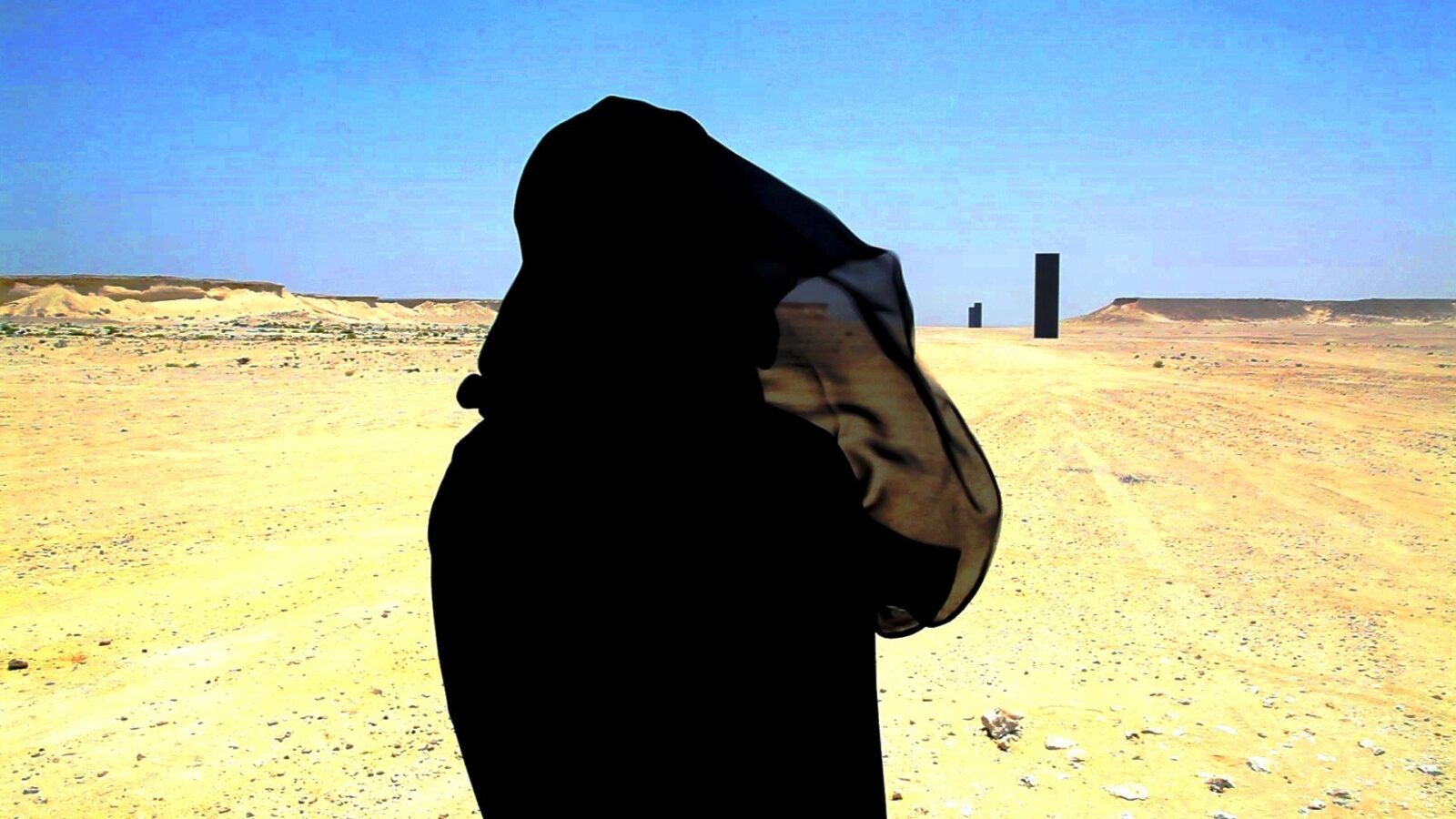
The Sudanese-Russian filmmaker Suzannah Mirghani has always straddled multiple worlds. Raised in Khartoum, Sudan, before moving to her current base in Doha, Qatar as a teenager, she offers a global perspective on distinctly Sudanese stories. While those stories are not directly related to her own upbringing, they shine a light on her heritage, with nuance and specificity drawn from the lives of the wider family and community that birthed her.
Her first feature, Cotton Queen (2025), debuted at the 82nd Venice Film Festival, which has resulted in a spike of festival interest in her short-film work. A focus on her work was staged at the much-loved Minimalen Short Film Festival, where both her shorts and feature were screened, revealing the incredible scope of Mirghani’s imagination. Her films vary in tone and form but are structured around complex, intersectional feminist dilemmas that take on all the intricacies of Sudanese life. They begin in the middle of social arrangements that are fully understood by those inside them and rarely questioned. What her films observe is not conflict in the dramatic sense, but in the way daily life proceeds under conditions that limit speech, delay decision, and distribute authority unevenly. Sudan is not introduced or contextualised. It is present as a set of conditions that shape how people move, speak, and accept as their lot in life.
Mirghani’s films have, for better or worse, been placed in a new context in the past few years after the Sudanese revolution of 2019 seemed to open up a new era for the country and its artistic output, only for a terrible civil war to erupt in 2023, crushing the dreams of millions across the country and the wider diaspora. Mirghani’s work, both before and after the war, captures the glimmer of hope that still remains, for a future grounded in the liberation of Sudanese women beyond the present, far-reaching violence.
From her earliest short, Hind’s Dream (2014), Mirghani already establishes her refusal to neatly package the experience of Sudan’s youth. Hind, her protagonist, is not given a conventional narrative arc. Neither is she framed in orientalist cliches about the oppressed, nor as quietly preparing for departure from the land she occupies. The film follows her and her dreams without insisting on conventional notions of character development. The vision described in the title remains unresolved and open to interpretation, but it reflects a reality in which desire does not always take a form that can be safely articulated. In Sudanese contexts, where better worlds for us all are frequently discussed, it captures the resilience of believing in a future that has yet to materialise.
Within the film’s nine-minute runtime, there is no time for transformation, and none is offered. Hind exists within the frame without being pushed into an easy metaphor. The camera does not search for resolution. It accepts her presence as a sufficient reason to hope. Its opaqueness is not neutral; it is a choice to resist narrative extraction to speculate on a specific path forward. Hind’s Dream refuses the idea that solutions must be articulated in order to be validated.
This focus on experience rather than outcome is central to Mirghani’s work. Her films are concerned with how the self evolves, rather than how their existences resolve. In Caravan (2016), we deal with a liminal space, but not one that introduces change. Set in Doha during an infuriating traffic jam, the film flows through a cross-section of the city’s multicultural inhabitants as they consider their place in the world. They mull over their careers, their school work, and get lost in music, all while untethered from the land around them. Figures move across space, but nothing in the film suggests that motion leads elsewhere in any meaningful sense. The land remains steady, indifferent to passage and reflecting the largely transient population of the Gulf. Instead of framing travel as escape, labour, or metaphor, the camera simply observes it and asks the viewer to consider their own place in society.
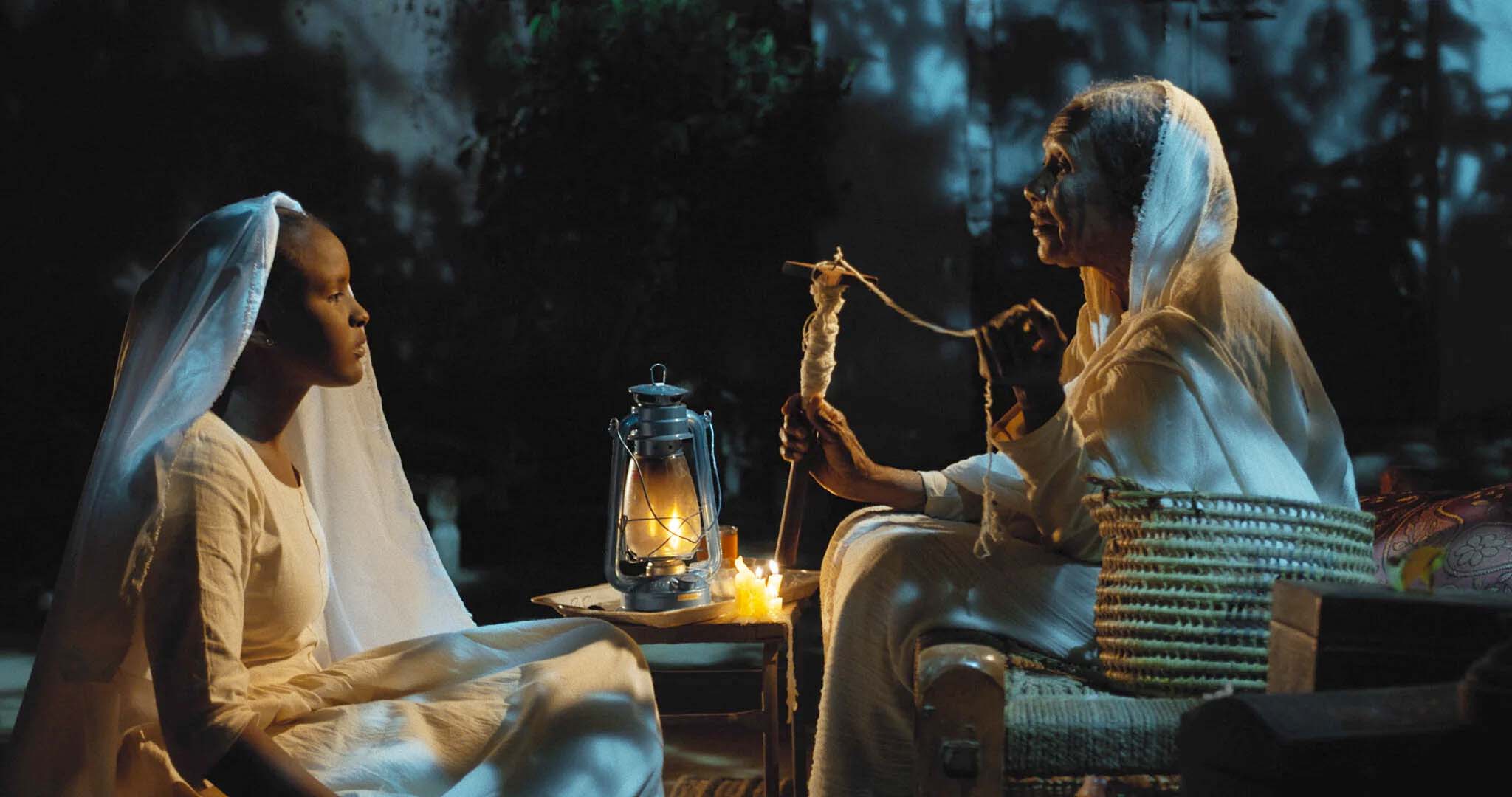
Al-Sit (Suzannah Mirghani, 2020)
In Sudan, which is currently facing the largest displacement crisis on the planet, movement has long been shaped by necessity. Migration and travel have often been responses to economic pressures or political instability rather than choice, and for many of its population, fleeing one’s home has happened several times in a short lifetime. Caravan does not reference this history directly, but the sense of being without a safe foundation is embedded in the film. The journey is neither hopeful nor tragic. It is habitual. By refusing to attach a single significance to travel, the film pushes against a cinematic language that treats movement as inherently transformative. Here, movement is simply a frequently hollow part of how life continues to march on. The film ends without arriving at a single destination—not an open ending in the conventional sense, but an acknowledgement that the journey, in life and in film, does not conclude, and a lack of closure feels accurate in a landscape that continually shifts.
With her following three-minute film, There Be Dragons (2017), Mirghani allows more tension to bubble underneath the surface. The short’s enigmatic title, suggestive of danger and fantasy, speaks to uncharted territory in old-fashioned maps and looks at the less-observed places and lives in Doha. The filmmaker, who also serves as cinematographer and editor on her shorts, commands a feeling of unease that accumulates through pacing. Lingering shots of flickering lights, kites eerily gliding through the sky without beating their wings, and self-playing pianos are noticed by no one in particular. Cutting between these slow-moving images creates a sense of freedom in being largely unobserved by anything but Mirghani’s camera. Life’s multitudes are present, but there’s a sinister undertone to the solitude of its experience. Eeriness as a quality extends across much of Mirghani’s work, which reflects a social reality in which limits are internalised early. In many Sudanese settings, particularly for young women, boundaries are learned through observation and anticipation. Behaviour is adjusted in advance, and the inner lives of women are determinedly ignored by the world around them. The film channels this condition without actually illustrating it, since the danger lies in what might never happen. The absence of attention becomes the subject.
For its build-up, There Be Dragons does not release its tension, no resolution offered. Instead, its end leaves the viewer in a state of suspension, mirroring the experience of living under unspoken constraint, where caution becomes habitual.
By the time Mirghani made Al-Sit (2020), she had expanded her formal scope, but her fundamental concerns hadn’t changed. The film centres on a young woman, Nafisa, in a Sudanese cotton-farming village whose family expects her to accept an arranged marriage to an ambitious young businessman, who also plans to bring prosperity to her community. The situation Nafisa finds herself in is so embedded in daily life that it’s framed as ordinary. Work continues, dreams are formed, promises are made. The rhythm of the village remains steady.
Shot in the Aezzazh village near Khartoum, the film captured a moment that felt like the cusp of an artistic renaissance. Mirghani returned to her hometown and found young non-professional actors to play the central cast, but didn’t hesitate to address the struggle to find enough young women to audition in interviews, and make work in a place where no filmmaking infrastructure existed.
But despite those obstacles, her short was a triumph, winning a litany of international awards and getting long-listed for an Academy Award. The global reception to Al-Sit proves the often-cited axiom, “the more specific, the more universal”, with this story of a 15-year-old in a cotton-farming village in Sudan seeking guidance through its matriarchal structures. Regarding the latter, the film makes it clear that the women hold the community’s wisdom, but their scope is limited. Nafisa’s mother, who approves of the potential union, is not presented as a villain, and power is exercised through care and spiritual guidance. The betrothed girl does not need to argue or be bullied into compliance, as the weight of expectation is enough. Tradition appears not as an abstract structure but as something maintained through meaningful relationships, thereby posing a challenge to resistance. There is no single figure to oppose.
Al-Sit centers around a teenager who does not stage a rebellion. She hesitates. She delays. She avoids commitment in small, but significant gestures. In contexts where a sense of self carries social cost, delay can function as a form of agency. The film does not romanticise this strategy or judge those who act otherwise. It presents her inner turmoil as a negotiation shaped by intricate circumstances in uncertain times.
The film’s ending offers no resolution and its ambiguity is not framed in any straightforwardly hopeful or tragic manner. It is a portrait of an evolving place as well as of a mercurial person. Al-Sit approaches this reality and inhabitant as precious by refusing to impose narrative closure. The village itself is shown with gentle grace, quiet and exquisitely lit in sparkling blues and sun-drenched oranges. It defies easy symbols of outdoor spaces coded as freedom, and interiors are not framed as confinement. The camera moves between them without assigning symbolic value because they are simply the spaces in which all the mess of life unfolds.
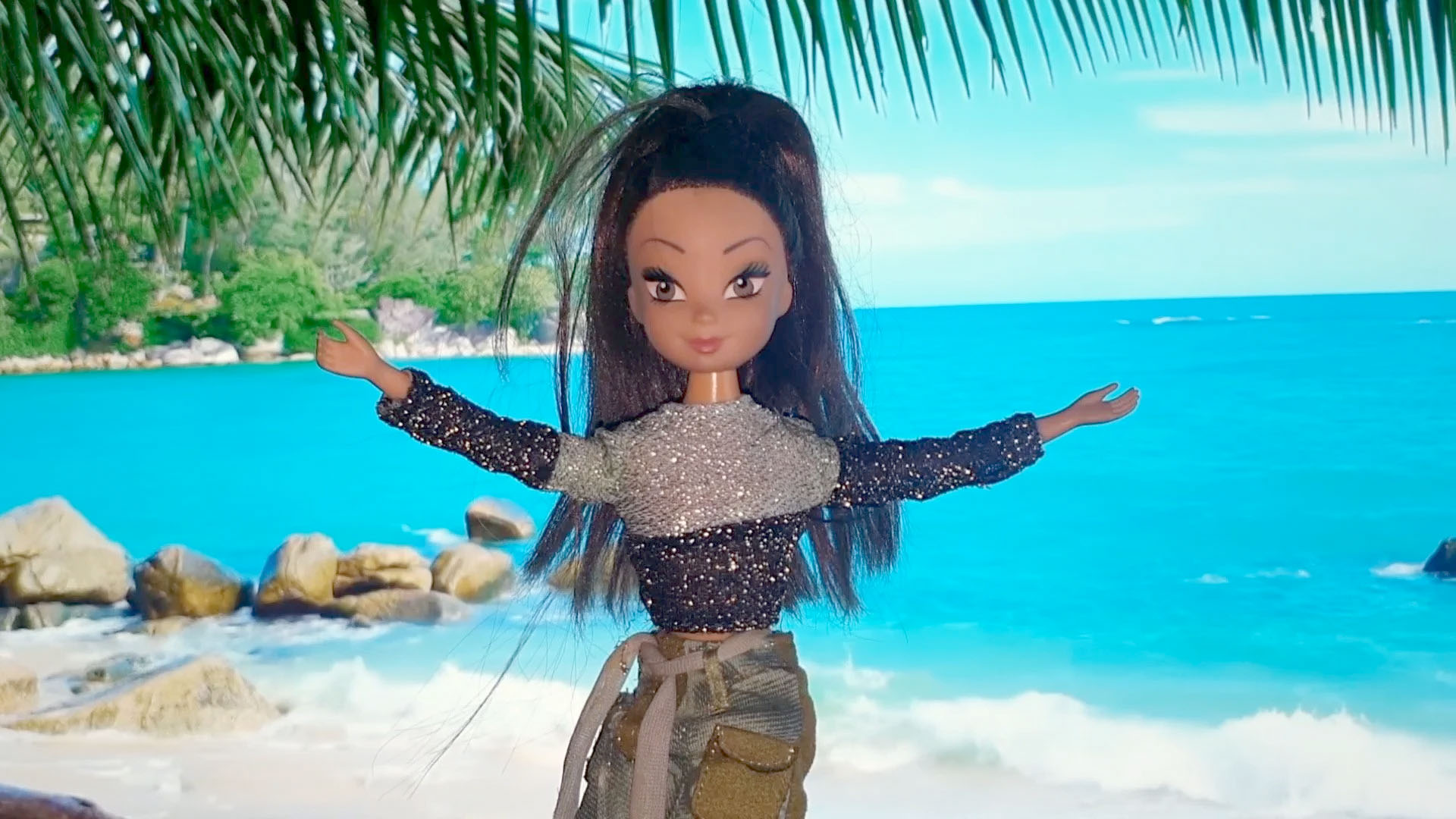
Virtual Voice (Suzannah Mirghani, 2021)
Her follow-up Virtual Voice (2021) shifts away from a physical setting, but, while shot on a mobile phone and rendered near-cartoonish through its colour and plasticity, Sudan remains present through language. It is a montage essay film in which a plastic doll and “ego warrior” is defined by the algorithms on her phone, creating a satirical reflection on social media, consumerism, and post-feminist propaganda. The film emerges from a moment during the pandemic when digital platforms became essential for political expression, where voices circulated without bodies and we saw the horrors of the world live-streamed on our devices. Speech appears fragmented. Hollow images surface briefly before disappearing. Communication and humanity itself feel unstable.
The film does not treat the virtual space as liberating. It also does not dismiss its utility. It stays with the ambivalence of public identity. To speak online is to reach others while remaining exposed and losing a little of yourself along the way. Sudan exists here across distance. The country is not shown, but it is present in what is being said and in how speech is shaped by interruption. The absence of bodies matters. Voices gain reach, but they lose grounding. The film does not offer a solution but notes the sacrifice as part of the contemporary condition.
In her latest short film work so far, Kamala Ibrahim Ishag: States of Oneness (2022), Mirghani turns her attention to the eponymous Sudanese artist whose work spans decades and is considered one of the true greats that emerged out of “The Khartoum School”, going on to international acclaim and recognition. The film does not attempt to summarise Ishag’s career or establish her significance through biography. Instead, it follows her thinking and her connection to the wider diaspora, where the concept of oneness is approached through practice rather than explanation.
Kamala Ibrahim Ishag’s methodical approach to filmmaking mirrors Mirghani’s own. Ishag’s work is often eerie but always highly considered, and the film does not move towards a singular purpose of her art. It allows understanding of their approaches to emerge gradually, but leaves space for ambiguity. By focusing on Ishag, Mirghani situates herself within a lineage of Sudanese women who have had to leave their country’s borders in order to thrive as artists. But across both Ishag’s and Mirghani’s work, Sudan appears not as a place that can be fully left behind.
Each of Mirghani’s films approaches similar conditions from a different position. Sudan moves between intimate villages and distant lands, between physical presence and cultural influence. The Gulf is a place that is never quite home. Whatever the space or context, these films do not announce their politics or descend into histrionics to prove their subject matters’ worth. What these films require is to approach them with curiosity and openness. Taken together, Suzannah Mirghani’s short films form a body of work grounded in a rich inheritance. As her runtimes expand and she grows as a filmmaker, Mirghani remains rooted, creating work that is elegant in form but screams with political urgency.