No Way Out of the Dark Forest
Veneta Androva on Spray and Pray
Veneta Androva’s 3D-animated documentary Spray and Pray plunges us into the dark side of the internet, where the anti-LGBTQ+ political agenda serves the economic interests of an unscrupulous minority.
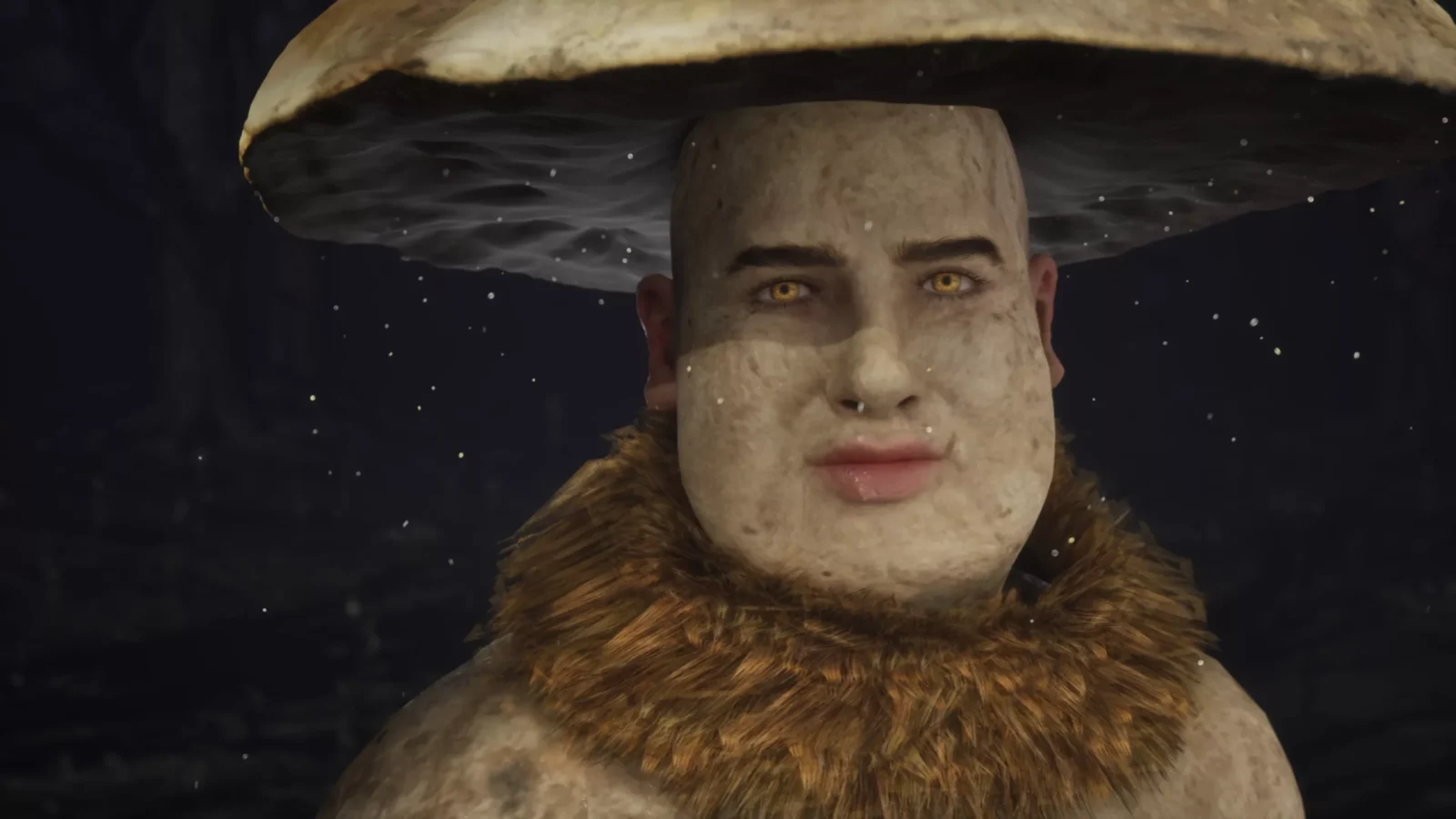
The internet is a dark forest: every new step might lead you to trip on a rotten branch. Suddenly, a huge anthropomorphic mushroom stands in your way. Its mushroom-shaped head has a humanoid face, sensual lips, and orange bulging eyes; an enormous belly sits atop a pair of stubby, fat legs. In a flirtatious voice, it speaks to you over an electronic rhythm that grows increasingly insistent. It announces enraging headlines that bait you to click on them: “Unseen gender orgies on US streets, children targeted (PHOTOS)”, “Protect the children: US scientists reveal dangerous diseases spread by transgender”. The mushroom starts moving; it happily pirouettes as it declares: “Italian textbook has turned gender ideology into everyday life!” (This last one I recognise immediately as fake, after the recent limiting of sex education in schools by the far-right government of my country.) Mushroom dust falls from the creature’s head like yellowish snow. To say the atmosphere is eerie would be an understatement.
Veneta Androva’s latest film, the speculative animated documentary Spray and Pray (2026), continues to reflect on a question she has explored in previous work: How do technological infrastructures, disinformation networks and automated media shape perception, political imagination, and social reality? “For Spray and Pray, I researched so-called mushroom websites in Bulgaria,” the Sofia-born filmmaker explained at a roundtable interview during this year’s edition of FeKK in Ljubljana, where the film was given a special mention by the jury. “These websites are news-like portals disseminating disinformation on social media. And the mushroom is, first of all, a metaphor. They are called mushrooms because they are created and spread quickly; they appear and disappear, similarly to the mushroom mycelium structure in nature. It was a very organic metaphor to start with.”
In The Dark Forest Theory of the Internet11 Konior, Bogna. The Dark Forest Theory of the Internet. Flugschriften, 2020. ↩︎, Polish researcher Bogna Konior takes a key concept from contemporary Chinese science fiction—Liu Cixin’s dark forest theory—and expands it to encompass every aspect of our online lives. She argues that the internet has transformed from a space for free speech to a scary place where deception and fear control the narrative, create national identities, and polarise politics. The internet is an entropic system, she argues: the more communication increases, the more disorder and conflict emerge. Androva physically portrays this dark forest in which the disorder is schizophrenic. Submerged by mountains of content, at the center of the dark forest of the internet lies—both figuratively and literally—the fake news.
The mushroom character has existed since the beginning of Androva’s process, first taking the form of a video installation in a gallery space: The Secret Life of Mushrooms, exhibited in 2023 at Structura Gallery in Sofia, centered solely on this androgynous fungal creature. “These mushroom websites look a bit ugly. They have a lot of advertisements about weird things that also look horrible. But then they have super attractive titles that you want to click on. So this is what I was thinking when creating [the mushroom creature’s] visual appearance: attractive but in the same way disgusting.”
After two years of research on the infrastructure behind the websites—in collaboration with computational linguist Tsvetomila Mihaylova and using Bulgarian-language models developed at the GATE Institute in Sofia—Androva analysed a corpus of collected headlines and articles and developed the film’s narrative skeleton. The resulting structure alternates between the mushroom creature announcing fake headlines and constructed interviews with blurred-faced CGI characters who represent the real people operating behind the websites. Visually, what appears to be a documentary is entirely composed of what Androva calls “synthetic content”: content she made herself. But though the form is fictional, the content meticulously sticks to the research.
Spray and Pray (Veneta Androva, 2026)
The term “spray and pray” is believed to have originated in email marketing in the 1990s: marketers sent out large volumes of unsolicited emails to unsuspecting recipients, hoping that some would respond or engage. This “spray and pray” approach stemmed from the desire to cast a wide net and see what gets caught, and it is used in the same way in a military or video-game context: shoot blindly and you will easily kill someone. This is how mushroom websites work: by spreading a huge amount of fake news across social media, on Facebook groups and private chats, somebody is bound to trip and fall.
Androva archived headlines from mushroom websites from 2023 to 2025, and even created some of her own. She found that the content of the headlines does not vary much: “It was very obvious that the gender-based disinformation is consistent.” While some political topics rose and fell sharply, with certain narratives reaching pronounced peaks right after the Russian invasion of Ukraine before gradually fading away, identity-based information remained present and consistently aggressive. “This is why I found it urgent to concentrate my research on [gender-based disinformation], because it comes from such an obvious agenda: it’s the same thing again and again,” she says, elaborating on the central role of a word like gender, which was never explained or translated in Bulgaria. “It became this monster word. If something’s wrong, then it’s just gender.” Androva started archiving all articles with gender as a keyword, and when she started looking more broadly at identity-based disinformation, the anti-immigrant narrative appeared. “Terrifying VIDEO shows how refugees with knives can break into your home,” says the mushroom creature, intentionally designed to appear gender fluid.
Androva’s work lives in the space between what can be documented and what must be imagined. “For me, speculation is a method to approach realities, or to make realities tangible, by using a synthetic construction.” It’s not about replacing facts with fiction, but about “trying to get a sense of reality” that otherwise would be difficult to grasp, by piecing together speculative evidence with real evidence. When choosing to make a film about fake-news websites, the most unsettling path is that of a constructed documentary in which scripted testimonies, delivered in distorted human voices, alternate with machine-learning experiments. The line between the real and the fabricated is therefore completely blurred: it is easy to be tricked on first viewing into believing that the interviews are real, just like someone might believe fake news they just received.
One of the CGI characters interviewed in the film notes that he isn’t sure whether the content he keeps sharing with his friends is real. He says: “But tell me, what news is real? Is there even such a thing?! As the saying goes: everyone decides for themselves.” That phrase became commonplace in Bulgaria during the pandemic, fueled by a very aggressive disinformation campaign against vaccines, which was ultimately effective. Of course, everyone decides for themselves if the ecosystem is unsafe. Reality is so subjective; a couple of hours spent browsing the internet seems to suggest that fending for oneself and spreading misinformation simply means adapting to an environment—a dark forest—where deception is safety. People participate in the fake news machine because the alternative is scarier: being its victim and getting lost in the woods.
This is the bitter note on which Androva ends her film: the mushroom websites are a profoundly human-made infrastructure, and the people spreading fake content remain more effective than the algorithmic methods designed to automate it. Human agency, then, is fundamental to how this mycorrhisal network of disinformation functions. This is what makes Spray and Pray so disturbing and allows the bitterness to stay with you long after the 16-minute film ends. Androva’s research captures a specific moment in Bulgaria’s internet history. But the landscape is changing: as AI advances and algorithms grow ever more sophisticated, it remains to be seen just how much darker this forest can get.
This text was developed during the European Workshop for Film Criticism #10—a tandem workshop set during FeKK – Ljubljana Short Film Festival and Bucharest International Experimental Film Festival (BIEFF)—and edited by tutor Yun-hua Chen.
The European Workshop for Film Criticism is a collaboration of the European Network for Film Discourse (The END) and Talking Shorts, with the support of the Creative Europe MEDIA programme.