
Petrol Station Lesbians
Bleifrei 95
The petrol station at the heart of Bleifrei 95 feels like its own universe: a cruising spot imbued with lesbian life and possibilities, and a place to come of age for the film’s protagonists.
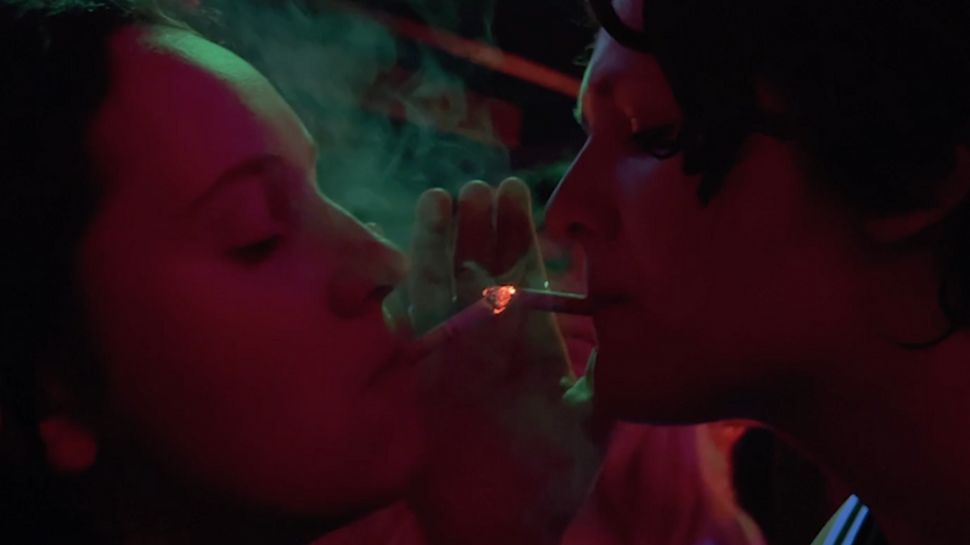
Within a few minutes, Emma Hütt and Tina Muffler’s short film Bleifrei 95 establishes its seemingly contradictory setting: a rural petrol station as a lesbian11 The term “lesbian” is used in different ways by different people. My impression of the film is that lesbian is meant as a broad descriptor of a specific culture that excludes cis men, and often (but not exclusively) describes women, who are sexually/romantically involved with women or non-binary people. ↩︎ meeting and hookup point. The concrete landscape, neon signs, and flat roof architecture exude an immediate familiarity, perhaps because, even if not the same, petrol stations in most places tend to be similar in structure and setting: far from what’s considered “culture” but often in close proximity to “civilisation” (a motorway and fast-food restaurants), never comfortable but occasionally comforting.
In this film, such an environment is imbued with lesbian life and possibilities. It’s the formative place of the protagonists’ youth, and while it’s still where Toni works (and fucks), Aino and Lolly seem to have moved away. The trio’s enduring friendship serves as a contrast to the transactional nature of the petrol station: a queer-lesbian cruising spot, where flirty glances are exchanged, or where an ostensibly heterosexual mother has a quickie as her husband and child wait by the car for her return.
Cruising and sex as brief and transactional are more often attributed to queer men. For the characters in this film, though, sex is urgent, sloppy, and fueled by need, and thus a departure from a certain “lesbian aesthetic”, where sex between women is a slow and careful act, shown in warm lighting and with tasteful shots of semi-nude body parts or close-ups of faces in orgasmic pleasure. Instead, consecutive sex scenes are filmed looking upwards from inside a toilet bowl and end with a golden shower for the camera. As the screen blurs, the short’s title card appears, referencing standard unleaded petrol. As viewers, we may find this disgusting, funny, or too obvious in its attempt to provoke, but it sets the scene for the somewhat juvenile behaviour of the film’s protagonists and forsakes any notion of respectability politics.
If the petrol station works as a cruising spot with fleeting encounters, it’s the introduction of the bar that ultimately works to establish a sense of lesbian place-making in Bleifrei 95. The bar is the spot where Aino, Toni and Lolly unite to celebrate Aino’s engagement. This outwardly happy occasion brings underlying tensions and secrets to the surface: Toni drunkenly babbles about previous “bro sex” with Aino and takes the piss out of Aino’s impending marriage, while Lolly starts publicly making out with Aino’s mother, thus revealing their illicit age-gap affair. These conflicts could’ve played out anywhere, but by placing them in a lesbian bar, the film avoids treating the protagonists like isolated characters and instead as part of an environment frequented over decades by generations of lesbians or queer women to drink, smoke, and gossip.
The setting in Bleifrei 95 feels like its own universe, one that is at once recognisable and elusive: while the petrol station and the lesbian bar could generally exist anywhere, it’s their proximity to each other that makes the film feel like an alternate reality, where an entire motorway service area is populated by lesbians. The film hints at the existence of a lesbian lineage by using the old-timey, wooden interior of Frankfurt’s “La Gata”, Germany’s oldest lesbian bar, as a set while leaving the connection ambiguous: “La Gata” appears in the film’s credits and is briefly named in a voice note (yet not in the subtitle) but the bar doesn’t seem to share a location with its real life counterpart. There are indications that the shooting location of Bleifrei 95 is in rural south/west Germany, but it’s never explicitly confirmed. As a result, the petrol station area could be anywhere (in rural-ish Germany) or nowhere in this world. The latter notion is particularly pertinent since the real “La Gata” is in danger of closing due to a termination notice by the landlord.
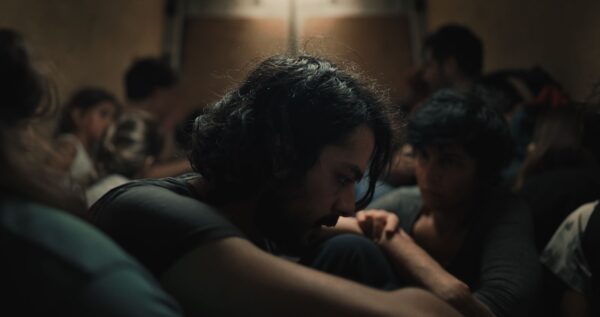
With its often unsteady camerawork and fast-paced dialogue in dramatic, interpersonal scenes, Bleifrei 95 is imbued with a frantic energy, which lingers even in quieter scenes, where the film observes its characters during reflective moments. It makes for a shaky, uncomfortable ride, not unlike the one Lolly finds herself in at the film’s midway point, when she gets in a car with a group of random men instead of directly going to the lesbian bar to meet her friends. In the crammed space of the 90s BMW, the camera moves between shouting, coked-up faces and creates a mood that, in its constructed messiness, is reminiscent of drunken arguments on 2000s reality TV, an aesthetic that permeates the entire short. In this scene, the close-ups make the confinement of the car palpable for the audience, which adds to a stressful and perhaps flashback-inducing viewing experience, at least for anyone who’s ever sat in the backseat of a car with an untrustworthy male driver. There is a more sinister version of how this scenario could’ve played out, and the loud, confined space evokes a suffocating feeling, so when Lolly pees on the car’s front seat before finally leaving the men, the relief isn’t just bodily.
During Lolly’s unplanned side-quest, the pent-up frustration about her secret affair eventually spills out of her, prompting disbelief and uncomfortable questions from the men. In the English subtitle, Lolly says, “And we don’t even really fuck. We don’t fuck anymore because…”; but what gets lost in translation is the German word Lolly uses to say “fuck”, as it’s not a literal translation. Instead, she says “vögeln”, which is a slangy verb that’s similar to the German word for birds (“Vögel”). It’s equally vulgar, but through its etymological proximity to the animal,s it’s more playful and adds a linguistic specificity that is present in the entire film: characters shout, talk over one another, and vomit their thoughts into voice notes—they think as they talk, and the chaos in their speech mirrors their erratic behaviour. This is contrary to a dominant strain of German cinema, in which dialogue reads like carefully composed prose and is delivered with theatrical fervour. Although the circumstances in Bleifrei 95 are certainly heightened, it makes the characters appear tangible and rooted in something real.
While the underlying conflicts among the protagonists are central to the tension in Bleifrei 95, the film doesn’t dwell on them and ultimately prioritises queer friendship: when the same men that Lolly spent time with crash the lesbian party and refuse to leave, their disruption ends in a brawl that acts as a unifying event. The ways in which conflicts implode but are resolved in quick succession point to the familiar, not easily ruptured bonds between the central characters—if the film begins by showing fleeting encounters, it concludes with the opposite. When Toni, Aino, and Lolly sit in the car in the short’s final moments, the camera observes them from outside the car, evoking a more grounded feeling. Still, instead of taking a serious or sentimental turn, Bleifrei 95 stays true to its tongue-in-cheek attitude and ends with the protagonists’ laughter, prompted by Aino asking, “Lolly, did you fuck my mom?”



There are no comments yet, be the first!