
Radical Worldmaking
An interview with Onyeka Igwe
On the occasion of her artist-in-focus programme at Vienna Shorts earlier this month, we spoke with artist-filmmaker Onyeka Igwe about her long-standing engagement with archives.
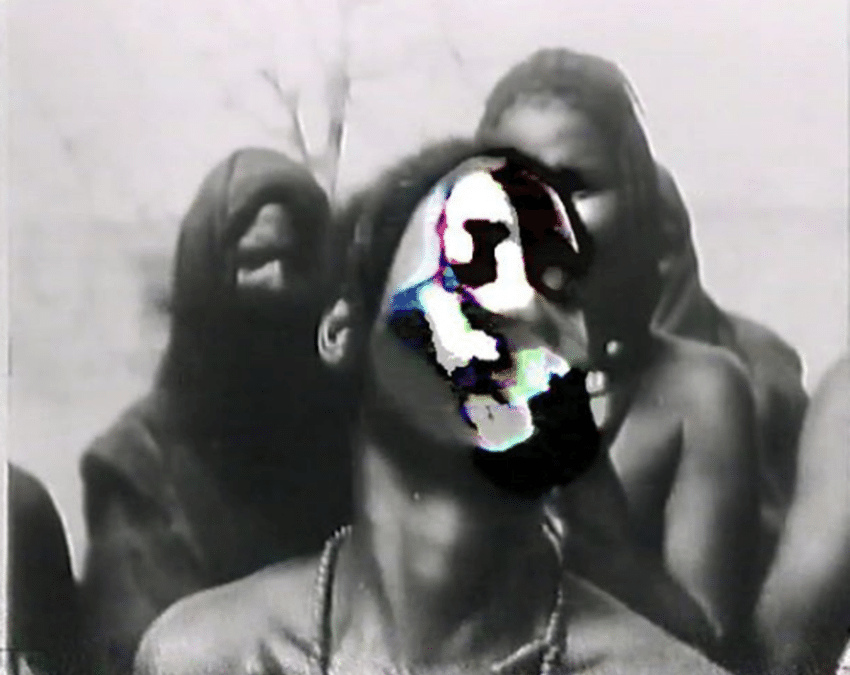
How do we live together? This is the question at the heart of Onyeka Igwe’s practice. To investigate the present, the London-born and based artist-filmmaker looks back at the past and goes into archives, where documents that purport to be truthful accounts of history reside. Yet for Igwe, the encounter with archives offers no clear resolution.
Whose history is fact and whose is fiction? As Igwe’s films show, it comes down to hierarchy of knowledge produced and undergirded by a complex structure of power, race, gender, and imperialism. To collapse this hierarchy, she turns to multiplicity. In We Need New Names (2015), beginning with her own grandmother’s funeral, she examines Igbo funeral customs by conflating facts and fictions through the juxtaposition of real and imagined, personal and ethnographic materials, as well as exploring the relationship between her diasporic position and her Nigerian heritage. Cinema thus becomes a perfect home for Igwe’s work, for its capacity to contain multiple narratives simultaneously, allowing none to settle or assert dominance, through which existing power relations can be destabilised and challenged.
If history is a story we tell ourselves and the world is our stage, then it becomes urgent to expose the staging itself. Photography, given the historical (mis)belief in its capacity to capture and reflect reality accurately, becomes the most potent prop in the colonisers’ script. In Specialised Technique (2019), Igwe interrupts and interacts with archival images of Black dance produced by the Colonial Film Unit through rhythmic editing and by posing questions to the subjects in frame. To stage a play, a set has to be created. Igwe’s films often focus on how the configuration of spaces directs the way we act and shape our reality. In Penkelemes (2025), the University of Ibadan was built as a branch of the University of London to internalise colonial agendas within its subjects. And even when the colonial infrastructure has decayed and no longer serves its original function—like the abandoned former Nigerian Film Unit building in No Archive Can Restore You (2020)—their skeletons continue to haunt us.
Individuals are not without the agency to act against the set. In The Miracle on George Green (2022), Igwe remembers the M11 link road protest from her childhood, where protesters attempted to save a chestnut tree in George Green by erecting a treehouse and sending letters to the address, so that the tree gained legal dwelling status, and thereby delaying demolition. But our imagination is often confined to its structure. The artist knows that to outmaneuver the status quo, we need to think beyond what has been constructed—and fiction offers exactly that carte blanche. Currently in development as her first feature, A Radical Duet (2025) fabulates a possible past where Sylvie St Hill, the fictionalised figure of Caribbean playwright and cultural theorist Sylvia Wynter, co-writes a revolutionary play with Adura Falade, an avatar of Nigerian activist and educator Funmilayo Ransome-Kuti, in early mid-century London. The film echoes Wynter’s ideas of rethinking society through theater and practicing a new world through play.
On the occasion of the programme “On Living Together: Onyeka Igwe” at Vienna Shorts and ahead of her solo exhibition No Archive Can Restore this Chorus of (Diasporic) Shame at Secession, we spoke with Igwe about her long-standing engagement with archives and the potential of storytelling to envision alternative ways of living together.
Much of your work is grounded in archival research, especially on marginal histories, which are mostly not well documented or absent from the archives. How did it all begin? What makes you keep wanting to work with the archives?
I had an experience working as an archive researcher on this TV show called NASA’s Unexplained Files [(2012–)]. I learned that all of these archival tapes, films, and videos were accessible because they were produced by the state with the taxpayers’ money. Therefore they weren’t copyrighted in the same way. I learned how to access archives and I had always had an interest in history, so I just started looking at things myself. That matched this moment in which my grandmother died. I became interested in my cultural heritage in a different way, in the disconnection that I had from it, and decided to use the archive to engage with it.
When I started doing that, I came face to face with colonial images. Because if you’re looking for material in the archive from that moment in history about somewhere like Nigeria, it’s always going to be through the colonial gaze. In looking at that material, I was confronted or challenged by several different kinds of reactions: one, a kind of disgust or anger at the colonial gaze, its racism, its paternalism, but feeling attracted to the material because it depicted things that I hadn’t seen before or that I felt some kind of connection to.
You asked, why’d I keep coming back to it? I don’t necessarily want to. I’ve tried at moments to part from it, or stop engaging with it, but I think it is this kind of tension that is unresolved and I continue to have questions about, and therefore make work about.
Archives can be very inaccessible. And your films, in a way, are offering people an alternative entry into them.
Yeah, some of the most exciting responses I’ve had to my work is when it’s become a prompt for people to engage themselves with archival material. Somehow it’s given them the tools to be able to think about accessing it.
You’re right that archives can seem far away. They’re these kinds of hallowed institutions that you have to get permission to, you have to sign all these forms, you think you have to wear special gloves. There’s all this ritual and ceremony around it that can make them seem very far away from us. I think that’s a problem. That’s how they retain power, the power of truth. I want my work to puncture that in some way and to bring the archives back down to earth. And by doing so, maybe we can challenge the histories that they purport to tell. So for me it’s a really good outcome of my work if people feel able to enter an archive.
In that [act of] entering, I think people will encounter all these kinds of questions that I encountered. And my ideal place for my work to sit is within one of these archives; maybe if someone was looking, they would select the original material and then also get one of my films and this kind of multiplicity.
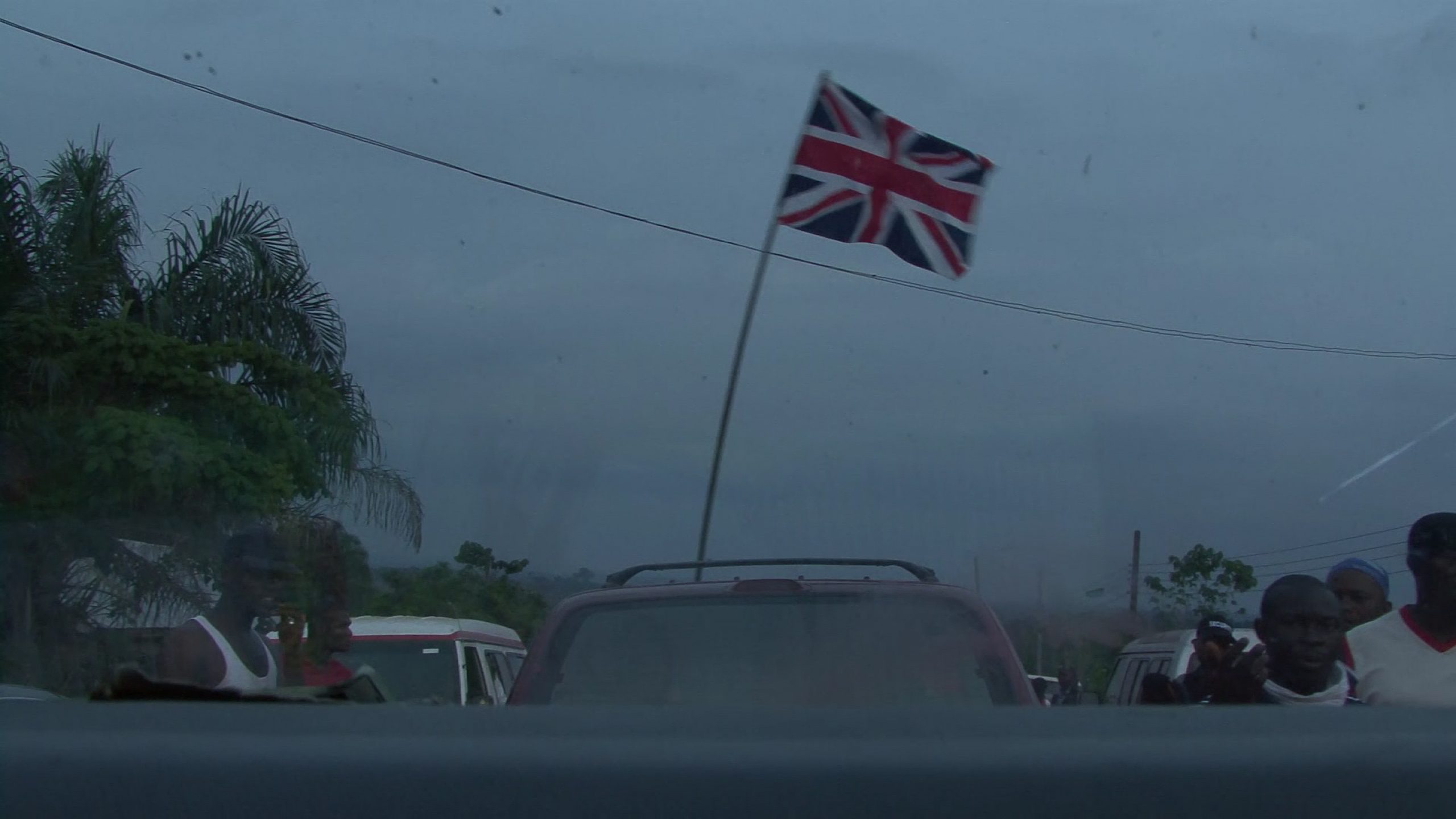
We Need New Names (Onyeka Igwe, 2015)
I love the idea that your work will become part of and challenge the archive itself. Could you tell me more about your artistic approaches to presenting archival materials?
Anything that purports to tell the truth about the past is just a story, is a speculation. And those speculations have had such a mark and an influence on the present. But in order to achieve them, you need power. That’s what the state has, that’s what the archive often represents.
I guess my films are like these offerings in some other way of thinking about the past,with a vague aspirational hope that could allow us to influence the present in some way. Not in a particular direction, but just the idea that the past is a story and we can change the meaning of that, and that means we can change the meaning of our present. This is the kind of idea that I’m offering.
Fictional narrative cinema and theatre in particular, seems to have an increasing significance of fiction in your work since A Radical Duet, particularly in relation to Sylvia Wynter’s ideas.
I’m definitely not the only one responding to absences and gaps with imagination. In order for that imagination to be communicated, it becomes fictional, it becomes narrative, it becomes performative. Dance has been kind of a method that I’ve used to try and think about that performance because it is mostly nonverbal. I wanted to explore that imagining without putting too much of a fix on it, and for the audience’s understanding of it to be broad, to be abstract, to have multiple kinds of readings.
That’s still something I’m interested in. But I guess theatre becomes increasingly relevant as I think about Sylvia Wynter’s ideas via Brecht and theatre itself as a strategy to open up other possibilities and to play.
A Radical Duet happens in three different time frames: One of them is like the speculative past. This is based on historical events but not really what happened. I made it up and imagined it. Another time zone is the present where we’re speculating about a future that hasn’t happened yet. But then the black and white scenes on 16 mm or 8 mm are this kind of non-time, this in-between zone. I often think about this idea of possible worlds and a lot of my work exists in a time of contingency—maybe it could have happened but it didn’t. So maybe that kind of contingent zone allows speculation to happen at multiple levels.
And perhaps it’s also an exciting way for a larger audience to engage with and reflect on the archives, like what Sylvie in A Radical Duet says—we need stories to reach more people because political debates in articles are only read by intellectuals.
Yeah, that’s a good point. I started making films through activism and campaigns that I was in. Film felt like an accessible medium, like a really easy way to communicate an idea to lots of people. There’s something that I appreciate about sneaking something in through a structure that we can feel very familiar with. And I think people engage with entertainment and cinema in lots of different ways.
You know, maybe people don’t see experimental cinema, but like it with A Radical Duet. I really wanted to front-load the narrative part of it and not really describe anything about the second part in the synopsis because I was just like, what is it to watch this film, think you’re watching a period drama, and then suddenly get something else. That construct is something that I am interested in playing with.
Thinking of the world as a stage to tell stories and how our infrastructure shapes that stage, reminds me of your interest in historical sites and the configuration of spaces. In No Archive Can Restore You, you filmed the abandoned archive in the former Nigerian Film Unit building. And for Penkelemes, you focus on the architecture of the University of Ibadan. Can you tell me more about this?
Sylvia Winter thinks about fiction, about stories creating our social reality. But I also think that how space is ordered and managed, the buildings that we occupy, the kind of layout of the places that we live in, produce us as well. When I went to the University of Ibadan for the first time, I was really affected by the space, by being on this campus, by looking at this architecture. I made a work a long time ago called Bordered. It reflected on borders but also compared them to roads and streets in London, in how we have permission to or are not given permission to go to certain places. It’s been a longstanding interest, but going to that university, I really felt this spatial configuration was producing something in me and I wanted to know more about it. That also happens in A Miracle in George Green. I’m from Leyton and there was a protest when I was very young. People created loads of autonomous spaces in that protest. As I’ve grown older, I’ve just met a lot of people who also came from the area and we all have a shared sensibility.
So I was just thinking, was there something about these protests, this atmosphere, these spaces that produce something in people? I’m interested in those kinds of links and how space also orders and structures our social reality.