Surrounded by Heads and Bodies
Tracing the Contours of a Corporeal Cinema
Bodily self-documentation becomes a means of self-preservation in Lesley Loksi Chan’s Golden Bear-winning Llyod Wong, Unfinished, María Cristina Pérez’s amorphous animated Once in a Body, and Mireia Vilapuig’s Skin Despair.
I’m not an avid reader of philosophy. The closest I’ve come to familiarising myself with the Urtexts of critical inquiry was the summer I read Sophie’s World by Jostein Gaarder: a widely popular coming-of-age novel, in which the titular character Sophie—a Norwegian teenager curious about the origins of the world and her place in it—starts learning about the history of Western philosophy. I remember leafing through my weather-beaten copy on the beach, trying to wrap my head around the vastness of the universe and the abstraction of human existence. I had my first panic attack the night I finished it, curled in a fetal position on the balcony couch at my grandma’s cramped summerhouse, where I had spent two weeks every summer since I was ten. Every time I would start drifting off to sleep, my mind would jolt me awake with thoughts of death, urging me to stay up till sunrise against the better judgment of the more rational part of my brain.
I’m not sure if there was a link between my newly acquired knowledge of capital-b big ideas and the all-consuming anxiety that convinced me that I had an incurable brain tumour, which would kill me the moment I closed my eyes to rest every night. My grandma certainly seemed to think so. I envied her self-assurance. It wasn’t the ever-looming threat of death that scared me but rather the lingering suspicion that I was unwell, for it is not a preordained sense of doom but an all-pervasive uncertainty that feeds anxiety’s perennial hunger for answers. The feeling that I had no control over how I experienced my body, its many foreign nooks, crannies, and crevices, made me dread being awake in the world. I started experiencing bouts of existential unease, which seep into the fabric of everyday life when you least expect it, disrupting the smooth flow of its God-given order by creating ripples on the surface, forcing you to see your mortal body for what it is: a sack of flesh and bone that is subject to the whims of fate.
More than a decade later—and with the added benefit of hindsight as well as a well-loved SSRI prescription—I was reminded of this ever-present fatalism of the body while snuggled up in bed watching screeners of Chinese-Canadian filmmaker Lesley Loksi Chan’s Berlinale’s Teddy Award and Golden Bear-winning experimental documentary Llyod Wong, Unfinished and Colombian filmmaker María Cristina Pérez’ amorphous animated short Once in a Body, both selected as a part of the International Competition at the 19th Vilnius Short Film Festival. The former is composed of footage taken by Llyod Wong—a Canadian-Chinese writer who prematurely passed away of AIDS-related complications in the early nineties—for an unfinished video project as well as an unaired episode of the cable access TV show Toronto Living with AIDS, documenting his day-to-day life living with HIV. While the latter is a visceral tour de force about a young woman’s struggle to find her footing in her own body.
Having arrived in Lithuania the day before, bundled up in layers in minus fourteen degree weather, I felt severely restrained by the physical limitations of my corporeal form. Perhaps this is why I was so taken with Wong’s meticulous descriptions of how to apply the vascular treatment prescribed for his diagnosis set to an eerie green-screen backdrop of 90s infomercials. Juxtaposing Wong’s self-recorded how-to guide with grainy footage depicting his hospitalisation for treatment, Chan’s film invites the viewer to bear witness to the gradual breakdown of the well-worn machinery of Wong’s emaciated body, without alienating the audience from the agency of its protagonist.
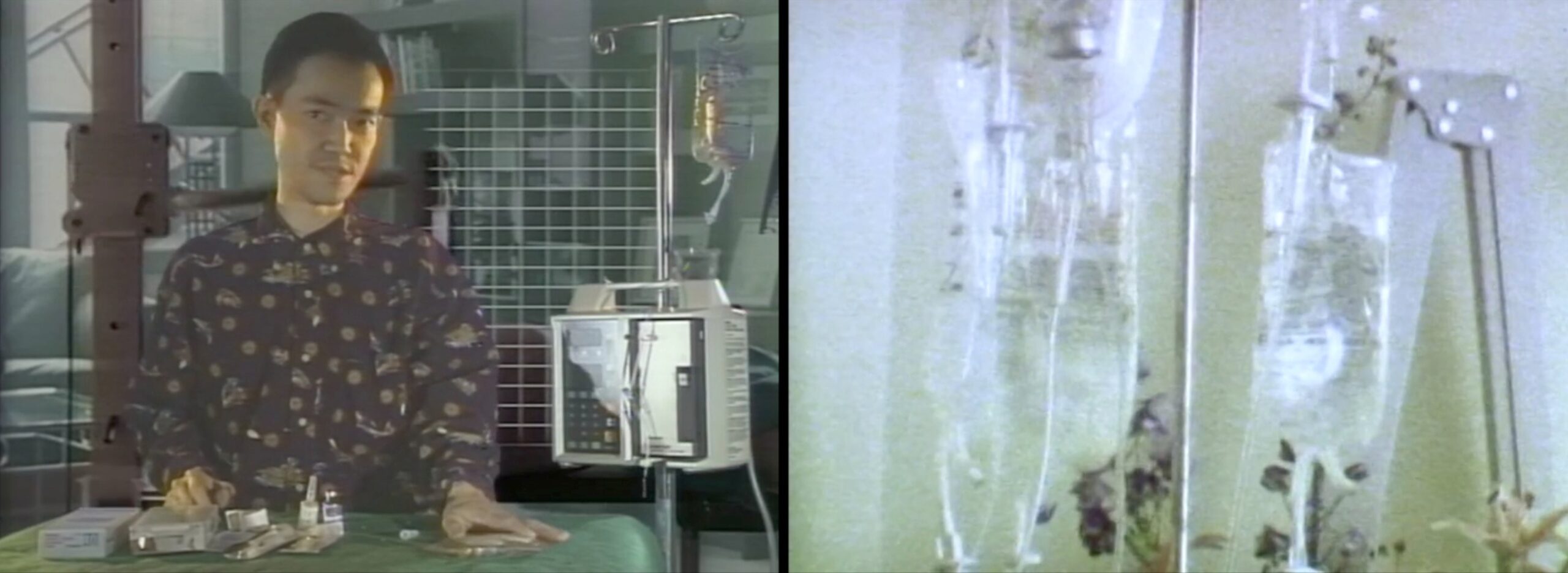
Lloyd Wong, Unfinished (Lesley Loksi Chan, 2025)
As a marker of its incomplete status, Llyod Wong, Unfinished intersperses archival material with abrupt cuts to a neon-green background featuring personal testimonies from Wong’s family and friends that provide crucial context. We learn how angry Wong was about having to live with the affliction that would eventually cut his life short; how excited he was to engage with the world around him; how he harboured a particular passion for semiotics. These poignant revelations are followed by an outtake from Wong’s unaired Toronto Living with AIDS episode, in which he delivers a sharp, albeit bitter monologue about his various frustrations with the lacking healthcare system, its imposition of invisibility on people who live with AIDS, and the subsumption of his Chinese identity under the arbitrary “Asian-American” label to receive funding for treatment. Watching Wong pause to inhale from a portable steam machine in between sentences, I was struck by the contrast between the self-assurance with which he delivered his speech and the evident frailty of his body that interrupted it in regular intervals. It was as if Wong was trying to assert his dominance over the illness that had taken hold of his physical being through eloquent appraisals of power and racial politics.
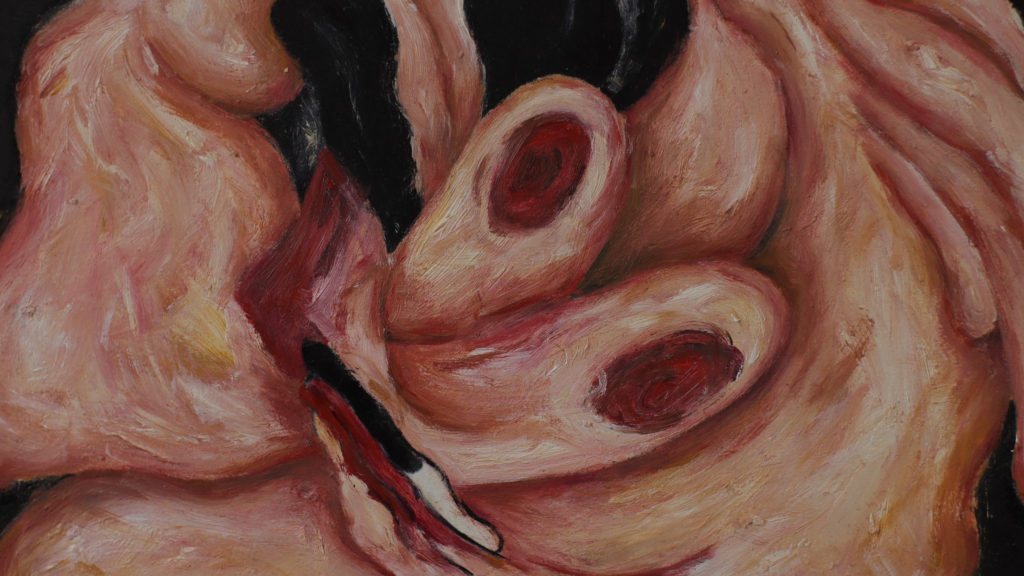
This attempt to display the mind’s agency over the body also crops up in Once in a Body, in which an unnamed narrator, haunted by childhood memories, attempts to mend her fraught relationship with her sister through a stream-of-consciousness-like spoken word letter, in which she confesses her various grievances about their shared family history. The delicate brushstrokes of the hand-painted animation depict the narrator as a bulbous woman, whose figure contracts and expands to fit the story of how she became alienated from her body. Recounting a particularly affecting memory of losing one of her baby teeth in front of a school friend, she asks, “How could my tooth forget me after spending so many days with me?”, lamenting the misalignment of her physical being with her inner sense of self.
Pérez’s narrator is made to feel ashamed by the treachery of her body’s will, which she can only exert control over through self-destructive tendencies. ”Once I wanted to kill it and ended up here,” she whispers into the void as if divulging a secret only her body is privy to. From her father’s ill-placed conviction that all unhappy women are doomed to get fat to her sister’s visceral disgust at the sight of her ‘ugly’ feet, everyone around the periphery of the narrator’s life seems to be able to see through the folds of her flesh and read the depth of its (rotten) core, mapping out her body’s past, present and future on the lines and wrinkles that have indented the surface. This disparity between the gaze of the body’s voyeurs and its owner isn’t lost on the narrator. As she herself admits, “This body likes to lie”, it smiles when its hurting, recoils in fear when its craving affection, and pushes loving arms away when it longs to be held. Its intentions remain a mystery to its maker, even at its most vulnerable. That is to say, the illusory power of its mental faculties notwithstanding, the human mind remains anchored to and curtailed by the corporeal limitations of the human form: the ghost is at the behest of a machine that is prone to malfunction.
This notion of the human body as a frail and fickle vessel for the soul is the common thread that weaves together Llyod Wong, Unfinished and Once in a Body, emphasising the burden of having a physical presence that outgrows its welcome. In the former, the body’s oppression of the mind is politicised through the AIDS crisis, wherein Wong’s ailing body is framed within the context of the heteropatriarchal body politics of 90s America, while in the latter, the unnamed narrator’s struggles with her bodily autonomy are strictly personal, almost to a fault. But as the great Carol Hanisch likes to remind us, one interpretation doesn’t negate the other, for the personal always contains traces of the political.
Nevertheless, these two readings of the human body—the personal and the political—are explicitly consolidated in Catalan actress-filmmaker Mireia Vilapuig’s autobiographical documentary short Skin Despair, in which the director reflects on the emotionally tumultuous summer she turned thirteen through the home-video footage of a teenage girl. Vilapuig uses a stranger’s pixelated recollections of adolescence to engage with her once pubescent (female) body, as a personal archive of shared intimacies and repressed memories; of unspoken violations and unrequited affections imprinted on the supple surface. Over a montage of clips depicting the day-to-day life of her teenage counterpart, Vilapuig recounts repressed memories of her own adolescent body: how it shapeshifted in the blink of an eye from that of a child to that of a young woman, how it seemed to solicit unwanted advances from strange men on the street, how it imposed an unspoken code of discretion for reasons that had yet to be revealed.
Vilapuig’s fragmentary narration over the video diary of a stranger imbues the images on display with newfound meaning, making the viewer question what untold secrets and hidden desires lie beneath the hazy digicam footage of a couple of teenage girls walking on the beach or watching the fireworks from an urban rooftop. Vilapuig’s recollections of a handful of firsts—first unrequited crush, first rejection, first violation—provide the emotional throughline of the film, wherein the lack of segue between one “scene” and the next mirrors the disjointed yet intuitive recollection of the dog days of youth that have left a permanent mark on the director’s self-image. In more ways than one, Skin Despair functions as a metaphor for the medium of film itself, by deliberately calling attention to the gap—across time and place—between the narrator and the “protagonist”, it exhibits how the depiction of one’s lived experience can unwittingly channel and thus rekindle that of another, providing companionship by way of celluloid. A silent pact that is made in the liminal space between the gazing and the gazed bodies.
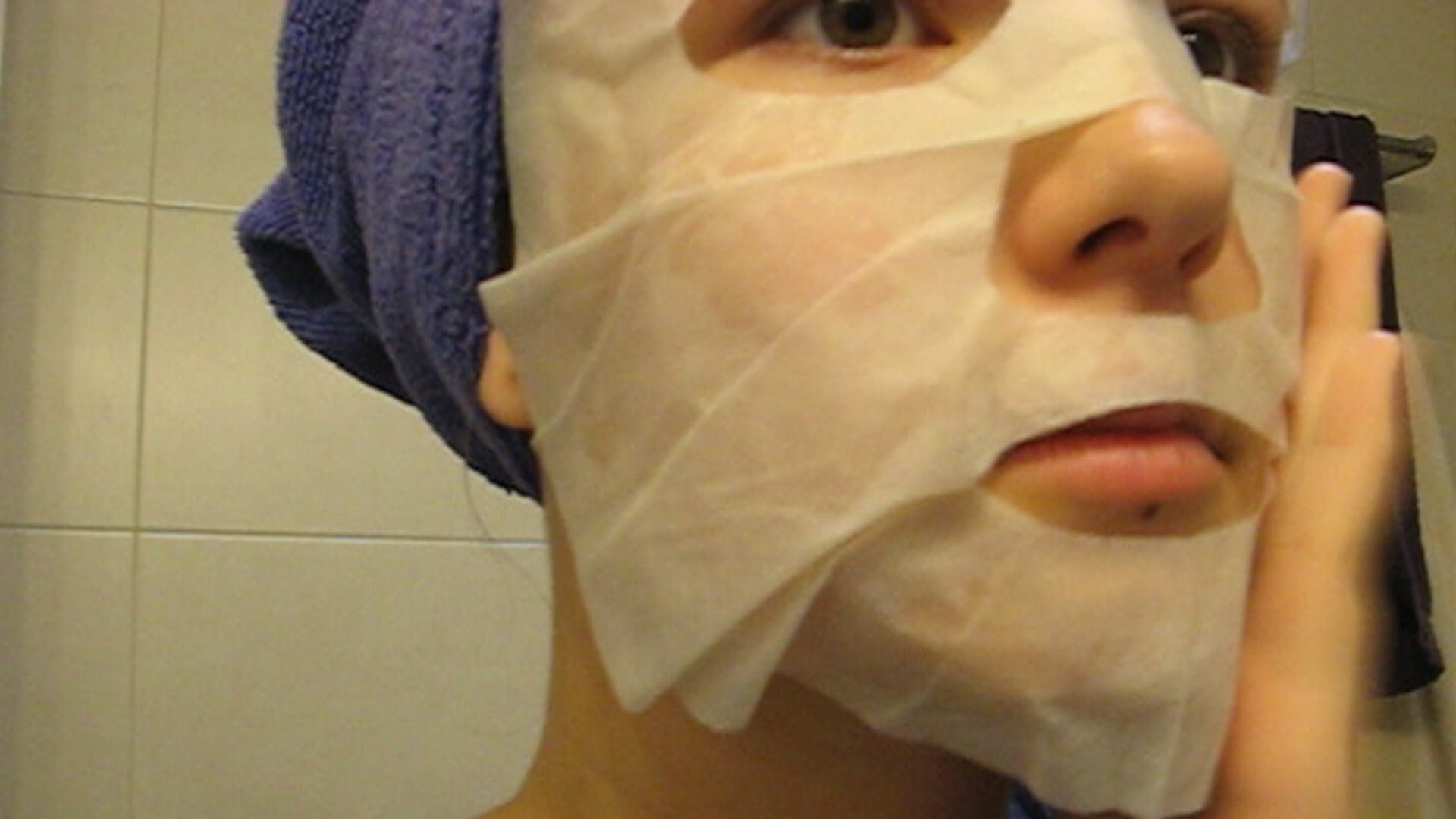
Skin Despair (Mireia Vilapuig, 2025)
Watching these shorts back-to-back, I was struck by the urge to trace the outlines of a corporeal cinema with my words, crouched under the duvet, my fingertips perched on the type keys, ready to paint a picture of films centered around the human body, warts and all. In all three films, bodily self-documentation becomes a means of self-preservation; an effort to commemorate the memory of one’s material experience of the world long after their physical remnants have become one with the earth. Etched into these images of flailing limbs, heaving torsos, and zoomed-in faces is the ever-present fatalism of the mass and flesh; the physical inevitability of the human body, that acts out of a will of its own.
My delineation of corporeal cinema entails a collection of cinematic practices that engage with various facets of the (human) body in all their minute idiosyncrasies. Whether it be through the first-hand account of a fatal illness or the second-hand experience of a stranger’s adolescence, corporeal cinema foregrounds bodily presence as a means of cinematic meaning-making. In that, it opposes the self-indulgent solipsism of the arthouse snob and the provocative antics of the wayward filmbro by situating the artistic ambitions of its proponents in the lived experiences of bodies across time and space. In other words, corporeal cinema creates nodes of interpersonal connection by putting the human body on display in all its visceral glory.
It is no coincidence that in the direct aftermath of my first panic attack, what kept me awake in the countless nights that followed was my inability to imagine a world in which I wasn’t the only one who felt at the mercy of their own mortality. As if this bag of skin and bone I had called my own for the last thirteen years had suddenly become someone else’s. It is easy to individualise one’s corporeal experience due to the immediacy of physical feeling. Ironically, the most distinctive common denominator of one’s humanness is also what threatens to alienate them from the rest of their kind the most. A corporeal cinema that acknowledges these contradictory inflection points should aim to encompass the full scope of the collective bodily experience by closing the gap between individuals as bodies: bodies in motion and bodies in place, bodies in sync and bodies out of pace, bodies frozen in time preserved in the amber of a film spool that will keep the memory of somebody alive long after they have ceased to be a body.
This text was developed during the European Workshop for Film Criticism #8—a tandem workshop set during Kortfilmfestival Leuven and Vilnius Short Film Festival—and edited by tutor Michaël Van Remoortere.
The European Workshop for Film Criticism is a collaboration of the European Network for Film Discourse (The END) and Talking Shorts, with the support of the Creative Europe MEDIA programme.