
The Impasse of a Mirage
Overnight Coup
Following a group of girls, Overnight Coup is a haptic teenage ballad that tracks the motions of an average night out against the backdrop of a changing socio-political landscape. The film won this year’s FeKK International Award.

Few images capture the freedom promised by the summer season more vividly than that of a dive. If only we could prolong that sensation of weightlessness that frees us from our tense and clumsy bodies, maybe the anxieties enveloped by it would also be suspended. Marina Xenofontos’ Overnight Coup opens on this beloved cliché, but counters its private experience head-on by having a group of tourists linger nearby. By filming the event—a girl jumps into the Mediterranean Sea—the mundane becomes a spectacle with the young woman as the unwitting protagonist. Even when the onlookers decide to stop recording, the girl will keep on diving into the water on loop, trapped in her leap on some server in a thirsty data center warehouse.
In Overnight Coup, set in Cyprus, people mostly want to be elsewhere. Some take planes, others jump off cliffs, and almost all of them put a screen between themselves and whatever is happening. There seems to be too much (and at the same time too little) reality, not to let off some steam. This brings a group of teenage girls to leave their hometown Limassol for a night out in Ayia Napa, one of the main tourist spots on the island. There they dance, drink, hang around, meet strangers who could be friends (and vice versa).
Kneaded into their most profitable shape, these hotspots have become city-sized theme parks, shopping malls, aspiring non-places. As such, they disappear before our eyes despite their hypervisibility, because places overgrown by tourism-driven desires are prone to be laminated by them. The glossy reflection of the sun on plastic surfaces tends to obfuscate any trace of social tensions and historical fractures.
Xenofontos explores how boundaries are being established, upheld, and crossed. Not only as they appear in their literal, geographical sense, but also in the intimate space which is threatened by voracious screens, intent on capturing innocence in moments of lowered guard. One of the girls ends up in a hotel room with a man maybe a few years her senior. They lay on the bed and talk, kiss, and smoke. He checks in on her as he caresses her leg. They have taken a shortcut to the kind of intimacy that only seems possible because of its one-time nature. “Do you know how beautiful you are?” he asks her. As she’s struggling for words, he pulls his phone from under his pillow and starts filming her. Although the shooting of Overnight Coup falls closer to the brat summer of 2023, seeing the film in 2026 strikes an additional chord after a summer marked by ‘perv glass’ as big tech found its way to commodify our gaze and surveil in a more covert and continuous way.
Overnight Coup (Marina Xenofontos, 2025)
Worn out by a night that leaves the young women with both much and nothing not talked about, the cab ride home proceeds in silence. As they leave Ayia Napa, sirens wail through its streets. Xenofontos leaves her spectators—tourists among their own kind—in no doubt as to why this is happening. A subtitle beams in: “[Sirens in commemoration of the coup d’état of 1974]”. Overnight Coup was shot half a century after the Greek-backed coup and subsequent Turkish invasion, which set in motion the division of Cyprus that continues today. Xenafontos captures the eeriness of such an event being commemorated in the coveted season of rest and relaxation at a tourist resort, turning a place into a mere backdrop. She subtly contrasts the ephemerality of the individual experience with a broader collective memory, stored within a landscape forced into silence beneath pounding beats and neon lights.
This sense of disruption is also reflected in the way Xenafontos blends documentary and fiction approaches and how her protagonists and their living environment are constructed primarily through glimpses, screens, and reflections. By complementing the grainy 16 mm with blurry mini-DV images, cinematographer (and filmmaker) Fern Silva evokes a certain voyeurism.
Overnight Coup lays bare the constant need to record a present made up of people, places and things that seem to exist almost by virtue of their digital sublimity: as Instagram images of immaculate beaches proving they’re worthy of our leisure time, or the clubbing stories we scroll ourselves to sleep with. Tellingly, Xenofontos chose Marilyn Manson and not Eurythmics in the soundtrack to disclose what “Sweet Dreams” are made of, further reinforcing the nihilism of the restless soul having “traveled the world and the seven seas”.
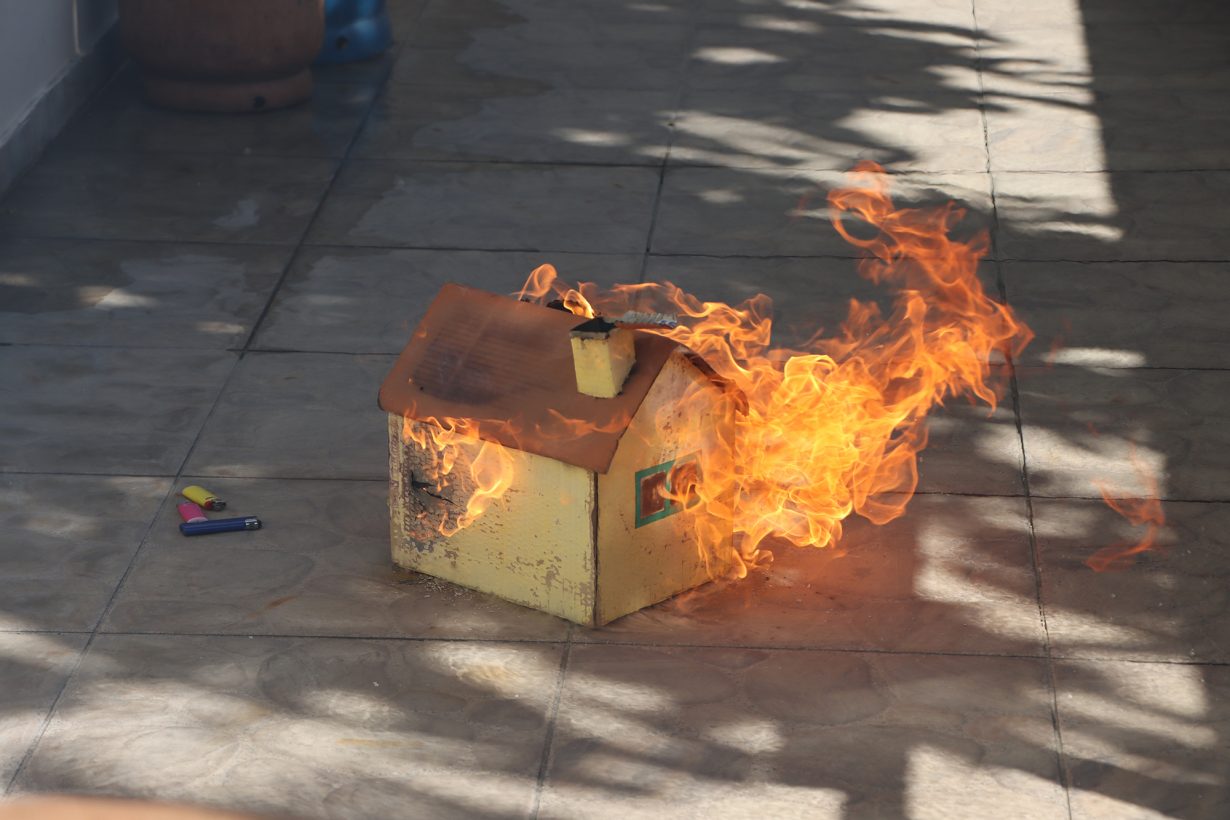
Going to the beach, lip-synching in front of the mirror, reciting funny dialogues at the dinner table (a scene in which the actresses are playfully making fun of Xenofontos’ script): the girls in Overnight Coup know how to spend their summer and find shelter in their friendship. That said, there can be times of maddening boredom: the kind that brings one of the young women to set fire to a toy house, maybe hoping that the ritual can put an unofficial end to childhood.
Coming of age means coming to terms with the demanding quest to find the first of many versions of your (more) adult self. Having to do so on an island whose natural boundaries are self-evident but is internally torn apart comes with its own set of challenges. And while the sea shimmers enticingly and the lit-up screens banish the dark, girls want to have more than fun on this fractured island, living with the impasse of a mirage.



There are no comments yet, be the first!