
The Sense of an Ending
Interview with Zuza Banasińska
A subtle tribute to their grandmother who passed away three days after the film’s Berlinale premiere, Zuza Banasińska’s Kontrewers reimagines possession as a negotiation between self and other.
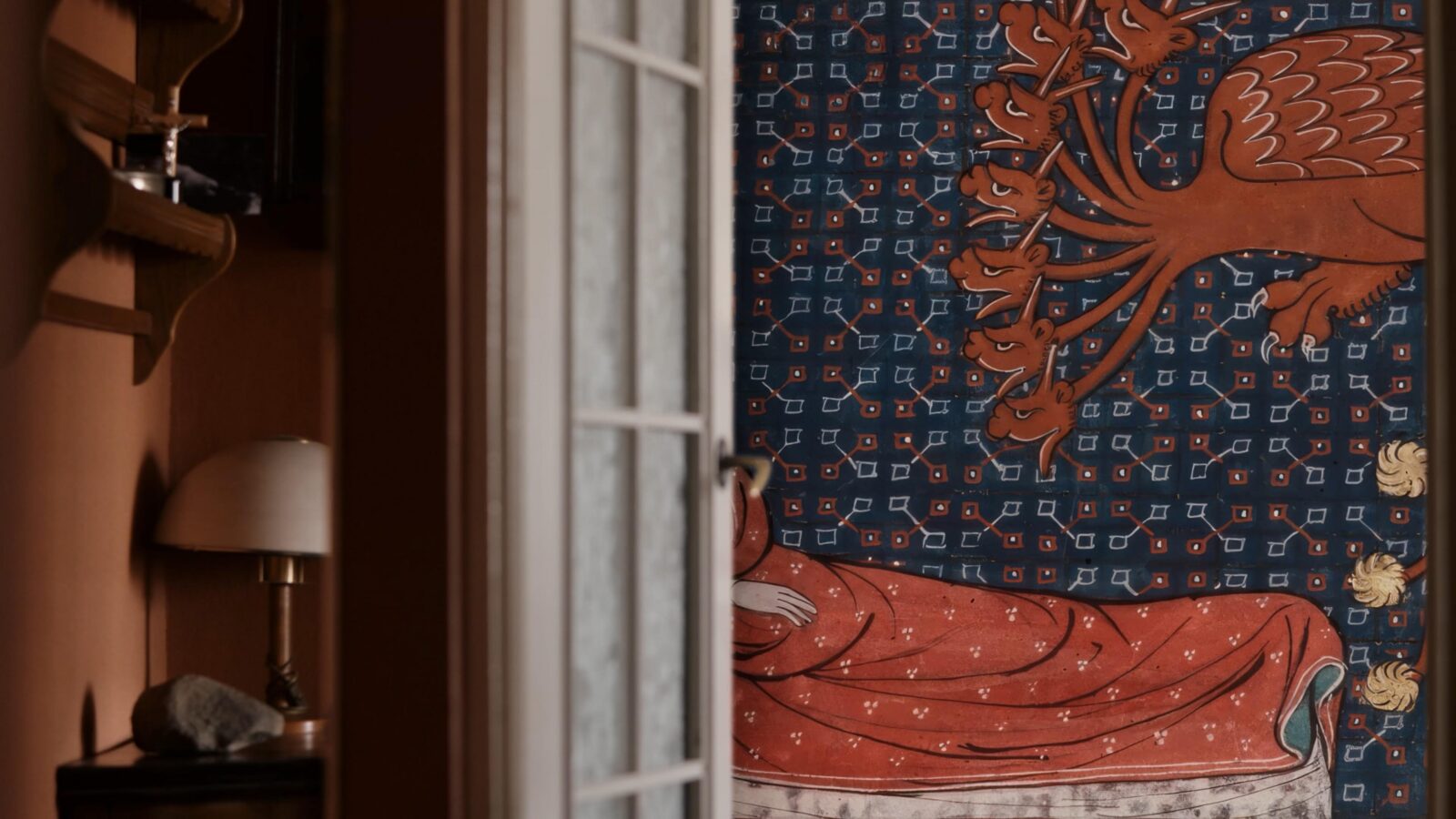
Zuza Banasińska has the innate ability to translate the tactility of real-world objects into cinematic language. Their 2026 short film Kontrewers is part experimental documentary, part fiction, tied to a Polish folktale. In it, the ghost of a young girl who has been trapped for centuries in the mysterious ‘Kontrewers stone’ is drawn to an older woman, mistaking her for her long-lost mother. The woman in question is Banasińska’s own grandmother, Barbara Ptaszyńska, age 102.
These two very different women become both the driving force and heart of this dream-like short: one in age limbo and the other nearing death. Banasińska tells us that pre-recorded conversations with their grandmother formed Kontrewers’ foundation. “We spoke about everything,” says the Warsaw-born, Amsterdam-based artist. “While asking intimate questions about her and the way she approached her impending death, I learned a lot about her.” Yet, it is only Grandma’s voice that can be heard throughout.
Even with its title, Kontrewers already promises ambiguity. On the one hand, Kontrewers is a tiny village in Poland with its own mysteries ready to be uncovered. One of them is a stone shaped as two unidentified figures with horns: a male and a female, both of them regarded as devils in folk tradition. On the other hand, the word is homonymous with ‘kontrowers,’ which is now considered a Polish archaism. In the past, “kontrowers” used to mean the clash of contrasting forces, the conflict of interests, opinions, and viewpoints [like the English ‘controversy’]. It is everything that leads to the dispute and/or the collision of two worlds that are not meant to coexist.
The short commences with a few shots of the mystifying stone, now regarded as one of the most intriguing archaeological monuments in Poland. Banasińska remembers seeing it for the first time and being completely enchanted by its presence. Its horned figures arrested mid-dance recall the Ancient Greek god Pan and other pagan devils, while locals believe that removing the stone from its designated place is a bad omen. The folklore inspired Banasińska to make the entrapped spirit character come to life. “It’s a relationship that commenced seven years ago,” they explain. “There is some sort of magnetism that nudges me to come back to Kontrewers. With each return, I always discover something new about the stone.”
While working on Kontrewers, Banasińska became acquainted with various people from different walks of life who had some sort of connection to the stone. Inspired by them, the filmmaker remarks that “it’s incredible how we all got intertwined by one item, which keeps generating an excess of meanings.” A simple yet enormous obelisk has become a source of communion, bringing people together as a collective, no matter their initial viewpoints. Banasińska calls this shared experience a “lesson in empathy.”
Today, a veil of mystique cloaks the stone. Some people believe it possesses ancient powers, while others, ethnographers mostly, treat it purely as an archaeological artifact. “I’ve learned that in the Old Polish language, the word ‘kontrewers’ also meant ‘disputed territory’,” says the director. Apparently, the stone became one too—since “the contention around it is still alive and based on different ideas.” At some point, Banasińska realised that even the act of spiritual possession, echoed within Kontrewers, can also be interpreted as a dispute over the physical space. In their words, “it becomes a moment when two forces can co-exist in the same body after an initial friction,” which made them stick with the title’s double entendre.
Banasińska aptly titled their film to reveal the duality of what life can and could be. No wonder that in Kontrewers we can recognise Eros and Thanatos in dialogue, exchanging opinions on the passage of time and debating whether souls exist, as friends would over a late-night drink. But who, ultimately, wins this dispute? Can life’s vitality defeat the approaching end? Or maybe it’s the other way around? As Banasińska suggests, “this is the kind of ‘kontrewers’ we are constantly talking about. Combining those two worlds was the greatest challenge of this film. The texture and all those traces and marks left by touch become a threshold to the living and the dead.” By weaving those microcosms together, the short already lends itself to such dualistic readings.
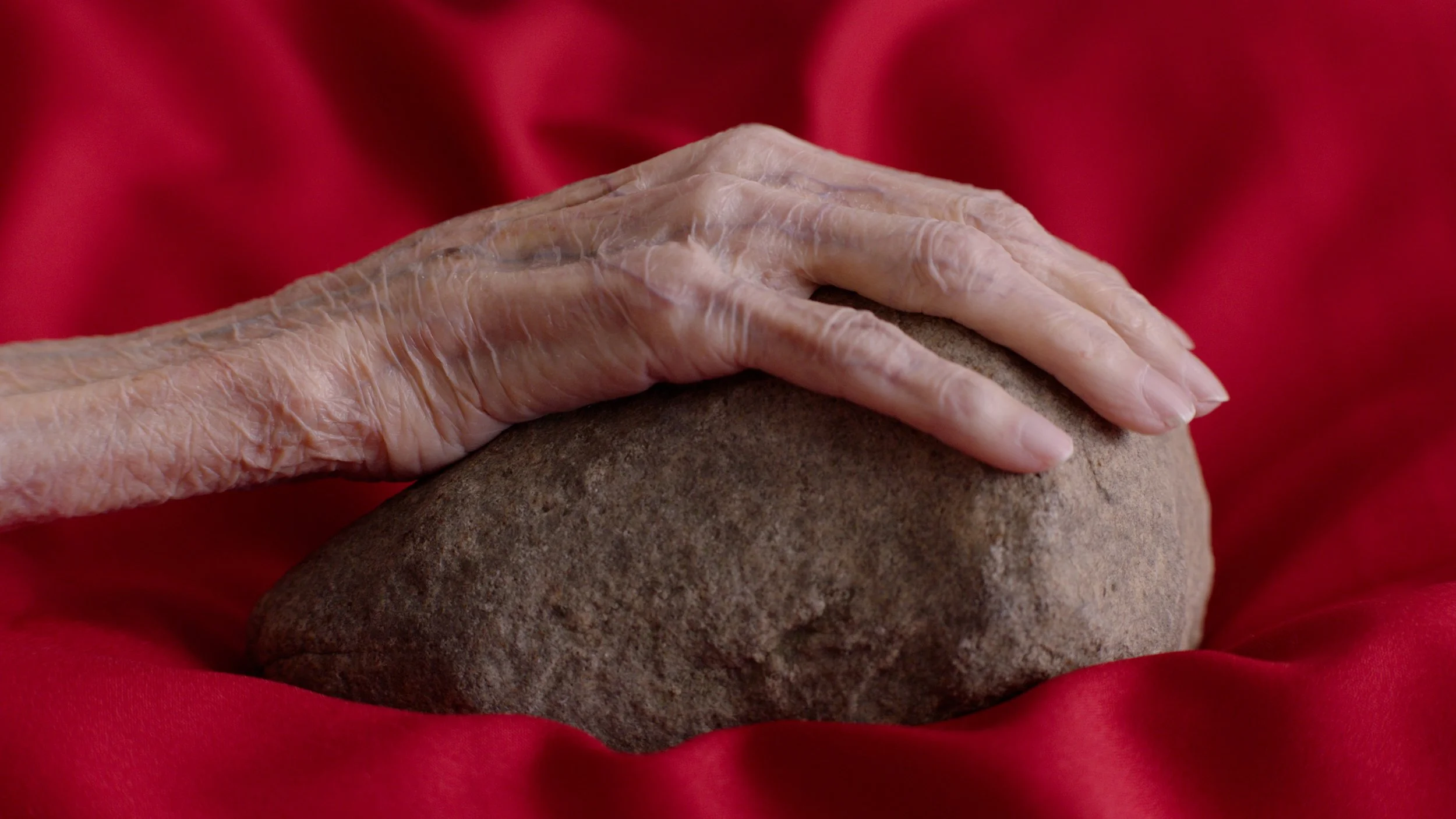
Kontrewers (Zuza Banasińska, 2026)
The grandmother is perhaps the more tangible heroine for the audience compared to the trapped ghost. Speaking of working with her elder family member, the director explains: “She doesn’t pretend to be someone else, except for the moments when she enacts the folktale.” Yet, the spectator does not see the woman’s face, nor her body in full, because she herself wished that her face would not be shown. However, cinematographer Jakub Dylewski centres the camera’s attention on grandma’s palms, which we spot in several close-ups. “There was something about her hands that has always been noble. I could also see the years of experience in them,” Banasińska adds. By focusing on gestures, they allowed their elder to “express everything that she couldn’t reveal through words.”
The notion of trust is often a significant factor on set. After agreeing to become a part of this short, Banasińska’s grandma has always been present and encouraging, but she put clear boundaries, refusing certain ideas and informing when she had enough and would like to rest. There is a dose of fulfilment that one can hear in the director’s voice as we speak; a gratitude that they were able to complete this project together. In this sense, Kontrewers can be read as paying homage. One that is executed through telling a meta-story.
This has always been something in film that photography is just incapable of doing. Instead of preserving one’s image, cinema mummifies (to paraphrase André Bazin) the entire presence, including the voice. When someone dies, the person’s face is often engraved in the relatives’ memory to evoke when needed. Yet, it is the memory of the voice that usually escapes us. All of this has become even more evident and, simultaneously, symbolic after the film’s premiere. “My grandma passed away a few days later,” Banasińska confides. Unexpectedly, Kontrewers became an archival record of her last days of full independence. “She did manage to watch Kontrewers before her death, but she wasn’t speaking anymore at that time, as her condition worsened.” However, she had a chance to hear her own voice. It made the whole screening experience something more than just ‘spiritual’. “I never got any feedback from her, so there will always be some sort of nescience that creeps in when I think about my film,” Banasińska admits.
But the grandmother’s story does not end with her death. The director believes that working on Kontrewers gave their grandmother some sort of goal to, perhaps, “leave something behind her, some sort of testimony.” This is when it becomes apparent that cinema can reawaken its subjects by filling their bodies with vital energy. For a moment or two, they are supplied by an immeasurable passion that starts running through their veins.
All the above makes Kontrewers not only an ethereal journey, in which the past corresponds with the present, but also a subtle “tribute to the grandmother” (to quote Banasińska one last time), as this short will make her—possibly—live forever. The spectator might not remember grandma’s face (which is, indeed, deliberately concealed by Banasińska), but her presence is powerful enough to inspire and reshape our understanding of life’s fragility. The sense of an ending is near, constantly tangible between the lines and the shots of the whole short, but Kontrewers ceases it for a little while. While being a film about dying and losing your own body, it still has a lot of life and faith in it. Two parallel tales within one story—Kontrewers aspires to tell a modern folktale and function as an eye-opening physical medium. By this, it becomes a “kontrewers” on its own.