
The Time After
Interview with Ibrahim Omar
Working in a country shaped by successive political ruptures, Sudanese filmmaker Ibrahim Omar, founder of the Sudan Film Institute, uses cinema to explore the human experiences that persist in the shadow of larger historical narratives.
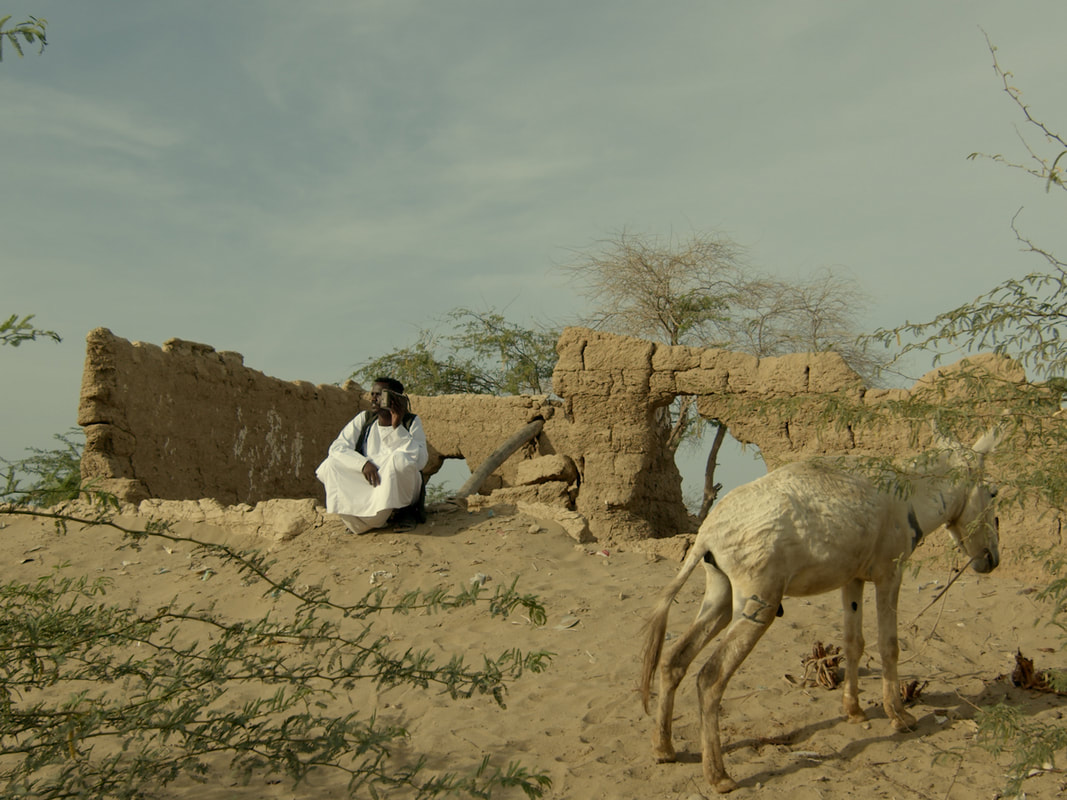
What happens after a revolution, a war, or a political upheaval? For Sudanese filmmaker Ibrahim Omar, the question is not simply what comes after, but how the consequences of a historical event weave into everyday life. In a country shaped by successive conflicts and political ruptures, that aftermath is not easily defined. Time seems to lose its clear divisions: the past spills into the present, while the present remains suspended in anticipation of what might come next.
These overlapping temporalities inform Omar’s After the Event or Post-Trauma trilogy—the short film Nothing Happens After That (2024), his feature Nothing Happens After the Revolution (2026), and his latest short, Nothing Happens After Your Absence (2026)—moving between Sudan and Cairo to examine the human experiences that persist in the shadow of larger historical narratives.
Nothing Happens After Your Absence brings this approach to his hometown in eastern Sudan. The film forms part of a wider artistic inquiry into the relationship between memory, violence and the present, while extending Omar’s interest in cinema beyond the screen. The same interest also informs his work with the Sudan Film Institute, which he founded to develop film education, critical discussion and opportunities for filmmaking in a country where the infrastructure for cinema remains fragile.
Omar’s approach to filmmaking is shaped by his resistance to conventional distinctions between documentary and fiction. He uses the medium to explore how lived experience, observation and interpretation can intersect, seeking a cinematic language that brings their underlying meanings and contradictions to the surface.
Nothing Happens After Your Absence, which premiered at Cannes’ Quinzaine des Cinéastes, has received awards at Curtas Vila do Conde, Reykjavík International Film Festival, Uppsala Short Film Festival and Tirana International Film Festival, alongside a special mention at Film Fest Gent. Most recently screened at DOK Leipzig, the film continues its festival journey as we speak with Omar about the ideas behind his trilogy, the boundaries of cinematic storytelling, and the possibilities of making and sustaining cinema in Sudan.
Nothing Happens After Your Absence is set in your hometown in eastern Sudan, where you seek to introduce children to cinema. What was the starting point for the story?
It goes back to an encounter I had when returning from Cairo; I was travelling by bus from Khartoum to Port Sudan. At a stop, a young boy was selling sweets. He asked me what I did, so I told him I worked “in cinema”. “What does cinema mean?” he asked. No matter how I tried to explain it, he couldn’t understand. He imagined cinema as a factory or simply a place where people worked. In fact, this boy’s very question had been on my mind for years. I searched for answers, reading widely, including André Bazin’s What Is Cinema? (1958-1962). The question became a compass guiding my filmmaking, both intellectually and practically.
So you took your camera to your native village. Did you go there intending to make a film, or did the work emerge from what was happening around you?
At that point, I was not thinking about making a film. I wanted to introduce cinema to children there, and maybe capture some images. I arrived in the village in April 2023, just two days before war broke out in Sudan. The political situation was extremely tense, and everyone sensed that an escalation was imminent. There was talk of compulsory recruitment of young men, and propaganda describing it as a war of dignity. The work somehow grew out of that moment.
The title of your short suggests that an absence can linger long after someone is gone. What does it mean in relation to the film?
The meaning is open to interpretation. Films do not impose answers on you, but I can tell you about one possible meaning. The village is an area where there have been landmines for more than forty years. A man named Saleh, who went to obtain permission for a screening in the village, stepped on one of them and died. I thought about the meaning of that. This man died because of the remnants of an earlier war, while another was only beginning. We are caught between a past and a present that keep circling around people and holding them in place.
The notion of living through successive periods of political turmoil in Sudan informs the whole trilogy. How did this recurring instability shape your decision to explore what comes after an event?
Whenever I return to Sudan, I can feel the instability in the country. People are always in a hurry. They go about their lives as though they are waiting for something to happen and want to finish everything before it does. We are not thinking about the event; we are thinking about what comes after it.
This idea had been on my mind for a long time, prompted by both major and seemingly minor events. In my village, for instance, a child walking to school one morning stepped on a landmine, probably planted decades earlier, and was killed. As people discussed the tragedy, they focused on its immediate aftermath: the child’s death. Some questioned why his family had sent him to school alone so early, before sunrise, and why they had not waited a little longer. Nobody asked who had planted the landmine, when or why.
With these thoughts in mind, I knew I had a project, though not yet a trilogy. The child later inspired the character of Saleh in my film. I wanted to explore contemporary Sudan through films with an intellectual and philosophical dimension. I am more concerned with the present than the past, even though the past shapes the present.
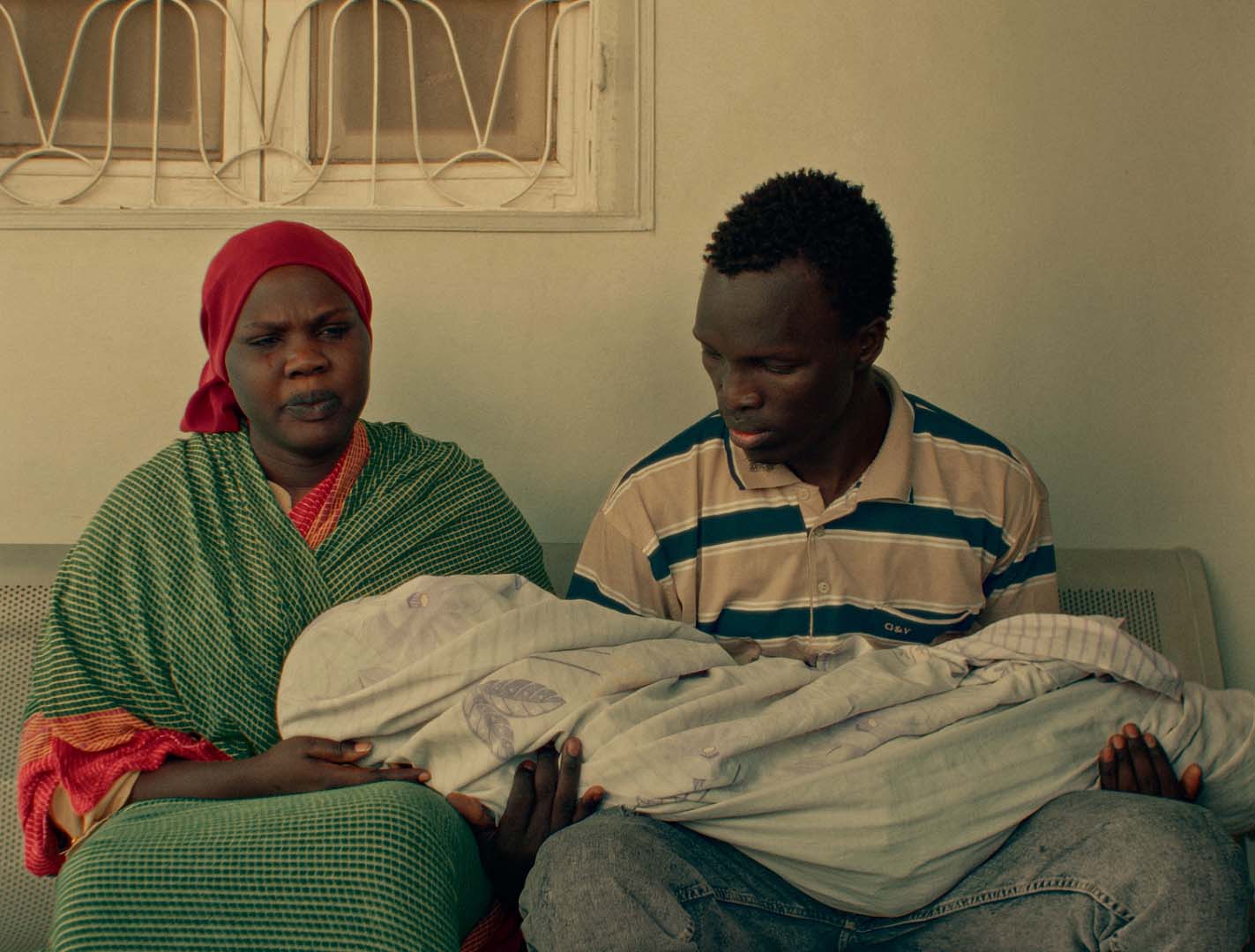
Nothing Happens After That (Ibrahim Omar, 2024)
Given Sudan’s history of political upheaval and the current war, how do you see the relationship between filmmaking and political reality in the country? Is it possible for Sudanese filmmakers to work outside this context?
My generation was born into political turmoil and wars. We lived through the Islamist-backed coup of 1989, the war in Darfur, the secession of South Sudan in 2011, the December Revolution of 2018–2019, the 2021 military coup, and another war since April 2023… There have always been wars or conflicts.
Many films intersect directly with political reality and others not as much, but most of the projects coming out of Sudan have a political dimension. You find films about war, about the consequences of separation, about villages where war has taken place. Their initial starting point is political. I don’t believe there is a genuine artistic project without that political starting point, and most Sudanese films originate from a political act.
In Nothing Happens After the Revolution (2026), you say that there is no distinction between documentary and fiction, that there is simply a film made by a human being, carrying an implicit, philosophical or intellectual meaning. How does this thinking shape your work, particularly in the After the Event trilogy?
There is only a film. If you, as a viewer, see it as documentary or fiction, I respect your right to read it whichever way. But for me, the distinction is purely a marketing process, an idea born in the first decades of the 20th century. Defining genres leads to treating artistic work as a marketable product. As a filmmaker, I do not bother looking into classifications, I am more interested in the idea of the film.
Nothing Happens After That is about a Sudanese family in Cairo trying to find a final resting place for their child. The film raises questions about how people are treated, about rights, and about the way a victim can become the problem rather than the circumstances that led to their demise. Nothing Happens After the Revolution draws on my experience of being in Cairo when the revolution began in Sudan. While editing it, I incorporated Nothing Happens After That into the feature film. The two works became connected within the trilogy, which concludes with Nothing Happens After Your Absence. In the latter, where I return to the village in eastern Sudan with an attempt to organise a screening, the search for permission and the possibility of showing films become entangled with the realities of war.
Those are not just records of what happened: there is no documentary and no fiction. The film has to carry a meaning. In my case, I am interested in what lies beyond an event: what happens to people afterwards, how they understand what has happened, and how they continue to live with it.
Speaking of the Sudan Film Institute, this initiative grew out of your interest in making cinema accessible to people who had never encountered it. Tell us more about it.
I founded the Sudan Film Institute in Port Sudan. It is the first specialised school dedicated to teaching cinema. We began establishing it in 2018, but at that time, under the government of Omar al-Bashir, we could not obtain the official permission to operate, so we started organising Port Sudan Cinema Days: screenings of short films in villages. I collected films from friends at film institutes, from other filmmakers I knew, and we took them to the villages, to children and people who had never seen cinema before.
We would screen a film and then discuss it with the attendees. We also held a small workshop about what cinema is, why it matters, why we need cinema, and why we need to watch films, write about them, and learn how to make them. We finally registered the institute in 2019. It became a school interested in cinema and anthropology, as well as the humanities more broadly.
How is that relationship between cinema and anthropology reflected in the institute’s activities?
One of our big, one-year workshops was entirely focused on this. We taught young people who, for the first time in their lives, were making a film or even seeing a camera. Even girls began joining the workshops. Keep in mind that eastern Sudan is a very conservative, strongly tribal society, where it is rare for girls to study. After that year, the war broke out. The young participants continued working on their films, and the four films that came out of that workshop dealt with the conflict, the conditions people were living in, and the effects of war. They also explored how people could make art in a time of upheaval.
The institute has also been interested in critical writing. We published a magazine called Short, devoted to short films. We produced thirteen issues, distributed free of charge as PDFs across Sudan, Tunisia, and Egypt. We then began working on a book series called Cinema of the South, of which the first title is about the Chadian filmmaker Mahamat-Saleh Haroun. We also published a book in another series called A Meeting With, translating a work by Slovenian thinker Slavoj Žižek about cinema and the films he had watched, approached from a critical and Marxist perspective.
After all these efforts, what possibilities do you see for cinema in Sudan, particularly amid the ongoing war and the absence of a functioning film industry?
It is difficult to speak of the film industry in Sudan in the literal sense. There is no functioning cinema system, but there are individual efforts by people who continue to make films. Young people are still making films, and the Sudan Film Institute is still working.
We are also continuing to organise screenings, including in villages, smaller settlements and marginalised areas. I remember screening an Egyptian film made by friends of mine, about a woman who gets out of a car and stands in the street, refusing to return. Even now, when I visit the village, children remember the film and ask me what happened to the woman. That stayed with me. It showed me how deeply a film can resonate, even long after a screening.
We are preparing another edition of Port Sudan Cinema Days. These experiences remind us why we need to keep bringing cinema to people and why, despite everything, these efforts must continue.