To Paint the Synthetic Scenery, Bodily
Yuyan Wang on Green Grey Black Brown
Yuyan Wang’s new experimental documentary is an enchanting procession of images, revealing the flawed rationale behind techno-solutionist visions of the future. Green Grey Black Brown was nominatied for the New Critics, New Audiences Award 2026.

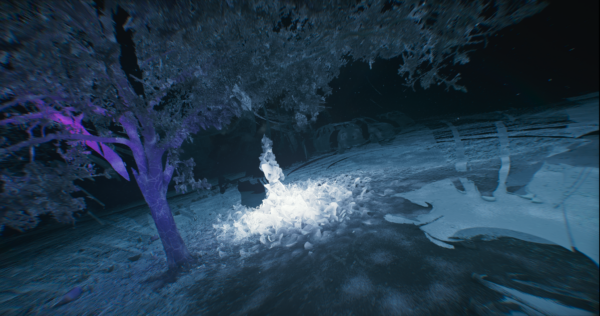
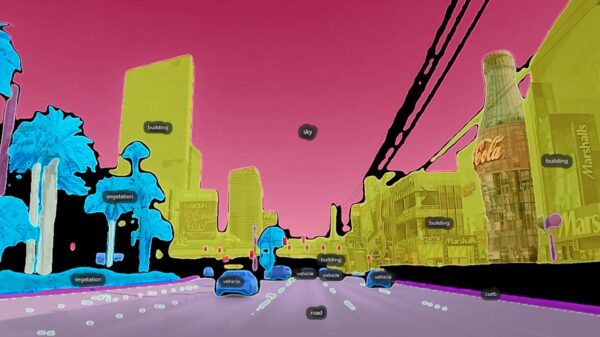
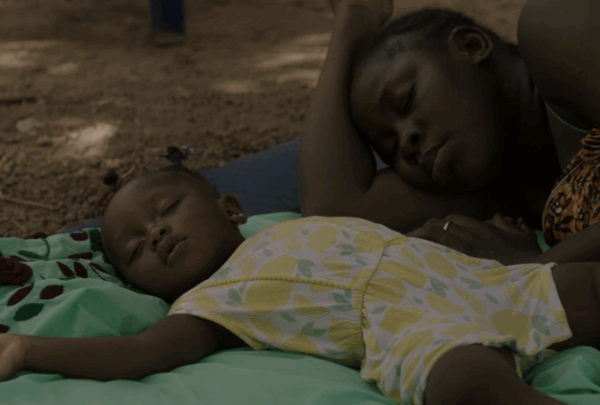
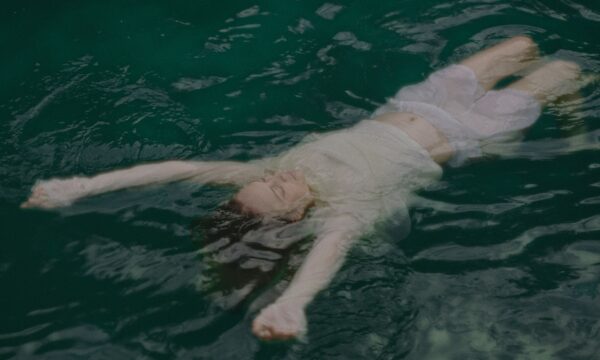
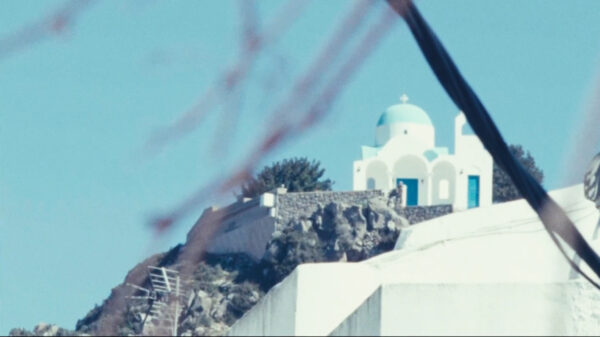
Green Grey Black Brown (2024), the latest experimental documentary short by Paris-based Chinese video artist Yuyan Wang, can come across, at least initially, as fragmented. The video clips included in the short span starkly contrasting scales; to name just a few: close-ups of workers assembling artificial flowers, a mushroom connected to a modular synthesiser, mud flows, and wide-angle shots of people spraying green paint onto bare mountains. Colours form the film’s title, but most of its imagery is drenched in slime—muddy, greasy, perhaps even repulsive to some. It is precisely this slithery texture, however, that binds the seemingly disjointed clips together, unveiling a peculiar synthetic scenery that is not one of dystopian fiction, but the behind-the-scenes of our present reality, reliant on plastic manufacturing and the petroleum industry.
Some of the video clips come, in fact, from Wang, first-hand—snippets of her field visit to the Dongguan region in southern China, home to the world’s largest hub for the manufacturing and distribution of artificial plants. In our conversation, Wang shared with me that, during her month-long stay, she discovered that each village had its own specialised craft, with an entire street—or even whole villages—dedicated to producing a particular shade of leaf with a lavish green sheen or flowers arranged in perfect symmetry. In Green Grey Black Brown, the camera zooms in on workers’ hands as they carefully lift petals from the mould, manoeuvre spray nozzles with precision, and control the switch that drops the metal platen onto the plastic bud—a choreography of hand and machine directed by human’s fetishisation of nature. The rhythm of labour becomes a structured refrain in this dance: dyes applied, cavities filled, details carved. “I found this type of line production very industrial, yet organic; it is a bizarre combination,” Wang tells me.
These “ethnographic” clips were part of her research for an upcoming feature. But, as she shares, the filmmaker soon realised that the footage itself embeds a level of complexity and information—the intricate dynamics of commodity culture—that could never be fully grasped through writing a script alone. Alongside her fieldwork, Wang had also already sourced some video clips online, mostly commercial ads from the extractive and petroleum industries. “Part of the online videos were recommended by algorithms based on my browsing history from a separate working account,” Wang explains her approach to collecting materials, adding that she’d also input keywords, or hashtags, and then extract relevant content from the images retrieved. The video artist likens this process to writing, except that “images substitute words and phrases.” The “thinking-in-image” logic illuminates the agenda behind Wang’s montage of filmed and found footage in Green Grey Black Brown, which, in the artist’s words, reveals the “vicious loop” in which “materials, humans—or rather the body, the organism—keep circulating upon the assembly line of imagery, essentially become part of it.” Through careful sequencing, Wang re-enacts this circulation between humans, nature, plastic, and oil. Here lies the paradox: artificial plants imitate natural landscapes, yet their raw material—plastic—is a major product of the petrochemical industry. Meanwhile, petroleum itself originates in part from ancient microscopic flora, transformed over millennia by heat and pressure. We are trying to imitate the very nature we unearth and destroy.
The short’s sound design further enhances this hypnotic loop. A slowed-down version of “Owner of a Lonely Heart”, the 1980s pop-rock classic by Yes, dampens the already slimy atmosphere. Wang and her sound designer, Raphaël Hénard, turned down the idea of using an otherwise fitting siren sound, instead looking for a more affective, fragile, and embodied sonic expression, leading them to this track, which dominated the pop charts at the time. For Wang, the song is more than a lingering background tune; it evokes a collective memory, a shared impression of the 1980s—an era that marked the global rise of consumer culture and the intensifying extractivism. “I want to let the visual medium renew our conception of landscape, not merely as nature, but as a mixture of the synthetic and the organic,” Wang explains. The impulse of making the short also connects to her encounter with a Nature article titled “Global human-made mass exceeds all living biomass”. The research suggests that, roughly in 2020, the total mass of human-made materials (concrete, plastic, metal, pitch, and more) exceeded all living biomass on Earth. “I was quite shocked when reading this,” Wang says.
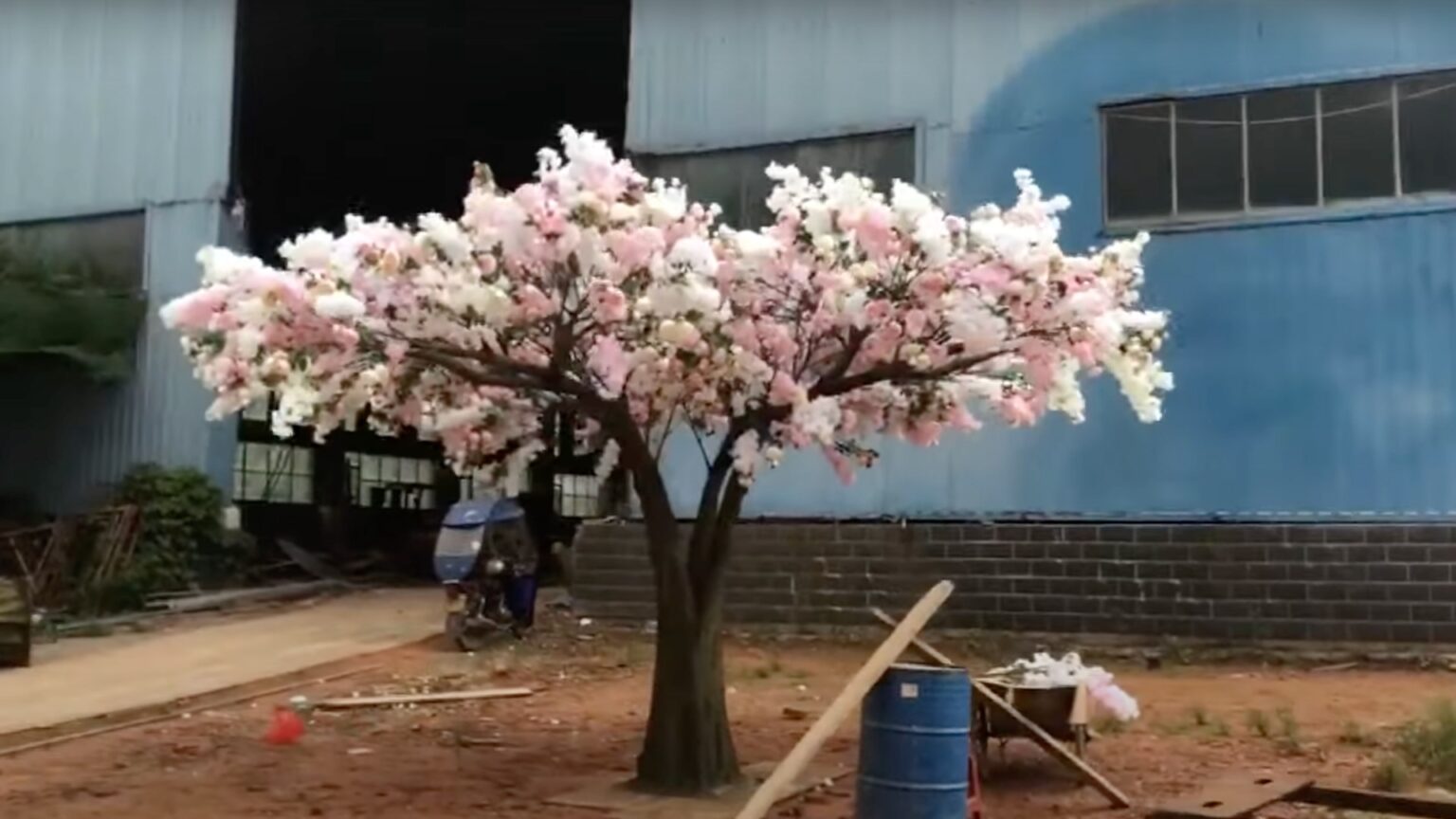
Green Grey Black Brown (Yuyan Wang, 2025)
Green Grey Black Brown is about the appalling weight of man-made materials; at the same time, the film is built upon the quantity of video clips—the mass of images. For Wang, who refers to the methodology as “recycling images,” Green Grey Black Brown also explores the ways we cope with a world overloaded with visuals. Never before has information been as conveniently embedded and exchanged through images as it is in today’s digital environment. “When we perform searches [online], a huge amount of information gets compressed into basic colour blocks, just like the ones that keep loading when the internet speed is slow, for example,” Wang explains. In spring 2025, the Douglas Hyde gallery in Dublin presented Wang’s solo exhibition, including Green Grey Black Brown and her previous short film Look on The Bright Side (2023). The title of the exhibition was revealing: #16161D, which is the colour code for eigengrau, or “intrinsic grey,” a shade that we see with our eyelids shut or in complete darkness. The artist chose the colour to signify that often-neglected embodied relationship between image and body. “Throughout my workflow, my body has to consume a massive number of images,” says Wang, “I started thinking of the retina almost like a plant doing photosynthesis, transforming light into cognition, memory, or imagination.”
This analogy allows us to rethink the short’s title as symbolising the transition of humans and non-human entities trapped by petro-capitalism. The artist describes this vicious loop as follows: “We watch a plant corrode, or return to an oil-like state, transforming from green to black.” On the other hand, the colour blocks also point to the very process of acquiring knowledge—a visual epistemology—prevalent in today’s society. The title, then, according to Wang, “captures the most essential information—the colour information—to summarise the overall sensory and visual message of the film.” One detail that Anglophone audiences may miss is that the film’s Chinese title is diyi (lichen), a plantlike symbiotic organism covering all four selected colours, which the artist decided on after the English one: “I wanted to find a word that can symbolically catch the message I want to convey with the colours.”
In her previous work, One Thousand and One Attempts to Be an Ocean (2020), the pleasure accumulated in montages of videos that are satisfying to watch eventually becomes a sensory overload. Similarly, Green Grey Black Brown is a work of irony; it invites the viewers to a seemingly unknown or distant territory: the deceptive artificial greenery takes place on a remote hill, the grotesque extraction of oil is in another country, and the eruptive natural disasters are not here, but there. Nonetheless, the film reminds us of the proximity and legitimacy of these scenarios, located on the same planet we inhabit and in the corners of the shared cyberspace we may be too reluctant to search.
Intriguingly, when discussing the short’s collage, Wang recalls her earliest training in traditional Chinese landscape (shanshui) painting, which later resonated with her when creating digital landscapes, whether metaphorical oceans or artificial vegetation. “When left to ferment, this recycled footage becomes a sort of compost and acquires that texture of ink wash.” Moreover, shanshui painting’s emphasis on negative space and scattered perspective advocates a silent, contemplative, sensory viewing experience, corresponding to what Green Grey Black Brown’s ten-minute visual collage seeks to enact. “This film deals with a subject on a rather grand scale, and the short format takes the dual dynamics of the positive-negative,” Wang explains, “What I show on screen simultaneously reveals aspects that cannot be articulated, are difficult to recognise, or cannot be easily summarised.”
The curated, reflexive viewing, guided by Wang’s intuitive editing of found footage and informed by her artistic background, demonstrates her confidence in this working method. But the artist’s intuition and self-assurance should in no way be mistaken for effortlessness. “There’s not much advanced technology or sophisticated techniques in processing [such] images. It’s entirely physical, low-tech, almost a basic form of labour of a traditional worker.” The artist stresses the manual labour required to complete the film and, jokingly, calls herself “an image artisan,” a role she considers intensely physical and exhausting. “It forces the time of editing performed by your body to collide with the temporality of the algorithm and the velocity of images, which far exceeds the human scale.” Wang uses the phrase “Sisyphean subjectivity” to denote the vulnerability and burnout as a result of confronting, through one’s body, the overwhelming flood of images. But she also suggests that it may be precisely this fragmented, easily overridden visual perception of the world that can bind us together, regardless of nationality, language, or culture. “As individual human beings, we all experience this sense of fragility, this helplessness, this futility,” she adds.
Green Grey Black Brown foremostly critiques ecological exploitation; it also continues the filmmaker’s recent interest in tackling the oversaturation of images and, if not worse, their relentless acceleration in our time, leaving us with that “oceanic feeling,” as Wang describes. “There is no longer an ‘outside,’ a purely external critical stance towards images,” explains Wang, referring to practices of ‘détournement’—editing and appropriating images—in the 1980s and 1990s. In the artist’s eyes, the current time’s absorption and citation of images resemble digestion and metabolism: physiological processes that are animal-like, primitive, and instinctive. “Our relationship with images is part of a more organic, larger eco-system.” Images have become a layer of the atmosphere we breathe.
Green Grey Black Brown was nominated for the New Critics & New Audiences Award 2026 at Bucharest International Experimental Film Festival by Alexandra Sirotenko, Cindy Chehab, Mai Nguyen, Najrin Islam, Raouf Moussa, and Tania Hernández González, the participants of the European Workshop for New Curators #2.
The European Workshop for New Curators and the New Critics & New Audiences Award are projects co-produced by the European Network for Film Discourse (The END) and Talking Shorts, with the support of the Creative Europe MEDIA programme, and in collaboration with This Is Short.