
To Run, One Ought to Travel Light
Night of Passage
Three Iranian refugees are dropped off by a smuggler near the Austrian border. In Reza Rasouli’s short film, a night of passage unlocks questions about the rights of passage: whose, and at what cost?
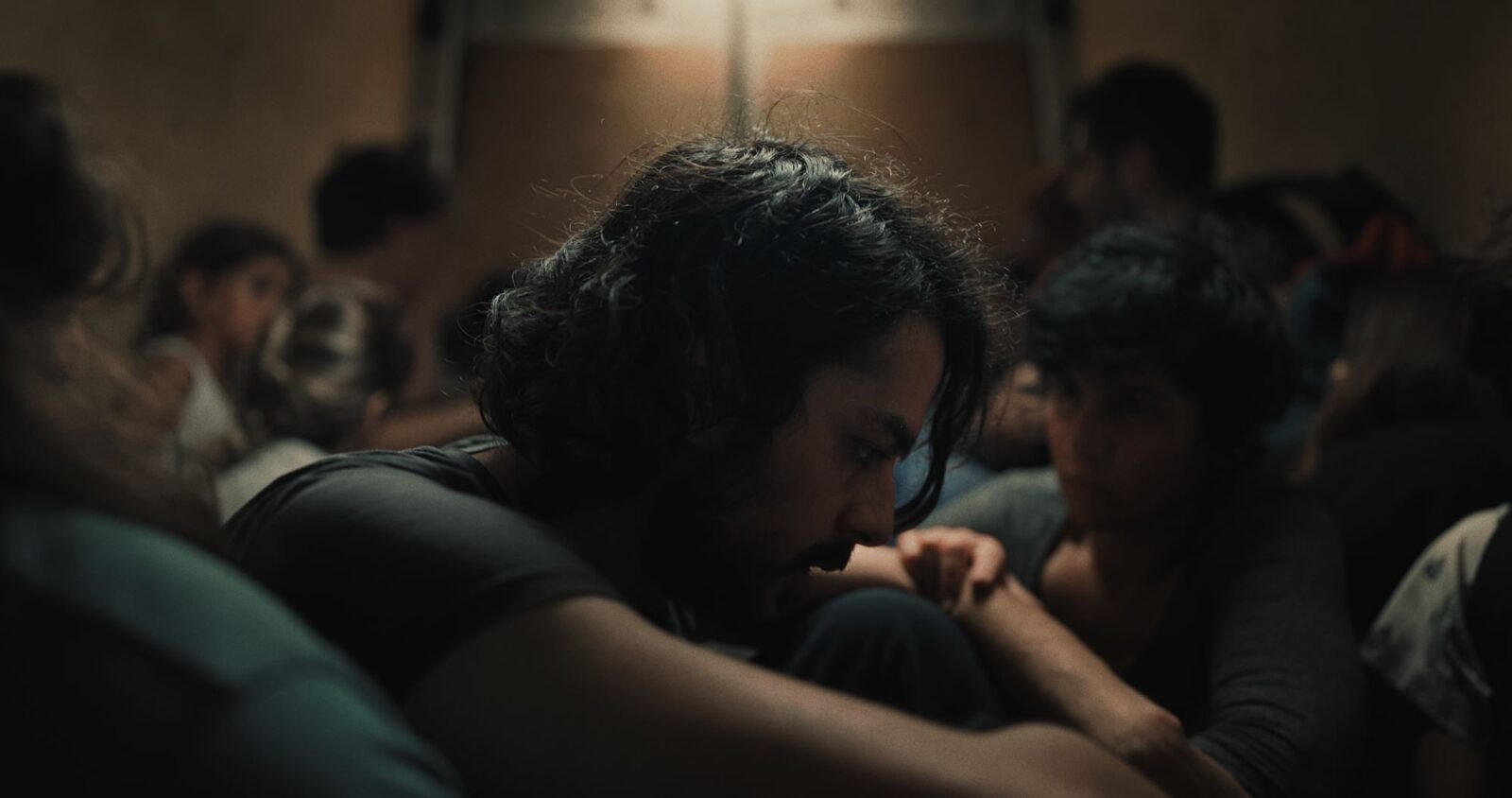
Reza Rasouli’s Austrian–Iranian Night of Passage (2025) resists overstatement when capturing the fragility of each step for those forced to cross Europe’s borders through unsafe and covert routes. In a short film about flight, excess is a liability. One look in the wrong direction and the path forward disappears.
Dropped off by a smuggler at the Slovakian–Austrian border, Leila, Meysam, and Arian are weather-beaten, hungry, and in pain, but most importantly they have never been closer to Vienna. In the film’s key scene, they hide under a bridge to eat and try to regain strength before it’s time to head to the next truck. Meysam and Leila indulge in talking about the future, as near as the next day. She is anxious to see Ali again, whose ring she’s already wearing as a pendant, and he hopes their papers will come through soon so that he can go back to working as a barista. They don’t yet know that Arian, who had instead been pleading to keep moving, has died in his sleep. By the time we reach this turning point, the film has guided us to read it not as the product of tragic fate, but as an end point shaped by the cumulative weight of every choice that came before it.
The film opens inside a womb-like windowless van in motion, where huddled migrants stay alert to noise outside. A short debate over a heard siren makes the crucial distinction between ambulance and police, and a seemingly benign conversation establishes Arian’s headache. From the very first shot, both the internal and external dangers that will sentence the protagonists are introduced. When the doors finally swing open, the crowd scatters under both instinct and implicit instruction. Our protagonists stay together, but only under the collective agreement that “if something happens, we can’t help you”, and “if something happens, just run away”. When hunger and exhaustion influence their non-unanimous decision to veer off course and buy food at a gas station, this is the first break setting the downfall in motion.
A limited number of spaces marks the perimeter of a temporary, tightly-shut universe—forest, gas station, bridge by the highway. Whether paced by the cracks of twigs and the rustling of foliage, or by the sound of a breath held when coming out of a hiding spot, each step brings them both closer to and farther from danger. Against the incessant backdrop of the highway’s at times deafening roar, the film’s movement is commanded by tracking shots that shift from focus on one character to the next. Steps on gravel, sirens, voices — they navigate space with the same sounds that jeopardise their efforts to keep out of sight.
Even after Leila and Meysam renounce caution by carrying pulse-less Arian back to the gas station, the camera remains loyal to its chosen subject, capturing in this case every second it takes for Meysam to run inside, ask for help, and rush back out to find that Leila has saved herself and left. With no time to process the desertion, he answers first responders on the phone, and the ambulance shortly follows. While paramedics tend to the inert body, police sirens blare in the distance: this is his cue to finalise the group’s fracture and escape back into the woods.
If the characters’ experience of their own grief and emotions is momentarily subordinated to survival, so does the film renounce the pause and distance afforded by drivers of narrative sentimentality or a sensationalising register. While defensible tools to reveal as much as distort, Night of Passage adopts realism that doesn’t pretend to be a portal into a truth unburdened of emotional weight. Instead, it seems to aim to render an intimately tangible experience from the ongoing global displacement crisis. This unbroken immersion binds us to the characters’ bodies in continual restless motion. Only once this shared momentum is established does the film seem to turn outward, as if confronting its European audience’s understanding of the real threat at hand here. While the protagonists no longer face the state repression and persecution that precedes the concern over what clothes to wear to go to the shops (as Leila can’t help but note), in these sparse waypoints the characters’ hopes collide with the cold infrastructure of a continent growing exponentially hostile to those seeking shelter within it.
The title interrogates the transitional and transactional dimensions of the quest for a safe place to live—night of passage becomes rite of passage, itself then posing the question of the right of passage: whose, and at what cost? While some “succeed” at leaving everything behind and arriving at a destination whose promises are less than secure, Rasouli directs our gaze to those whose courageous and perilous crossings earn them nothing but the right (the privilege!) to die under a Slovakian bridge.
This text was developed during the European Workshop for Film Criticism #8—a tandem workshop set during Kortfilmfestival Leuven and Vilnius Short Film Festival—and edited by tutor Michaël Van Remoortere.
The European Workshop for Film Criticism is a collaboration of the European Network for Film Discourse (The END) and Talking Shorts, with the support of the Creative Europe MEDIA programme.







There are no comments yet, be the first!