
Tribal Belonging
All on a Mardi Gras Day
A portrait of an eccentric and passionate man, who works all year long sewing and beading a decadent costume that he will wear only once—on the annual Mardi Gras parade.
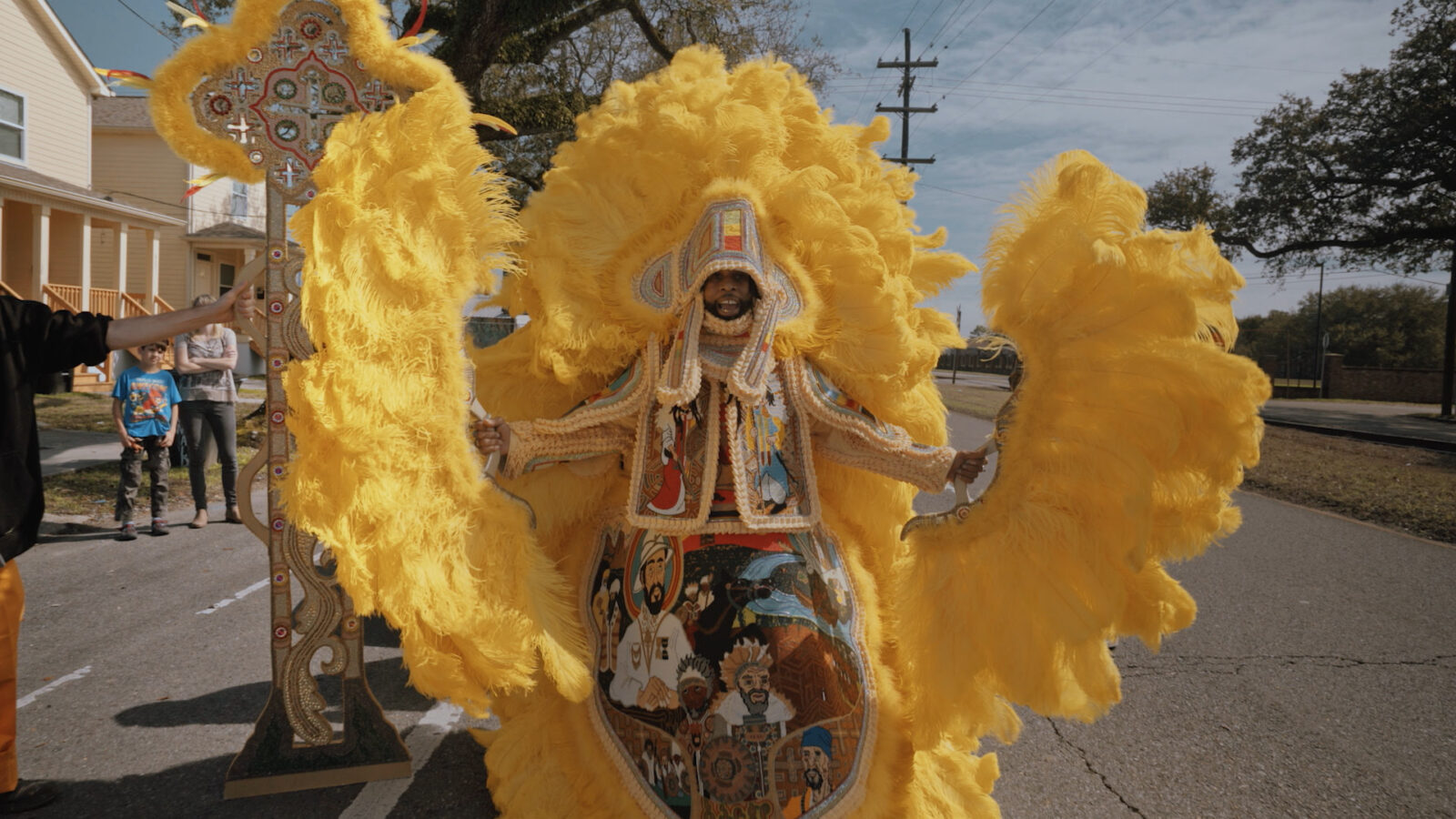
Instead of letting talking heads or quiet observations do the job, director Michal Pietrzyk lets Demond—the film’s protagonist, Big Chief, on the outskirts of New Orleans and known as the master of the needle—tell this story through his own prism. All on a Mardi Gras Day is a portrait of an eccentric, passionate man who spends the year sewing and beading a decadent costume he will wear only once, in the annual Mardi Gras parade.
The film opens at twilight, as we see Demond working in a fully lit house, claiming that he “cannot stop”. Each new costume is supposed to be more sophisticated than the last one, as if he is constantly competing with himself. He believes in his artistic work and categorically refuses to call costume making “just a hobby”. At times, we hear the director’s voice remind us that this depiction is a dialogue—both parties are comfortable in each other’s presence.
We soon learn that Demond used to be a drug dealer and addict, and that his mom was an addict as well. The craftsmanship of Mardi Gras costumes showed him the right path, exemplifying one of the film’s strongest points: creative expression can lead to salvation and improve overall life quality. These revelations show how multi-layered this anecdotal storytelling actually is. Demond isn’t defined by his addiction any longer; instead, he has an artistic devotion to follow and a community to lead. Through design and art, he has mustered the strength to fight his past and continues to grow instead.
Pietrzyk lets this narrative unfold logically and gradually, maintaining a beginning-middle-end structure: introducing us to the importance of costume making first, then feeding it with the subject of Indian influences that turn it into an insightful look into gentrification matters and family issues, finally reaching its culmination on the day of the carnival. Both director and Demond love accentuating details. Pietrzyk and director of photography Gabriel Bienczycki attend to every little aspect of Demond’s work and life, curating them with precision. Close-ups of the coffee pot, costumes, tiny pearls, Demond’s tattoos, his hourly schedule—no detail is too small to be left out.
Simultaneously it highlights the strong community and neighbourhood Demond belongs to. Showing this from the protagonist’s point of view, Pietrzyk adds yet another personal touch to an already deeply private story. This community has remained resilient despite moving to the city’s periphery. While speaking about these like-minded people, Demond mostly uses “we” pronouns. As their leader, the Big Chief is a father figure to the others since many of these “young cats” (as he refers to them) don’t have one. To each other, they are an extended family—brotherhood, if you will.
Over the last years, middle and lower class people have suffered greatly from New Orleans’ gentrification. Demond is nostalgic for the Ninth Ward district, where he used to live. Among other areas, it was vastly destroyed during Hurricane Katrina in 2005, after which these neighbourhoods were rebuilt and gentrified. As rents skyrocketed, Demond moved to a cheaper place. Despite decreasing household expenses, he still doesn’t have any free financial resources – the bulk of his income covers rent and sewing materials only.
Black Americans are not respected by many in New Orleans, Demond states. It is the South, after all. Historically, due to racism and slavery, they couldn’t participate in the official parade. Therefore the Black neighbourhoods developed their own celebration. Demond belongs to Mardi Gras Indians: people of colour who dress up in costumes influenced by Native American ceremonial regalia, thus paying respects to Indians, who protected and sheltered slaves who tried to escape from captivity. Symbolic messages about African, American, and Indian heritage are encoded in the costumes, connecting past to present and mythology to the modern view of the world—clothing as an act of rebellion against social and racial injustices.
All on a Mardi Gras Day connects art to personal development and the environment to its people, ultimately laying bare a passionate story about belonging and family. Building on the strength of its central figure, the director equally and successfully represents New Orleans’ diversity and history.



There are no comments yet, be the first!