When Grief Speaks in Folklore
On Loss and Childhood in Grandpa’s Fur
Berenika Balcer explores the five stages of grief as represented through the kukeri tradition in short films such as Grandpa’s Fur (2026), Kukeri (2023) and Pamfir (2022).
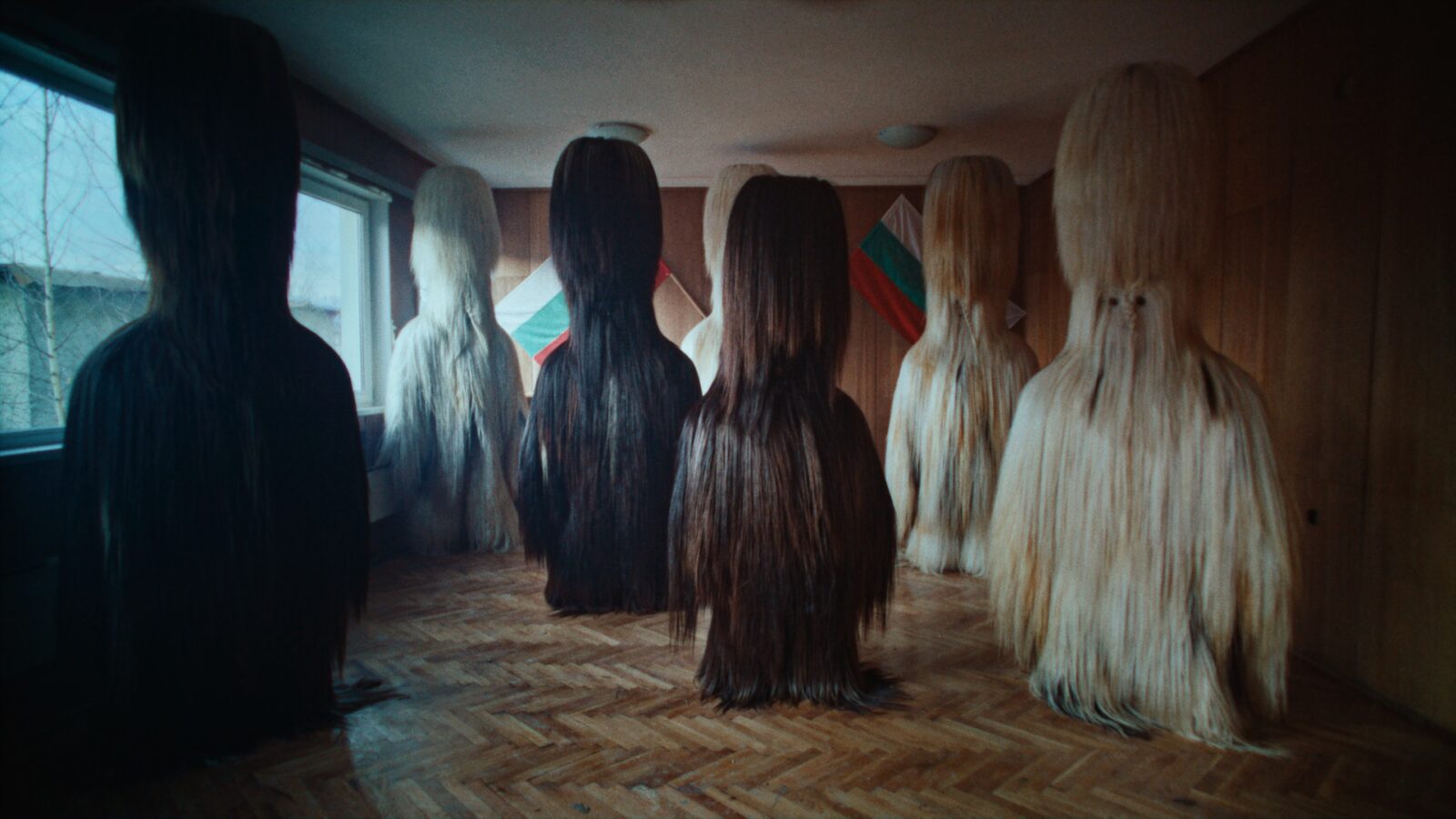
Fur sways with every step, fully covering the body beneath it. Heavy figures move through the landscape, bending and twisting beneath their shaggy skins. They stomp, whirl, and shake, heedless of everything around them, as though nothing exists beyond the ritual. Their faces hidden, their bells clanging with every movement, they seem almost non-human, more like creatures passing through dawn: huge, strange, unreal.
One of these figures crosses the boundless Bulgarian landscape alone, like a sheep without its flock. When this towering creature approaches, a young boy, in a red woolen sweater, playing with a tiny bell, is neither frightened nor surprised; quite the contrary, he asks, “Are you my grandpa?” before hugging it.
This elaborately costumed figure is a kukeri—a participant in a Bulgarian pagan tradition designed to scare away evil spirits and bring prosperity. Heavy, handmade outfits of goat, sheep, or bear fur and fleece cover most of the body, while large, intimidating wooden masks feature horns, fangs, bulging eyes, or double faces. For many viewers, the image might recall the furry costume scene in Maren Ade’s Toni Erdmann (2016). Here, however, the absurdity of the oversized creature makes room for a different form of tenderness.
Screened in the International Competition at the FeKK in Ljubljana, Teodor Stoilov and Nellie Rajala’s short Grandpa’s Fur (2026) grew out of both a fascination with the kukeri tradition and Stoilov’s experience of watching his grandfather live with dementia, which ultimately became the film’s key inspiration. Following six-year-old Gabo as he tries to understand his grandfather’s disappearance, the film turns folklore into a language for grief.
Denial
The boy’s question has no easy answer. His grandfather, Ivan, is still there; his memory is not. At home, Gabo’s father, Kamen, is running out of patience. Ivan can’t keep walking around dressed like that: the bells and the costume belong to the kukeri ritual, but outside it, his behaviour becomes strange, disruptive, even unsafe. “I don’t understand,” Ivan repeats like a mantra. Gabo, listening from the next room, understands as little as his grandfather. Nobody has yet taught him what it means to lose someone who is still sitting in front of you. He loves his grandfather dearly, so he does the only logical thing available to him: the kukeri ritual, which drives away evil spirits and, hopefully, brings back his grandfather’s memories.
“The story unfolded in a strange way because it almost felt unplanned,” Teodor recalls during our video conversation on a rainy September evening. As the script was being written, Teodor’s grandfather’s condition was worsening. His father had installed a CCTV camera in the apartment to keep track of what was happening, and Teodor had access to it. Watching it while trying to write a fictionalised version of it felt undeniably strange. Yet, many scenes that emerged are almost word-for-word from life. That proximity to real life also explains why the film needed a language beyond realism: dementia is difficult for a child to comprehend, just as death is.
“We knew grandfather would pass away,” Nellie recalls, referring to the onscreen grandfather, even though the boundary between real life and fiction had long blurred. They did not yet know how their protagonist would die. One day, after struggling through many versions of the script, Teodor’s father came home and said that the grandfather had asked him to give him all his pills, so that “his suffering would end, and everybody’s suffering would end, too.” In the film, Ivan asks for the same. He recognises his son’s struggle and offers a solution to “the problem.” The plea is ignored, a son’s love taking the form of duty. One night, Ivan falls from the bed, caught somewhere between awareness and lucidity. Gabo becomes the executor of his final wish—a heavy glass cup holds all the pills that will allow Ivan one last kukeri dance with his grandson, out in the fields in the early dawn light.
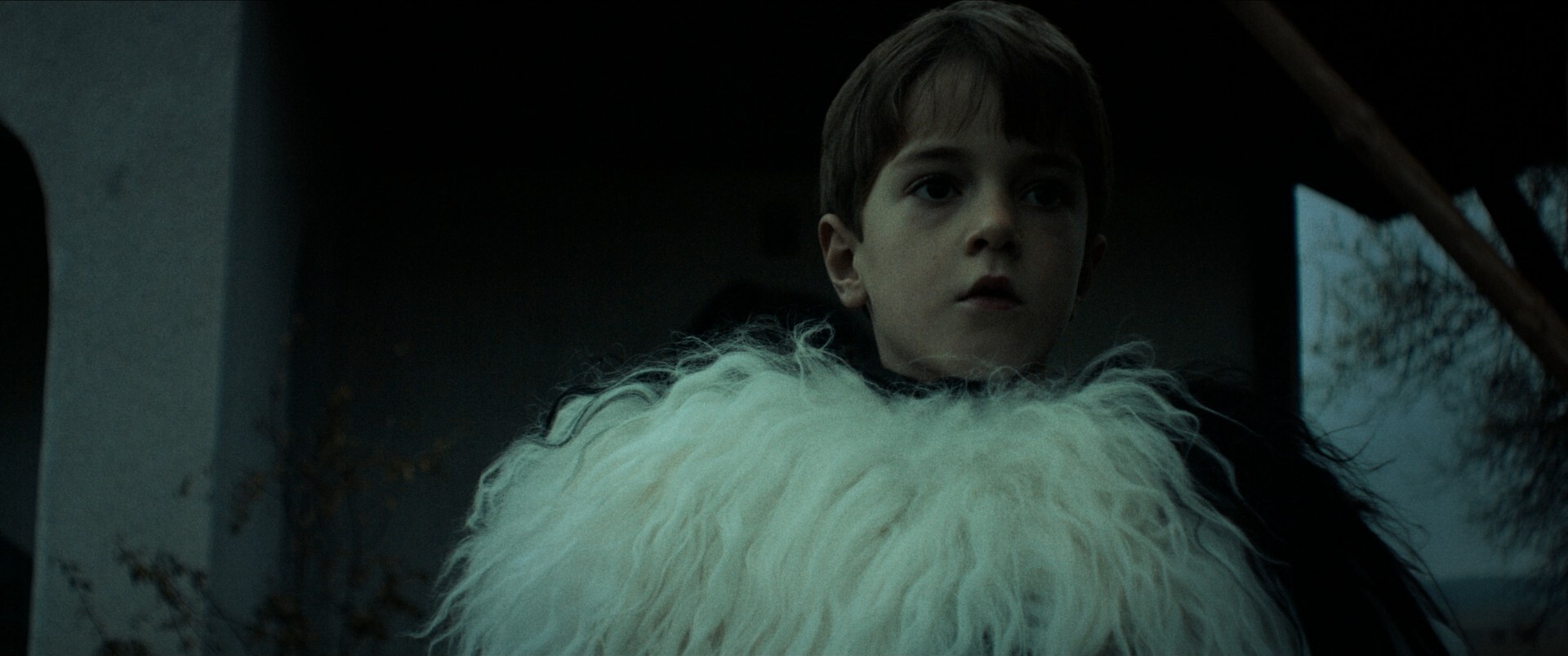
Grandpa’s Fur (Nellie Rajala, 2026)
Bargaining
For Gabo, the ritual begins with a bell. He plays with a small one when his grandfather first appears; later, when Ivan tells him he needs different bells, the boy searches for them in a shed. They are meant to be louder, bigger, more “adult.” The little bell is a child’s object, while the larger ones belong to the kukeri costume and ritual, a world Gabo is still learning to enter. The sound of the kukeri bells (chanove) is far from a light, musical chime, and closer to a thunderous heartbeat made of bronze, iron and copper. As the dancers sway, hundreds of heavy bells collide in a wild, synchronised chaos, producing a rhythm of their own. Recognising their power, Stoilov and Rajala make the bells the film’s core motif.
Folklore thus becomes a language Gabo can actually use. Killian Lassablière’s documentary short, Kukeri (2023), offers a glimpse of the tradition on a different scale: moving through the landscape, its figures look less like individuals than a strange collective presence. As the directors researched the tradition at the kukeri festivals, they defined that masked collective as less about the performativity of the events and more about the community moving together beneath fur, masks, and bells. “It exists for the village to protect the place their loved ones live in,” they say.
A Bulgarian ethnographer, Ganka Mihailova, notes that the bells make the masked groups seem both frightening and comic: their noise accompanies behaviour that would be unacceptable outside the masquerade.11 Mihailova,Ganka, “Are the Masked Personages in Bulgarian National Tradition Really Masked?”, 2002. ↩︎ In Grandpa’s Fur, the bell motif extends beyond the kukeri themselves. At the edge of the village, the small white church sits almost swallowed by darkness, its bell tower rising above the roof, with the mountains looming behind it. But the tower is empty: where the bell should be, only a dark opening remains, echoing Gabo’s search for his grandfather, who is physically present yet mentally absent.
Anger
The kukeri’s faces disappear beneath their masks. What remains are strange, animal-like shapes: almost monstrous, made more unsettling by the fur that swells around the human bodies underneath. In Grandpa’s Fur, such figures are not simply part of the landscape, but they become forms Gabo turns to when he cannot confront the real source of his fear directly.
The kukeri belongs to a much wider tradition of winter masquerades across Central and Eastern Europe, in which masked figures blur the lines between Christmas and the pre-Lenten Carnival. Lassablière’s Kukeri offers a glimpse of this tradition as it is practised today, following several generations of participants as they prepare their costumes and take part in the ritual. In Ukraine, the Malanka celebration similarly brings masked figures into the streets to mark the new year—a tradition shown in Dmytro Sukholytkyy-Sobchuk’s Pamfir (2022).
As in Grandpa’s Fur, the costumes in Pamfir are more than visual spectacle: they become part of the film’s language. The most striking outfits are the primal “Bear” (Vedmid) costumes. The protagonist, Leonid vel Pamfir, wears a snarling, carved wooden mask and heavy layers of straw and hay rolled tightly into thick bundles.
Mihailova reflects on the relationship between kukeri ritual, totemism, and animism. In Pamfir, that connection emerges through Leonid’s almost mythical physical strength, amplified by a costume that exaggerates the violence and masculinity of the world he has built around himself. For his son Nazar, putting on the costume becomes an initiation into manhood. By the finale, ritualistic play and deadly reality have become almost indistinguishable: Nazar enters adulthood marked by guilt, while Pamfir sacrifices himself to secure his son’s future.
The initiation in Grandpa’s Fur, however, is less about transgression than inheritance. To describe one particular feeling among people involved in the kukeri tradition, Teodor reaches for a Bulgarian word: “merak” (мерак). Difficult to contain in one simple definition, he settles on calling it a feeling in one’s body that keeps you doing something for a cause. “If the grandpa manages to pass something to his grandson, it’s this kind of will in his body, in his soul, to keep this tradition, to have this energy in him, to keep going,” he adds.
The title in Bulgarian—Кожите на дядо—adds another layer. “Кожите” can mean both “fur” and “skin”. One points to the material of the kukeri costume—something worn. The other, however, suggests getting under, living in, becoming. Rather than explaining the ritual from outside, the film lets us experience kukeri through Gabo’s understanding of it. Originally, there was a scene filmed in which the boy watches old tapes he has found, a documentary of sorts, because the directors felt the need to explain the ritual more explicitly. They cut it in the editing room. “It felt like everybody had this subjective view towards this spiritual thing,” Teodor reflects. Instead, they found it more fitting to frame the grandfather and the boy as unreliable narrators. They carefully point out that they are not experts on kukeri, and that the film is ultimately more interested in the relationship between its two characters.
In his article, “A Play to Banish the Darkness: The Domestication of Death in Bulgarian Folk Traditions”, Richard Fawcus recounts telling one performer that he had just seen the whole ritual. The man, however, replied that Fawcus had not seen it—could not, in fact. An outsider could witness the ritual, but never fully experience it from within.22 Fawcus, Richard, “A Play to Banish the Darkness: The Domestication of Death in Bulgarian Folk Traditions,” in The Routledge Handbook of Dark Events: Celebrations, Heritage, and Customs of Death and the Macabre, 2026. ↩︎
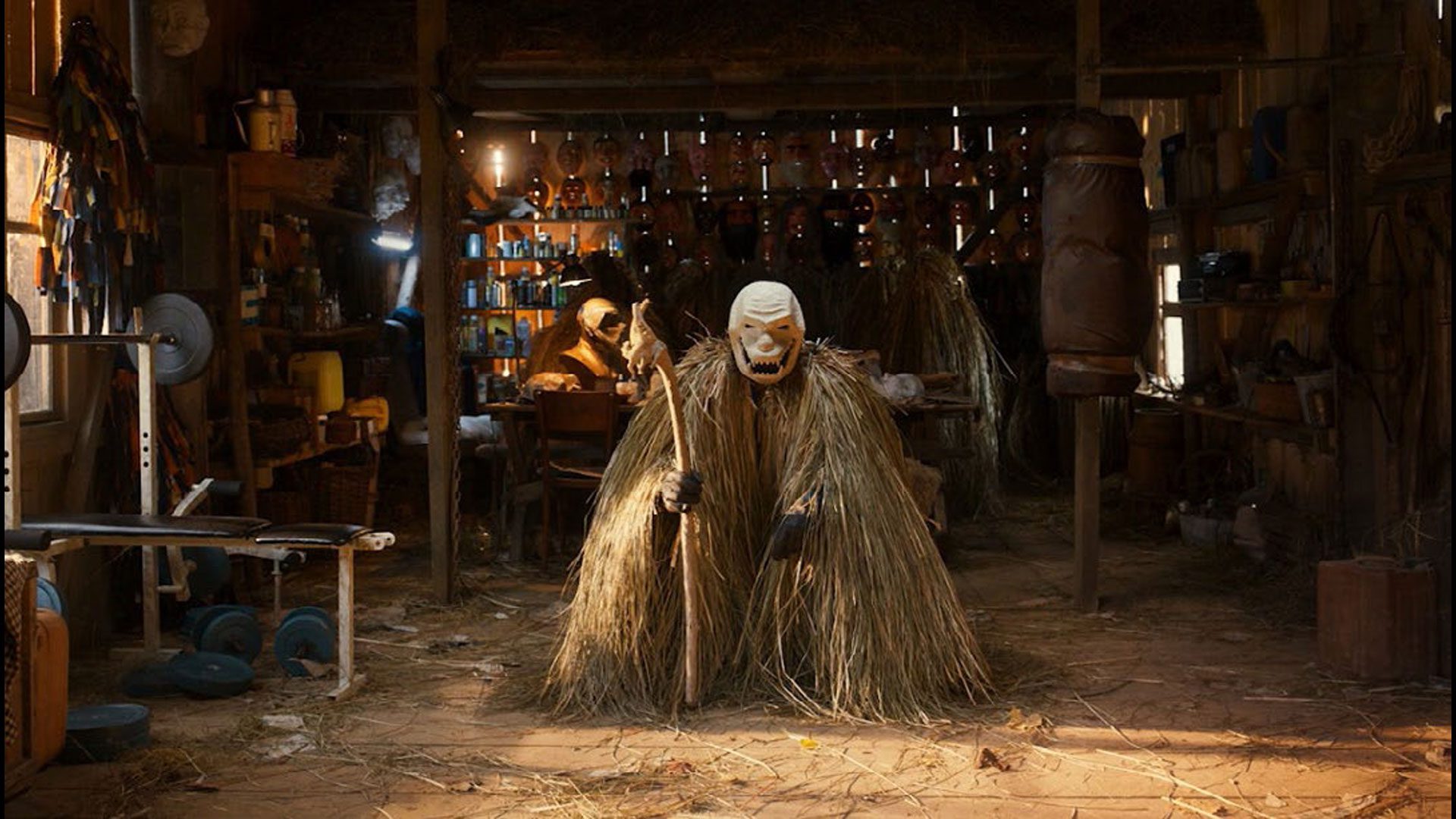
Pamfir (Dmytro Sukholytkyy-Sobchuk, 2022)
Depression
Teodor’s grandfather died a few days after they finished shooting. By then, the film had already become entangled with real life in ways neither of them could have planned. “It was almost like a spiritual moment to get over the feeling of his death,” Teodor says. He describes the process as something that helped him move through his grandfather’s death while discovering more about him along the way.
Grandpa’s Fur is not alone in turning to folklore when something cannot be explained directly. Folklore gives grief a structure through which it can be understood and communicated, while also maintaining a sense of continuity with the past. In this sense, folklore does not simply preserve memory; it offers people a way to live alongside it.33 Zou, P. H., & Priscilla, B. E. “Folklore: An identity born of shared grief”, in Cogent Arts & Humanities, 2023. ↩︎ “Filmmakers generally adopt two strategies in representing death: domestication or annihilation,” Maria Boguszewicz states in her analysis of folklore and cinema, stressing how folklore serves as a medium for cultural memory, continuity, and resistance.44 Boguszewicz, Maria, “We Who Speak with the Dead: Galician Folk Belief and Cinematic Reimaginings in Diana Toucedo’s Trinta lumes (Thirty Souls, 2018)”, in De Gruyter Brill, 2025. ↩︎ In Bulgarian folk traditions, the macabre elements of ritual can instead give death a place within the social and natural order, “domesticating” it. “We often talked about similarities with how mysterious and slightly scary the kukeri tradition is,” Nellie recalls, “and how mysterious and slightly scary dementia can feel.”
When asked about inspirations, the directors recall watching old Bulgarian cinema, like Rangel Vulchanov’s surrealist The Unknown Soldier’s Patent Leather Shoes (1979), a film rooted in memory, grief and intergenerational relationships. It follows Mone, a boy growing up in a Bulgarian village, whose childhood memories blur reality, myth, and imagination. As in Grandpa’s Fur, the grandfather stands at the centre of the boy’s world, passing on knowledge and experience while making him a witness to the weight of that history. After his grandfather’s death, Mone is left to carry that connection to the past himself, becoming the new guardian of his memory.
Acceptance
“It’s just in my veins. It’s in my blood,” says a young boy in Kukeri, following in his father’s steps. Teodor, however, admits he was never close to the ritual; he discovers it through Gabo’s eyes. In the final scene, Gabo walks down the path from the church—alone, as the grandfather is no longer there. Then, the sound of bells cuts through the otherwise empty air. A group of kukeri surrounds him, dancing, shaking their bells, almost as if performing the ritual for him. While both Pamfir’s and Lassablière’s processions become a vast, almost mythical presence, Grandpa’s Fur shrinks the ritual to a handful of figures around one small boy.
Yet Gabo looks around—is he searching for a familiar figure? Then, he is alone again, and all that’s left is sorrow. “The reason you feel grief is that there is so much love,” Nellie puts it simply. Gabo will always have kukeri: in practice or in memory, they will remain a connection between what was and what is.
This text was developed during the European Workshop for Film Criticism #10—a tandem workshop set during FeKK – Ljubljana Short Film Festival and Bucharest International Experimental Film Festival (BIEFF)—and edited by tutor Yun-hua Chen.
The European Workshop for Film Criticism is a collaboration of the European Network for Film Discourse (The END) and Talking Shorts, with the support of the Creative Europe MEDIA programme.