
A Camera in Hand
Militant Filmmaking in Latin America, Then and Now
Lucía Salas’ programme for Kurzfilm Festival Hamburg offers a view of what militant cinema has meant in Latin America, mainly in the 1970s, while interrogating how we relate to this filmmaking approach today.
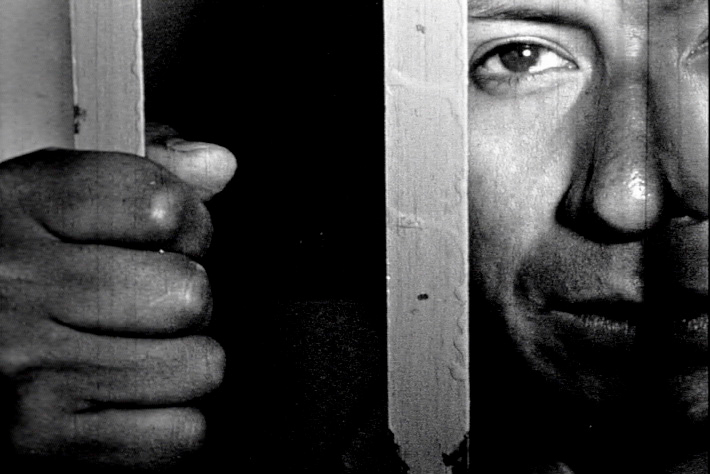
Made famous by the now-canonised, then disruptive Brazilian filmmaker Glauber Rocha, the statement “uma câmera na mão, uma ideia na cabeça” (A Camera in the Hand, An Idea in the Head) argued for a sense of urgency as the driving force behind filmmaking, and that a filmmaker must not give in to financial constraints. In other words, get out into the world, film what you see, and do not let The Man push you down.
Drawing from Rocha’s proclamation, Argentinian film critic, programmer, editor, and filmmaker Lucía Salas curated a programme strand for this year’s Kurzfilm Festival Hamburg, cleverly disguising a nuanced approach behind a deceivingly direct title. The shorts presented in “Una camara en la mano y una idea en la cabeza” embody the spirit of documenting the present at all costs and against all odds. However, they also display strong mise-en-scène strategies and a formal ambiguity far more significant than we may give them credit for.
Salas’ strand comprises two blocks of twelve films in total, all of which can be read through the lenses of militant cinema and in conversation with what has been known as the Nuevo Cine Latinoamericano, or New Latin American Cinema. In the words of scholar Cristina Beskow, the movement “had as its main political banners an anti-imperialism stance, cultural decolonisation, and the national liberation of third-world countries. Drawing direct inspiration from each nation’s reality, cinema was seen beyond its representational aspect, therefore serving as a tool for social intervention.”11 Beskow, Cristina Alvares, “O documentário no Nuevo Cine Latinoamericano: Olhares e vozes de Geraldo Sarno (Brasil), Raymundo Gleyzer (Argentina) e Santiago Álvarez (Cuba)” (unpublished doctoral thesis, Universidade de São Paulo, 2016) ↩︎
From Grupo Ikamau’s Revolución (Revolution, 1963) to Aloysio Raulino’s O tigre e a gazela (The Tiger and the Gazelle, 1977), the twelve shorts screened as part of this archival programme sought to intervene in a context of totalitarianism, state violence, social inequality, and the workers’ movement. To these filmmakers documenting political resistance through collective action in Argentina, Brazil, Bolivia, Chile, and Uruguay, the unveiling of a socially unjust reality, uncomfortable to these countries’ governments, represented a non-negotiable stance.
This is particularly true for the films featured in the first block of the programme, titled “Argentina 1976, Behind/Ahead”. Reflecting an understanding of the camera as a weapon, these are Argentinian films taking matters into their own hands while documenting people who also do the same. The opening short La paz (The Peace, 1968), which employs efforts to expose an authoritarian regime, contrasts sound and image. As the film progresses, we begin to understand that what is shown is there to contradict what is heard. As we negotiate our role as active viewers, we are invited to question official narratives about a nation’s current state. In the face of censorship against freedom of expression, the film calls our attention to editing as a narrative tool that ‘speaks’ loud and clear.
The voiceover from the official authority delivering a nationalist, pro-coup d’etat speech—a suffocating presence, albeit a faceless one—persuades, “I invite you to toast to peace”. We must then ask: to which peace are we toasting? “That peace which I do not wish to pursue”, as in the lyrics of Brazilian musical act O Rappa, who, in the same song, brilliantly states: “Peace, without having a voice, isn’t peaceful, but fearful.”
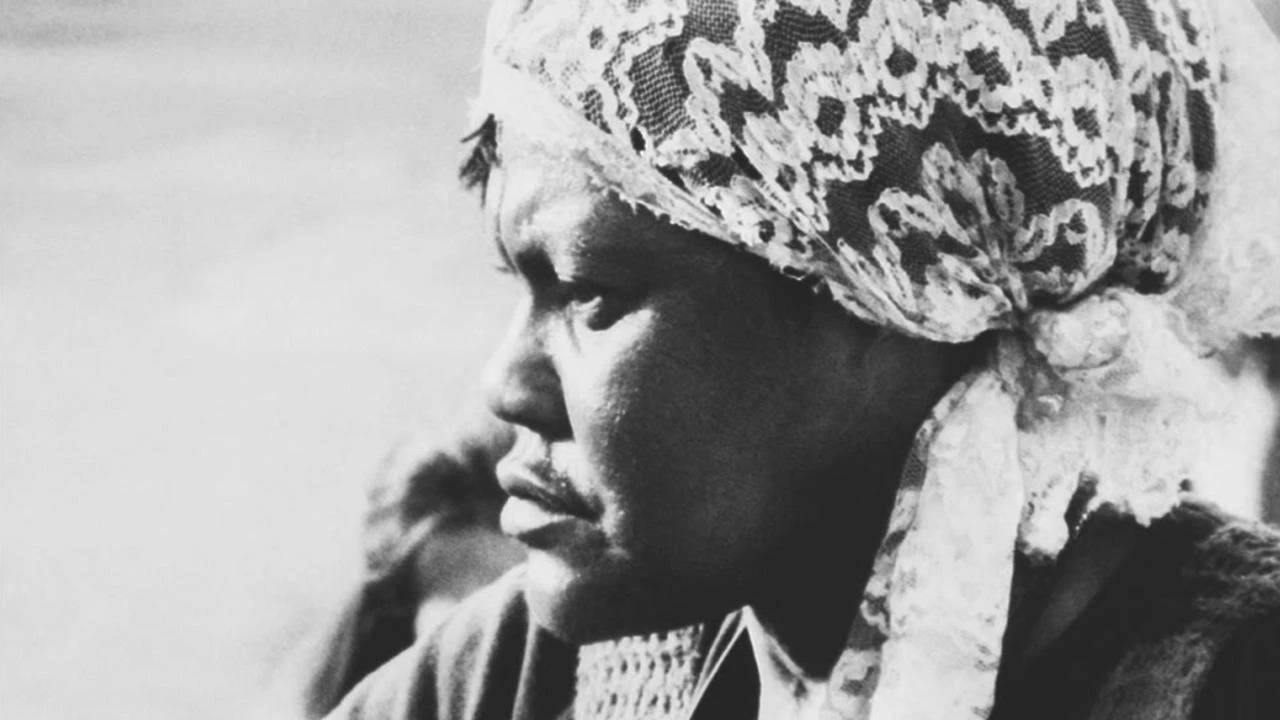
O tigre e a gazela / The Tiger and the Gazelle (Aloysio Raulino’s, 1977)
Me matan si no trabajo y si trabajo me matan (They Kill Me If I Don’t Work and If I Work They Kill Me, 1974) brings an ironic touch to political cinema, with the camera serving as a witness to workers organising against unhealthy conditions. At a certain point, the film shifts from a more traditional militant documentary iconography—political demonstrations and crowds—to pure sarcastic social commentary, making use of caricaturesque animation and dubbing to allude to surplus in capitalism. In doing so, it leans into a type of political sarcasm firmly ingrained in third-world subjectivity, which is to take gratification in making a fool of a gringo.
If for both La paz and Me matan the off-screen is a crucial narrative element that materialises the weight of History, Esta voz… entre muchas (This Voice Among Many, 1979) values speaking up. The film creates a space for listening, leaving room for accounts on the brutality of dictatorship in Argentina. In doing so, it becomes a testament, some type of justice in the face of systemic injustice, particularly to the three activists in exile documented by the film.
While the topic of violence carried out by the Argentinian state is the connecting thread that leads to the last two films in the programme, these works differ in their visual approach. A micro-budget, off-the-arts system type of film, Compañero cineasta piquetero (which loosely translates as “Our Comrade Rioter Filmmaker”, 2002) bridges state repression during the country’s totalitarian years with its legacy in post-dictatorship Argentina—the army then, the police now.
The closing short Warnes (1991) serves as both a confirmation of the political undertone of this first block and as an auspicious invitation to philosophical speculation. A viewer familiar with the context could read the film in a more factual manner, as one documenting the implosion of buildings that once sheltered socially vulnerable communities—the nation-state yet again making life nearly unbearable to its citizens. However, taking into consideration its placement as the closing film, as well as its visuals (colour, frame rate, silence, and a gaze that emphasises the magnitude of the implosion), the film invites interpretations around a certain feeling of collective loss, or even as a curatorial commentary on how the 1966 military coup alluded to in La paz led to nothing but utter destruction.
A Transnational Conversation
While the first programme centers the Argentinian experience, the second one, “The Painful Privilege of Being”, expands to films from other parts of the continent, fostering a conversation beyond national borders. The visual narratives of these seven shorts are of equal importance as the realities they capture—one cannot appreciate their beauty and political meaning without engaging with their mise-en-scène.
From Brazil, Lavra Dor (a play on the words “lavrador”—a peasant farmer—and “dor”—pain, so as to create a fictitious word meaning “to painfully plow the land”) from 1968 conjures poetry and uses a polyphonic voiceover to tackle agrarian reform in the country. Title cards inserted several times throughout the film with the word “documentary” serve as an assertive gesture. It may feel less compelling to some for a film to question its place in the non-fiction field. However, when seen in relation to its context, to uphold its status as a documentary short has both cinematic and political meaning—it serves as a counter-archive to the official narrative of prosperity and social harmony long promoted by Brazilian governments. During its initial distribution run in the late 1960s, it was no small feat to be awarded “Best Film About the Brazilian Reality” at the Belo Horizonte Film Festival at a time of authoritarianism.
If Lavra Dor features poetry as its main aesthetic trait, Me gustan los estudiantes (“I Align With the Students”, in a free translation, 1968) deploys non-diegetic sound and sonic cuts to build a strong contrast between “us” and “them”. Set during an international political summit hosted by Uruguay, it serves as an ode to student activism, idealising those demonstrating in the streets—a typical iconography of Latin America in the late 60s—against deceptive political agreements that favour imperialistic politics.
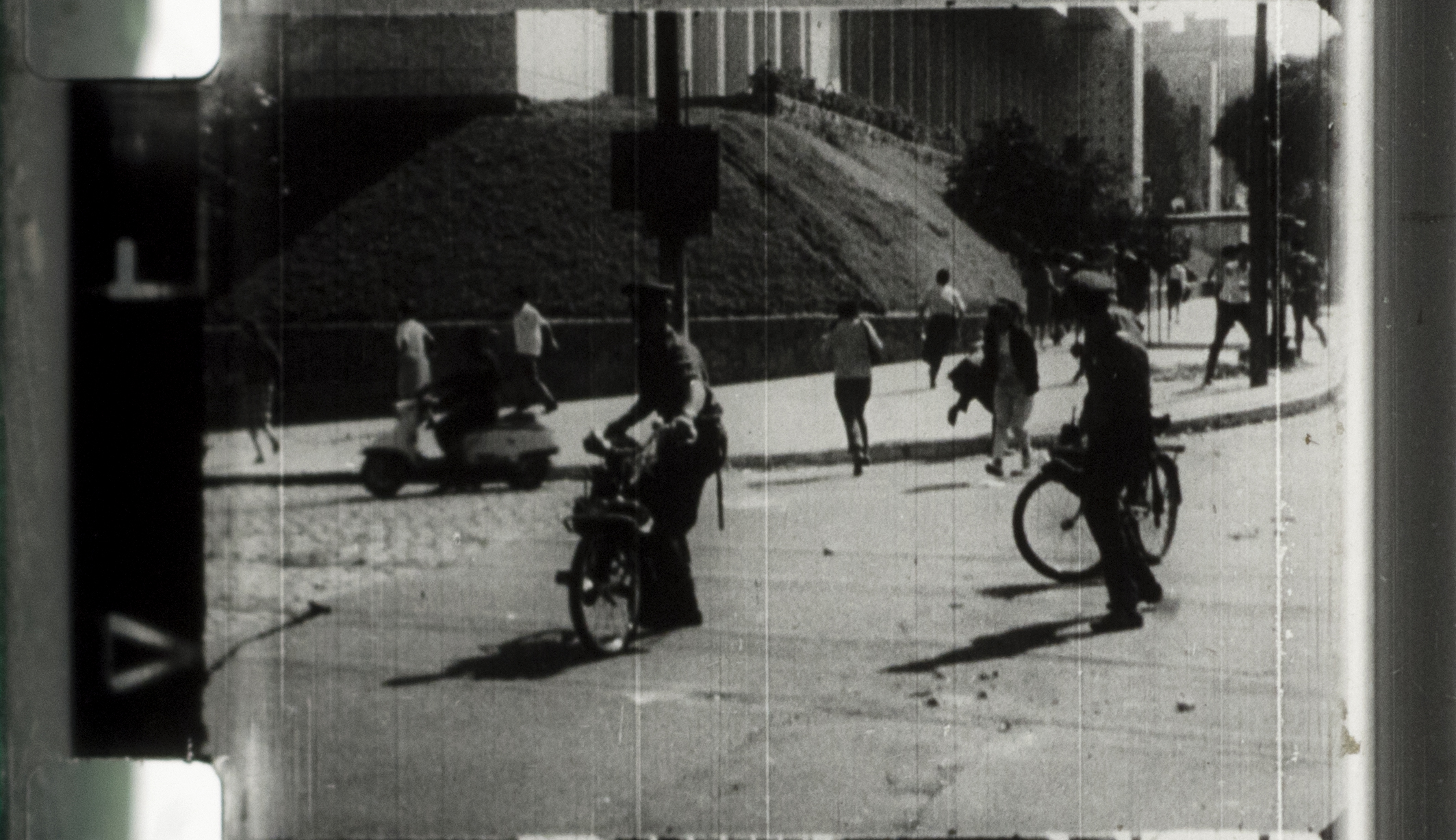
Me gustan los estudiantes (Mario Handler, 1968)
Other # Othering
Alterity is a concept shared by two of the most visually remarkable films from this second programme. Even though they were not screened in consecutive order, as two other shorts sit between them, Revolución (Revolution) and O tigre e a gazela (The Tiger and the Gazelle) cater to different cinematic traditions while filming the “Other”.
Revolución’s first shots—images of regular people in the streets immersed in a melancholic instrumental classical piece—bring to mind some of the most distinctive moments from Agnès Varda’s L’Opéra-Mouffe (1958). As it progresses, the short mobilises a storytelling repertoire ranging from Eisenstein to Vertov and Kuleshov. The result is a poignant commentary on harsh living conditions for Bolivians, but also a call to political organising.
O tigre e a gazela sits at the other side of a cinematic tradition. Perhaps the richest, most nuanced film in the programme, it is invested in powerful encounters between the camera, the reality it captures, and the individuals whose subjectivity blooms on screen. Writings from Franz Fanon on colonialism both confirm and give additional meaning to what is seen—a Black woman repeatedly singing the words of Brazil’s Proclamation of the Republic Anthem, which seemed at first an ode to patriotism, then becomes a critical take on how a nation depreciates its citizens.
The film’s most striking quality lies in its ability to hold the spectator’s gaze, uncompromisingly so. By looking at these characters for longer than cinema has often allowed us to—people often rendered invisible and irrelevant, undesired by a country long committed to racial cleansing policies—, O tigre e a gazela succeeds in accessing two key aspects of the Black experience for people of African descent, which are joy and terror. In doing so, it establishes an unsuspected connection to another film-essay made in a different country—the United States—and at a different time—the 2010s—, which is Love Is The Message, The Message Is Death (2016), Arthur Jafa’s visual meditation on Blackness in America.
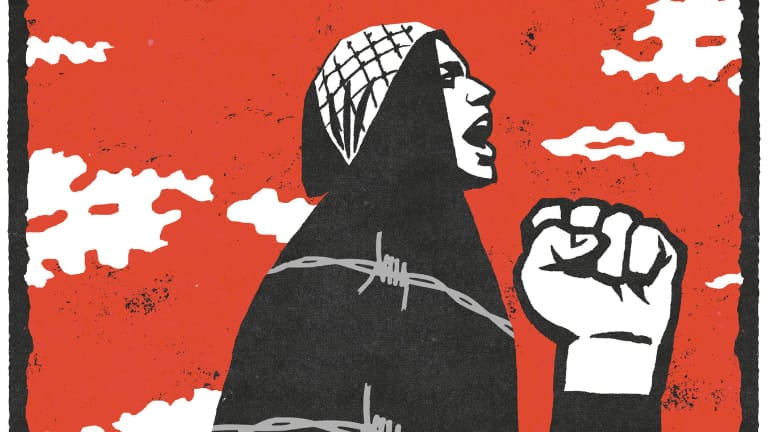
Palestina, otro Vietnam / Palestine, Another Vietnam (Jorge Giannoni & Jorge Denti, 1973)
From Past to Present—and Future
Set in Chile, Amuhuelai-mi (1972) and Abastecimiento (“Supplying”, in a free translation, 1972) are testimonies of a country’s final breath prior to descending into decades of authoritarianism and state-sponsored violence. The former builds a narrative path similar to that of other films from the programme, which is to contrast official rhetoric of progress with the lived experiences of real people.
Countering a discourse of social harmony, Amuhuelai-mi denounces the precarious living conditions of a migrant Mapuche community—both image and data are used to build a critical representation closer to the truth. Abastecimiento centers a character who is white and middle class—a social group whose contradictions constantly spark heated debates in Latin America22 From Lucrécia Martel’s acid portrait in The Swamp (2001) to Kleber Mendonça Filho’s sarcastic social commentary in Neighboring Sounds (2012), white latino middle class filmmakers have long turned their camera to their own class, sometimes with conflicting feelings of affection and repulsion. ↩︎—opposing her narrative about shortages with the efforts to redistribute wealth. Making use of polyphony to convey conflicting narratives about a country’s reality—a woman’s interview obstructed by a non-diegetic text that questions her ideas—, it serves as a reminder that a polarised society isn’t exclusive to the contemporary world.
Positioned as the closing short, Palestina, otro Vietnam (Palestine, Another Vietnam, 1973) incentivises, at a time of political tension, a global struggle perspective to colonial aggression. One can identify a similar—and yielding—programming strategy to concluding a screening block, which is to show a short film that expands the conversation and brings an open-ended aspect to the viewing experience.
A major quality of Lucía Salas’ programme at Kurzfilm Festival Hamburg is not just the artistic and political value of the films presented. By offering a representation of what militant cinema has been in Latin America during a time of political upheaval, it invites viewers to reflect not only on the realities documented, but also on the efficacy in contemporaneity of the filmmaking strategies deployed by these works. These are films from the past, and that by no means is used here as a demeaning sign of anachronism—rather the opposite. To view these moving images in black-and-white, shot and edited in ways that reflect an understanding of cinema as a “tool for social intervention”, to quote Beskow once more, is also an opportunity to interrogate contemporary narrative approaches by films committed to reshaping the world and uprooting structures grounded in inequality.
In an era when “activist” has been equated to “militant”, and when a presence in the digital world is often seen as a replacement to acting upon the material world, looking back at films that represented a type of cinema “that had to look at the face of history, quickly and collectively, with a new shape and a new grammar”, to quote curator Salas, inevitably invites interrogating cinema today.