
The Baltic Burden: Between Departure and Stagnation
According to 2ANNAS’s Emerging Critics, the future of Baltic cinema may lie in resisting the transformation of the so-called “Baltic burden” into a fixed aesthetic.
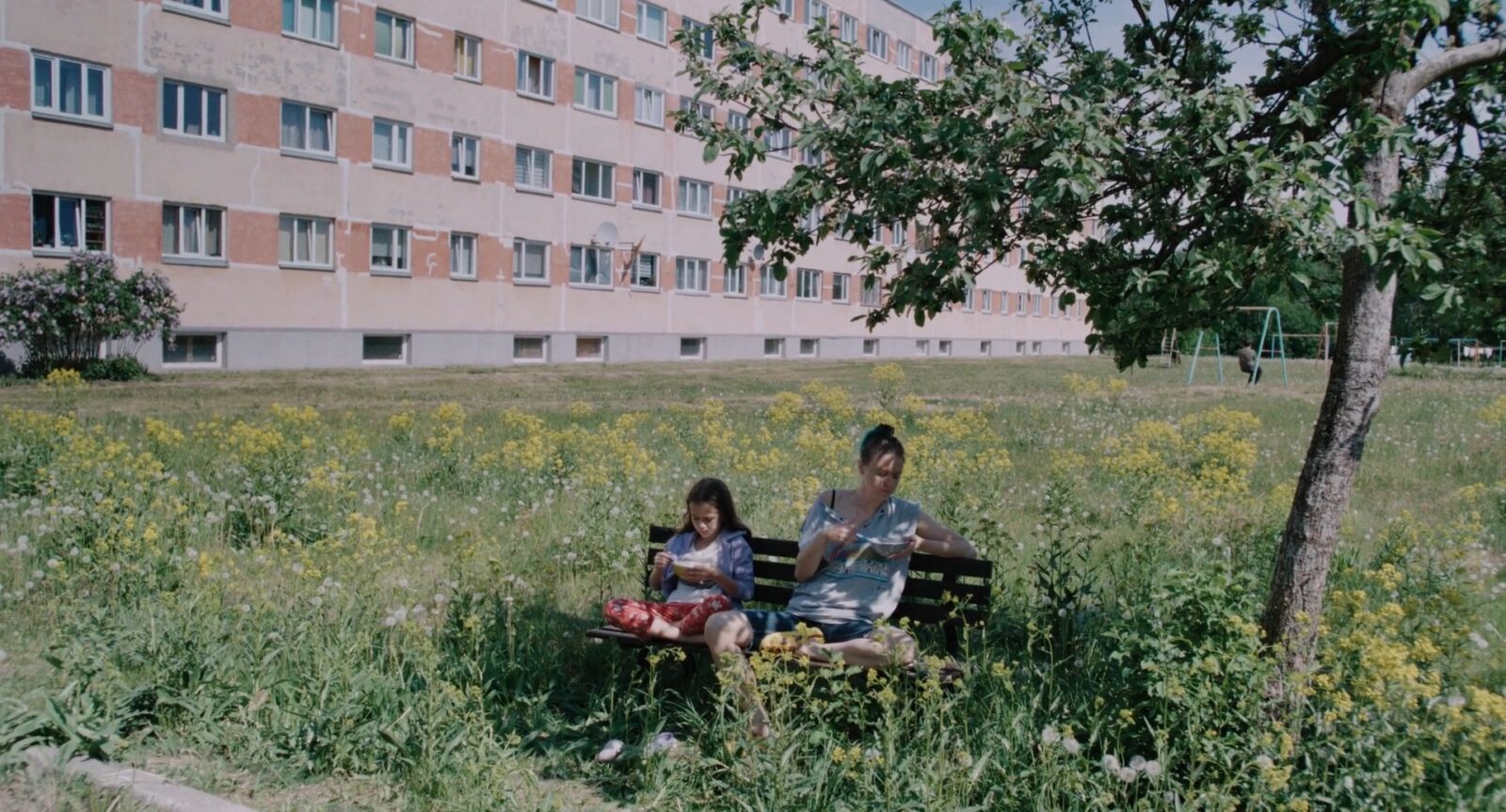
There is a recurring image in contemporary Baltic cinema: a young person standing still, looking outward, as if rehearsing departure. Characters stand, observe, wait, often positioned within rigid architectural spaces to represent them.
The term “Baltic burden”, coined here by yours truly, risks flattening into a shorthand for post-Soviet trauma. This B2B, Baltic-to-Baltic essay, places the Estonian short Stiina (2025) by Elisabeth Kušovnik alongside the Lithuanian short Concrete Kids (2026) by Saulius Baradinskas to examine how this condition is constructed—and, crucially, how it begins to harden into aesthetic form. While both films center on youth shaped by emotional neglect and limitation, they diverge in tone: one leans on recognisable arthouse conventions, the other develops a more internally coherent formal system. Both works explore absence, Concrete Kids immerses us in it, whereas Stiina observes it from a distance. Their juxtaposition raises a broader question: When does a shared regional sensibility harden into a reproducible style? And what distinguishes the Baltic burden from other cinematic conditions?
Socio-Economic Residue
Again and again, Baltic films return corridors, stairwells, courtyards, and aging apartment blocks. These spaces shape the stories, determining how characters move, encounter one another, and experience their surroundings. One way to understand this recurrence is through residue: the traces of trauma that remain in everyday spaces long after the original rupture has passed. It lingers in textures, gestures, and spatial arrangements—embedded in environments and behaviours rather than directly named or represented.
In the Baltic context, this residue often takes the form of Soviet-era panel housing. These buildings are more than just background; they structure a particular way of being. Their repetition, scale, and material uniformity shape not only the visual field but also the social dynamics within it. In cinema, this translates into a distinct spatial logic. Characters are frequently framed as isolated units within rigid grids—connected in theory, yet separated in practice. Corridors, stairwells, and courtyards recur not as neutral settings, but as systems that organise distance and disconnection, producing a sense of proximity without intimacy.
At the same time, these environments intersect with contemporary economic realities. Labour migration, although a universal issue, introduces a second layer of absence. Parents leave, often temporarily, but the temporary stretches into the indefinite. What emerges is suspended futurity: plans are made, but never fulfilled.
This dynamic becomes legible within the parent–child relationships in both Stiina and Concrete Kids. In the former, the mother promises to come home early, only to be met with quiet skepticism from her daughter—a reaction that points not to a single disappointment, but to a pattern. The child’s mistrust is learned and, as the narrative confirms, justified. In Concrete Kids, the logic is similar, but it is redirected into a longing for elsewhere. Rokas asks his mother when she will take him to America. Her answer—“After graduation”—positions the promise safely in the future, where it cannot yet be tested. It functions less as a concrete plan than as a mechanism of postponement, a way of sustaining hope while indefinitely delaying its realisation. A similar pattern is embodied in Stiina’s protagonist as well: a 28-year-old single mother who moves between a bar job and informal babysitting, caring for other people’s children while her own daughter stays home alone. Work and home blur into the same space of constant partial detachment.
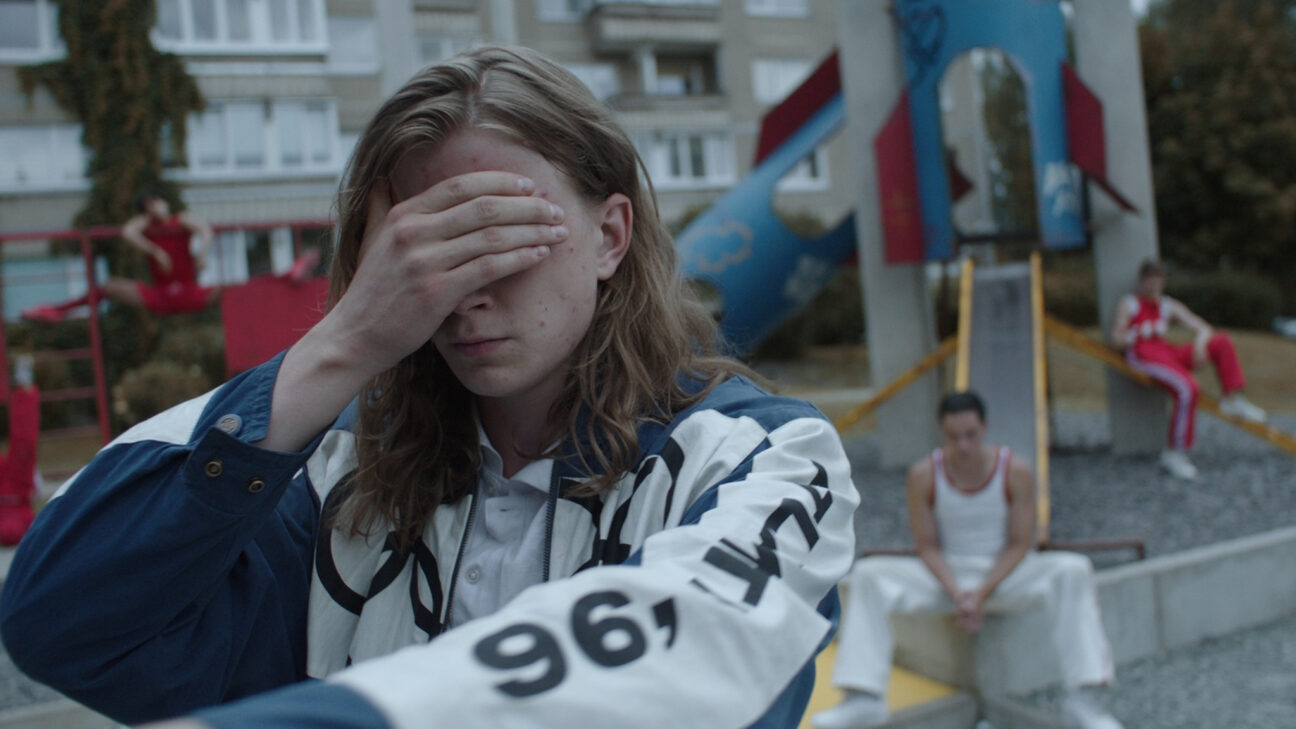
Concrete Kids (Saulius Baradinskas, 2025)
In Concrete Kids, the absence of the mother is emotional and structural. It shapes how children imagine their futures, what they want, and where they place hope. Rokas’s wish to leave is quickly reframed as an “American dream,” where America functions less as a real place than as a symbol: an idea of elsewhere, of escape and possibility. The film never fully visualises this America, but it resonates through Baradinskas’ cinematic language.
What lies beneath the “dream” is a quieter tension: a sense of not being “European enough”, a lack of confidence in what we are. In this context, the American dream becomes less a fascination with America itself than a substitute for a missing European or Baltic dream—a ready-made mythology of movement, success and most importantly reinvention. There is no equally powerful image of staying. America functions as shorthand for elsewhere and for possibility itself, perhaps also for distance from the shadow of Russia.
This tension is also visible in language politics. It was only last year that Estonia forbade learning Russian as a second foreign language alongside English. Latvia is expected to follow suit, either this year or next. Lithuania is actively reducing the role of Russian as a second foreign language in schools and perhaps will join the league as well. Nevertheless, a lack of working proficiency in the language of the former dominant power continues to limit access to job opportunities in their respective countries. The imbalance is still felt: Why was the adaption ours and not the other way around?
This can be easily tied down to the underlying sense of fear and, with it, a need for protection. Smallness plays a role here: geographically, historically, and psychologically. It can produce caution or even reluctance towards protest or collective disruption. Unlike in Germany or France, where even the smallest inconvenience takes the people to the barricades, Estonians, Latvians, and Lithuanians tend to just suffer instead of making noise, as the generational fright persists deep in our bones. One learns to endure before one learns to articulate.
Two films, two children
It is against this backdrop that Stiina and Concrete Kids become especially revealing. In different ways, both are films about childhood wounds formed under pressure, by dramatic rupture, and by the normalisation of emotional withdrawal within family life. In both, love is not violently withdrawn so much as shown to have never fully consolidated in the first place. The lack leaves deep marks on children trying to make sense of themselves.
In Concrete Kids, Rokas lives in a harsh world where support is fragile and inconsistent. As he grows up, he has to figure out masculinity, vulnerability, and survival in an environment shaped by danger. In Stiina, absence takes a quieter but no less devastating form: the mother is physically present, yet constantly pulled away by work, exhaustion, and the demands of endurance, leaving her daughter to inhabit a reality in which imagination must step in where attention cannot. Neither film treats abandonment as a singular wound; both understand it as a condition woven into daily life, shaping how a child perceives, attaches to, and endures.
Concrete Kids pulses with vibrant energy, kinetic and volatile, always on the brink of collision. The emotional void at its center is filtered through Rokas’s sensorium, through a world saturated with violence, neglect, and toxic masculinity. He is surrounded by hardness, by post-Soviet concrete apartment blocks and by young men bound by rigid codes of toughness, exemplified by the violent tracksuit gang that harasses him on the playground. The film captures this with fierce sensory force, radiating restless energy, splashing red, blue, and yellow against a gray landscape while techno beats pulse like an unrelenting heartbeat. We feel the instability, the pressure, and the constant thrum of anxiety beneath the surface.
What makes Concrete Kids so powerful is the tension between the brutality of this environment and the fragility of the child at its center. Rokas navigates a world of overt aggression and a deeper wound of emotional abandonment. Even the school principal offers little protection, suggesting instead that he “hits back” at the bullies. In this sense, the film becomes more than a coming-of-age story. It is a portrait of the Baltic burden as a search for identity under conditions of loneliness, precarity, and learned hardness—a portrait of the inability to ask for tenderness in a world that codes tenderness as weakness.
Stiina, by contrast, follows a single mother and her young daughter, bound together by intimacy yet separated by an emotional distance that quietly shapes their everyday life. The mother carries herself with the cultivated coolness of an ’80s-generation sensibility, drifting through adulthood with a sense of unfinished adolescence, while the daughter, despite still being a child, often appears more emotionally alert and grounded. Their relationship unfolds through small gestures, tensions, and absences, allowing the film to trace how disconnection becomes part of the texture of ordinary life. The sudden appearance of a slightly older girl, who seems to echo or embody the mother’s younger self—like an Estonian riff on Céline Sciamma’s Petite Maman (2021)—introduces another layer: childhood does not remain in the past, but returns in altered, fragmented form. What is unresolved does not disappear—it circulates.
Visually, Stiina leans into a restrained European arthouse language of stillness, silence, and carefully composed distance. It lingers on pauses, empty spaces, and faces suspended between withdrawal and longing. The domestic interiors feel sparse and emotionally cool, and the overall tone is marked by a subdued melancholy that renders even ordinary moments faintly unresolved.
The film is compelling in its emotional intelligence, yet it relies heavily on a familiar arthouse vocabulary: slowness, silence, compositional austerity, emotional restraint. These choices are not untrue to the material, but they can feel inherited rather than discovered. The risk is that the Baltic burden begins to register less as a lived condition than as an exportable mood: distance, stillness, grayness, silence. The film remains affecting, but at times its specificity gives way to familiarity. And yet Stiina still matters precisely because of what it understands so well: that absence within a family rarely takes dramatic form. It appears instead as emotional lag, as half-attention, as the inability to meet a child where she is. The mother’s failure to connect is not framed as cruelty, but as depletion: a condition in which care persists, but struggles to become legible.
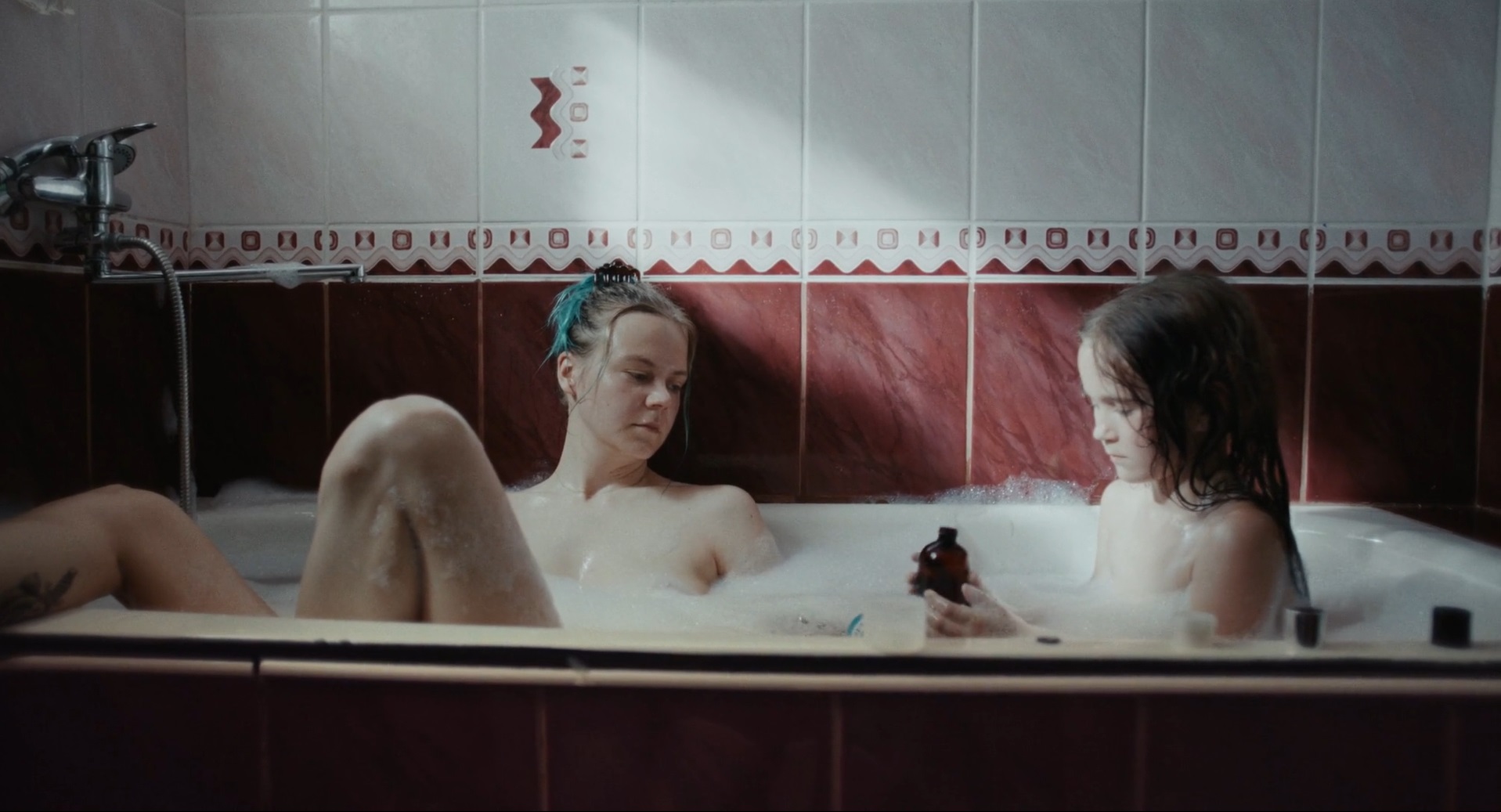
Stiina (Elisabeth Kušovnik, 2025)
What both films are structured on is a deeper architecture of substitution. Each asks what emerges when the stable forms of care fail and each answers by showing provisional structures taking their place: music, aggression, fantasy, instinct, repetition, spectral companionship, other children, fleeting acts of rescue. Both films are built on fragmentation of family, of attention, of security, of the self. Yet they are also built on the persistence of fragile attachments, on the possibility that care survives not as stability, but as residue: partial, displaced, and precarious, yet still enough to prevent total collapse. This is perhaps where the two films speak most productively to one another. Both refuse the sentimental fantasy that damage can be cleanly repaired. Neither offers catharsis in any conventional sense. Instead, both remain attentive to what persists in the aftermath of emotional insufficiency. The child’s improvisations, the micro-forms of attachment that emerge in damaged environments, the ways tenderness survives in coded, indirect, or compromised form.
If the Baltic burden risks stabilising into a recognisable form, this risk becomes most visible in Stiina, where it also opens, paradoxically, a space for reconfiguration. The film depends somewhat excessively on a well-worn arthouse repertoire: stillness, silence, and carefully distanced compositions. These choices fit its subject, but they also begin to feel slightly pre-shaped, as if drawn from an established cinematic language of “Baltic” or “Northern” melancholy. The result is a double effect: Stiina convincingly expresses emotional absence but also reveals how easily that absence can harden into style.
Its formal restraint sometimes feels inherited rather than fully earned, it exposes absence not only as a lived condition but as something that can be reproduced. Emotional distance becomes legible as an aesthetic pattern—recognisable, even expected. And once that happens, the “burden” is no longer only something experienced inside the film; it also becomes something the viewer learns to identify from the outside.
Concrete Kids, however, resists this kind of reflective distance. Its world is built on immediacy: constant movement, saturated colour, loud sound, and a sense of pressure that rarely lets up, keeping us within Rokas’s experience rather than outside it. Even its moments of formal control—the choreographed fights and the structure of Ravel’s Bolero—do not create distance, but escalate intensity. The film does not step back to treat the “burden” as a pattern; it stays inside it as something that is happening. Absence here is not something that can be named or looked at from a distance, but something that shapes action as it unfolds, pushing Rokas forward without giving him time or space to reflect. If Stiina risks aestheticising the Baltic burden by turning it into a familiar visual language, Concrete Kids keeps it in a more immediate state—not as form, but as pressure still in motion.
In this sense, films like Concrete Kids and Stiina do not only reflect a shared sensibility but mark different positions within an evolving landscape. Between them, a field of negotiation emerges, one in which younger filmmakers seem increasingly aware of the risk of turning lived conditions into aesthetic shorthand.
What might be taking shape, then, is not yet a coherent movement, but a growing self-consciousness across these works: a field in which images, rhythms, and inherited modes of expression begin to turn back on themselves, shifting from lived experience toward forms of critical legibility, where cinematic language starts to register its own conditions of repetition and inheritance. If earlier Baltic representations, visible for instance in The Temptation of St. Tony (2009), were shaped by endurance, silence, and existential stasis, newer works such as Drowning Dry (2024) or Concrete Kids suggest a more reflexive and formally unstable engagement with these inherited conditions. Rather than simply reproducing melancholy as atmosphere, they begin to interrogate the cinematic forms through which the “Baltic burden” itself has become legible. What emerges is not a rejection of this sensibility, but a growing awareness of its limits and repetitions.
The future of Baltic cinema may lie in this tension. Not in abandoning the burden, but in resisting its transformation into a fixed aesthetic. As long as these films continue to test rather than confirm, what now appears as a burden might also become a site of change.
This text was developed during the Emerging Critics’ Workshop, organised by the Riga International Short Film Festival 2ANNAS, with the financial support of the Latvian National Film Centre. Edited by workshop tutor Michiel Philippaerts.