
Samuel Suffren’s Trilogy of Selfhood
Blue Heart
In Blue Heart, the final instalment in Haitian filmmaker Samuel Suffren’s paternal trilogy, doubling becomes a continual quest: a return to himself through the figure of his father.
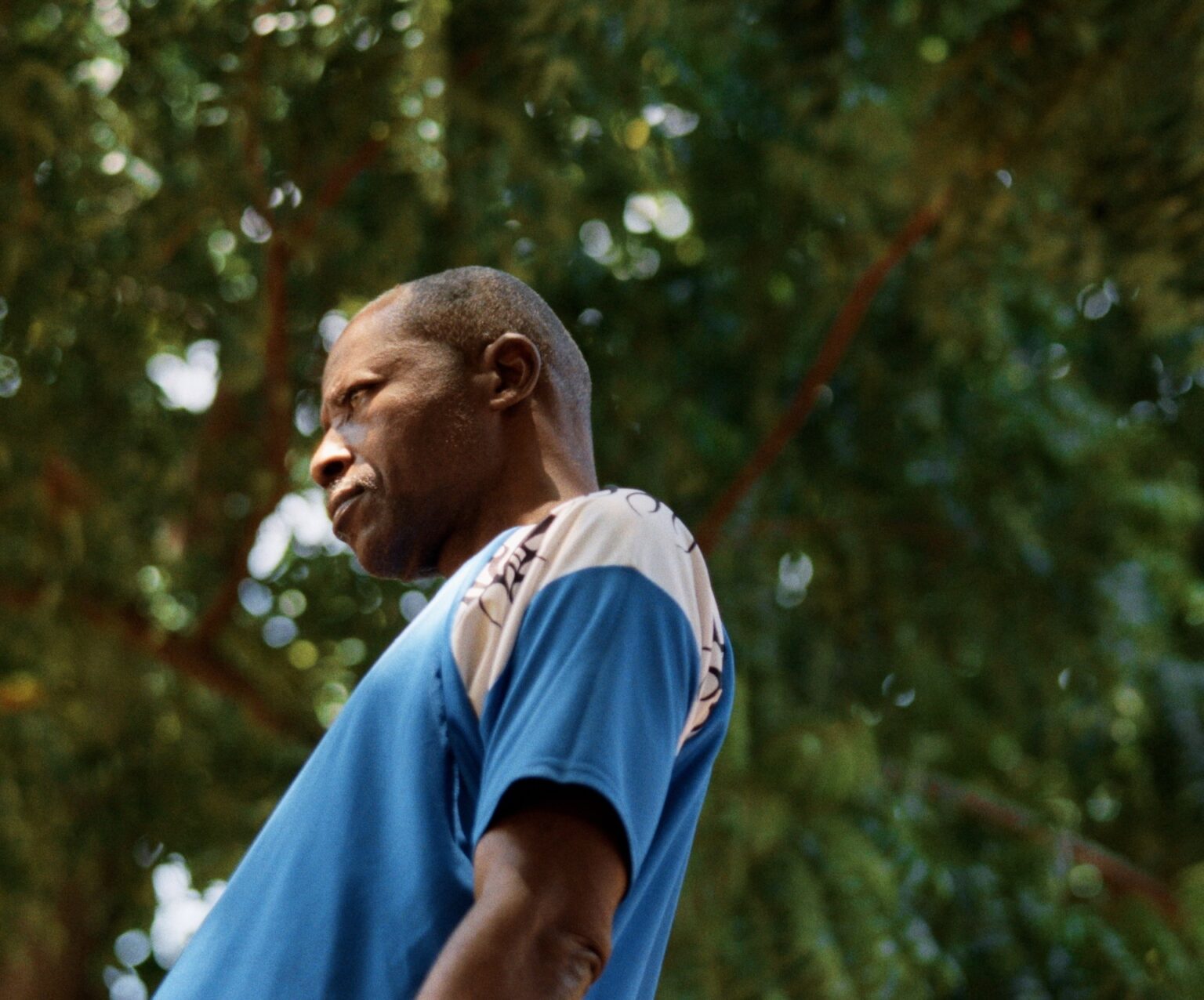
Imagine a place beyond your final shift, beyond shadow, beyond the rhythms that have shaped you. There, could you ruminate in the face of certainty, not as knowledge but as something that binds—as fate? And returning to it, could you reckon with that fate alongside generations of inherited will, without letting either harden into destiny? The final instalment of Haitian filmmaker Samuel Suffren’s paternal trilogy, Blue Heart (2025), which started its public life at Quinzaine des cinéastes last year and was recently in competition at Filmfest Dresden, crests in capturing this dialect of hurricanes.
“Life, fundamentally, is tension. Towards something. Towards someone. Towards oneself…” proselytises Frankétienne, Haitian poet and father of literary movement Spiralism, by whom the aforementioned dialect was 11 Frankétienne, “Dialect of Hurricanes,” trans. André Naffis-Sahley. Modern Poetry in Translation, no. 3 (2013), Secret Agents of Sense: Polish Focus: https://modernpoetryintranslation.com/magazine/secret-agents-of-sense-2013-number-3/. ↩︎ It’s in this tension, this threshold, that (often in comfort) the classically Grecian concept of nostos, of returning home, in one’s mind or one’s body, comes into being. Together with Agwe (2022) and Dreams Like Paper Boats (2024), Suffren’s films repeat this tale, time’s oldest: a person leaves their home, seeking fresher waters for their family, parting confusion on their loved ones in their wake. Circling the eye of a never-ending storm, Suffren’s iterative pursuit of nostos is less an exercise in nostalgia than a Frankétiennen struggle towards “one’s double, [a] pursuit that might even become confused with the intensity of a need, a desire, of a continual quest.” 22 Ibid. ↩︎
In Suffren’s work, doubling becomes a continual quest—a return to himself through the figure of his father, where familiarity and distance collapse into one another, and identity is reconstituted through acts of departure, mediation, and return. In Agwe, the father leaves Haiti for the United States, severing contact with his wife and young son, and leaving behind a silence, an absence shaped by disappearance and displacement. In Dreams Like Paper Boats, this movement inverts: the mother departs, addressing her husband and daughter through recordings sent adrift across distance, arriving already marked by separation. Intimacy no longer rests in presence but unfolds in transmission under strain.
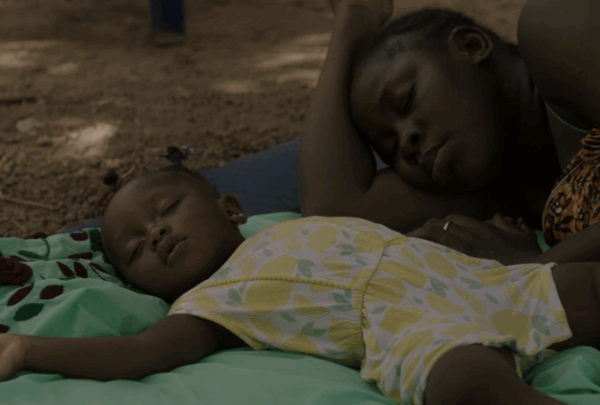
In Blue Heart, the reversal completes itself in failure: this time, the son departs, and his mother passes before he can return—waiting beneath an accumulating atmospheric weight, a call that doesn’t arrive, her life dissolving through the slow erosion of contact. Across these departures and failed returns, Suffren’s lost sense of self is mediated, delayed, and refracted through imagined forms of familial transference that shape audience perception and the persistence of that loss.
This fractured sense of self appears most clearly in the trilogy’s recurring communicative devices and acts of recording: close-up shots of tape players replaying a lost voice, televisions capturing travel, ringing telephones announcing missed calls, radios playing music from a different time, and speakerphones carrying speech across distance. These technologies establish a logic of filtered presence across the trilogy, where communication is displaced through recording and replay. Shots move through phases of confrontation and shifting perspective. In Agwe, the camera’s perspective begins to turn back on itself at the moment the shot assumes the function of a mirror, shifting the mode from observation to reflection. In Dreams Like Paper Boats, recorded speech circulates without a stable point of origin, so that what is heard comes through as residue rather than message.
This accumulated tension resolves into a cyclonic cinematic grammar in Blue Heart, where power becomes arrested as the camera spirals through positions: hidden at a remove, like a presence behind curtains or on shelves; drawn into close, confrontational proximity with the mother that remains unacknowledged; and pitched into extreme angles as the father braces his post. Across the trilogy, shifts in perspective produce a kaleidoscopic mode of seeing, where the viewer is continually displaced between mediated observer, delayed witness, and refracted reflection.
These altered modes of seeing converge in allegorical montage across Suffren’s films, where symbolic images cut across narrative continuity like pressure systems colliding. In Agwe, this first disturbance takes the form of passage and rupture, as a couple being wed on a boat is replaced by passengers throwing clothing into the sea, evoking Théodore Géricault’s The Raft of the Medusa (1818-1819) in its convergence of survival and abandonment. In Dreams Like Paper Boats, the movement turns inward, the system tightening into monochrome interiority. We observe the father as he sits in a darkened room, his double cast as the shadow of his former self by a shaft of light, recalling Kerry James Marshall’s Portrait of the Artist as a Shadow of His Former Self (1980). Next, we stand as witnesses before a lifeless boy in the road, whose stillness is quickly refigured as sleep, this symbolic play absorbing violence into passivity, folding meaning inward without settling.
This accumulated pressure reaches its most condensed form in Blue Heart, as the director’s tableaux become saturated with a recursive authorial vision, producing a sense of perpetual perceptual overload. Within an arched frame, a man on horseback holds a telephone as a woman beside him answers, both facing the camera in a composition that echoes Grant Wood’s American Gothic (1930), while elsewhere a wedding couple floats in still water holding telephones, suspended between ritual and disconnection. Across the trilogy, images and voices swirl in a single dialect of hurricanes in which meaning rotates through arrival and loss without settling into resolution.
Leaving an invisible mark on the familial narratives of Agwe and Dreams Like Paper Boats, Suffren then enters Blue Heart directly to address his parents: “How can I tell you that the borders have betrayed us? How can I tell you that the sea has swallowed our dreams?” Yet the trilogy has already answered: it’s in Suffren’s image where his double carries forward in a continual quest, like a storm spinning without release, still oriented—however faintly—towards something, towards someone, towards oneself.


There are no comments yet, be the first!