
Fear Eats the Soul
God is Shy
Brought to life by Japanese guro animation traits, Ariel and Paul pass the time sketching their deepest fears until their game takes an unexpected turn in Jocelyn Charles’ festival hit God is Shy.
There’s no experience quite as self-reflective as a high-speed train journey. The writer Agustina Bessa-Luís thought of trains as a “collective sleeping in transit”, the stillness of one’s body while in perpetual motion allowing for a door to open onto a liminal chronotope, with a distorted sense of space and time. From its stature as the “image of cinema” since the medium’s advent to its particular flair for melodrama and suspense (David Lean, Alfred Hitchcock), the moving train passes tunnels and weaves through cities and verdant landscapes, following the path of a fantastical dream, where we are, at last, unmoored.
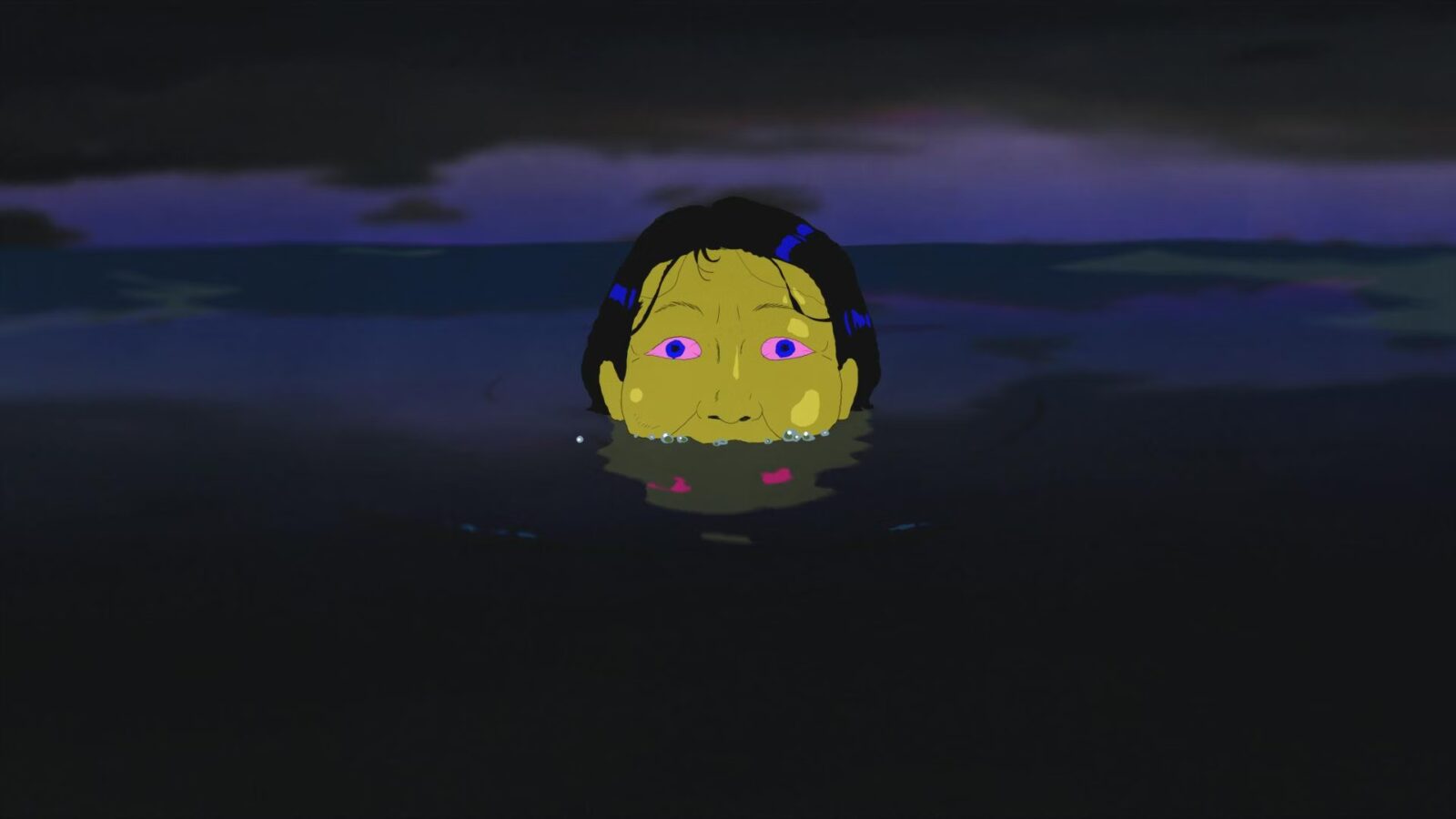
French illustrator Jocelyn Charles’s debut short film taps into the nuances of this ambivalent world perfectly. In God is Shy, the train journey is both materially real and internally truthful. After premiering at Cannes Film Festival’s La Semaine de la Critique in 2025, the film has travelled the international film festival circuit, opening itself up to a state of revelation, animating the resistance faced when we attempt to exorcise our personal abyss.
Diving into a bright-hued, hallucinatory watercolour universe, God is Shy distinguishes itself immediately by embracing an eerie coldness. We get a premonition of a looming future before any plot cues. A rhythmic, bird-like whistling. A woman swimming with ducks; then a duck on a train, and a piece of paper soaked in blood—all images we’ll come back to in due course. Ariel and Paul, both illustrators aboard a TGV, dare each other to draw what they’re most afraid of. In their conversation, they rightfully distinguish fear from fright: one manageable, the other uncontrollable. Paul’s oversized head, turned to the side, and his flaxen smile are disconcerting to look at; more so, they signal that something is about to go awry here. Charles sets the film’s alarming tone by threading it with defining traits of Japanese guro animation: the fine, precise linework, the unrealistic, bold colours and the exaggerated proportions of the characters’ heads as well as the stylisation of their eyes.
Throughout the film, there’s very little to learn about Paul or Ariel. And what we do find out mostly concerns Ariel, who falls asleep quickly, gets nosebleeds from the hot weather, and still hasn’t watched Stanley Kubrick’s The Shining because she wants to read the book first. The animations feel slurred every now and again, sometimes out of sync with the words that come out of the characters’ mouths. They’re both frightened of bodies of water and women hiding in plain sight. By drawing the objects of their fears in their preferred expressive medium, Ariel and Paul hope that they’re dispossessing the power those images have over them.
But when the woman Ariel has just drawn on paper boards the train and sits right in front of them, the film tonally accelerates. Somewhat reminiscent of A Kind of Testament, another wild ride of a film on which Charles also worked, God is Shy shifts into gory gears. In a perplexing story told by the stranger, her husband’s body is possessed by a god-like entity every time he falls asleep. Nothing haunts us more than the origin of our existence. When we’re given the opportunity to communicate with someone capable of solving the mystery, seeking out answers naturally becomes an obsession.
Charles uses live-action filmmaking not only to create the movement and emphasise the mundane real details of this world (he hasn’t forgotten a train’s WC mirror is always smudged), but to induce in the viewer a lingering dread, the kind that creeps up on one’s body. He also has a good ear for the rhythms and subtleties of dialogue. Through the sheer vitality of the wide-eyed woman’s storytelling alone, reality gets sparser and sparser. Gradually but surely, her story touches some of the darkest corners of humanity. The film entangles the viewer in its visceral imagery to such a degree that it becomes impossible to let go of the shadow it sets. The contrasting colours become so saturated at one point—metallic royal blue eyeshadow, tar-black hair, fuchsia lipstick—they sit, much like all other elements at play here, between caricature and tragicomic reality. A man’s reach should exceed his grasp. But knowing life’s origin may just open Pandora’s box.
Jocelyn Charles has been examining anime folklore tropes and body horror for quite some time now. His music video for “Do I Make You Love Me” by The Weeknd shows very clearly how devoted he’s been to reproducing animated horror dreamscapes as a way into excavating tales of vulnerability. God is Shy intensifies the establishment of that same fleshy purgatorial state by interweaving it with an existential quest for what ought to remain unknown. Can anyone really carve out a path if they know where it leads to?
Limits are pushed, horizons widened. A line is drawn from birth to death, from the linear to the abstract, from pen-drawn illustrations to their life-sized reproductions. Once the film rears its head at the end, making us trace our steps back to the beginning in a closed loop, we’ll see we’ve been a part of this all along. Bringing about the mere idea of emotional terror already unleashes hell. All the more when, in its place, only apathy is to be found.
What Ariel and Paul were subjects to, we were too, but under the influence of the mercurial images created of them. Jocelyn Charles knows too well it isn’t about the destination as much as the journey, and he proves it to us by being two steps ahead every chance he gets.


There are no comments yet, be the first!